Keep our news free from ads and paywalls by making a donation to support our work!

Notes from Poland is run by a small editorial team and is published by an independent, non-profit foundation that is funded through donations from our readers. We cannot do what we do without your support.
By Daniel Tilles
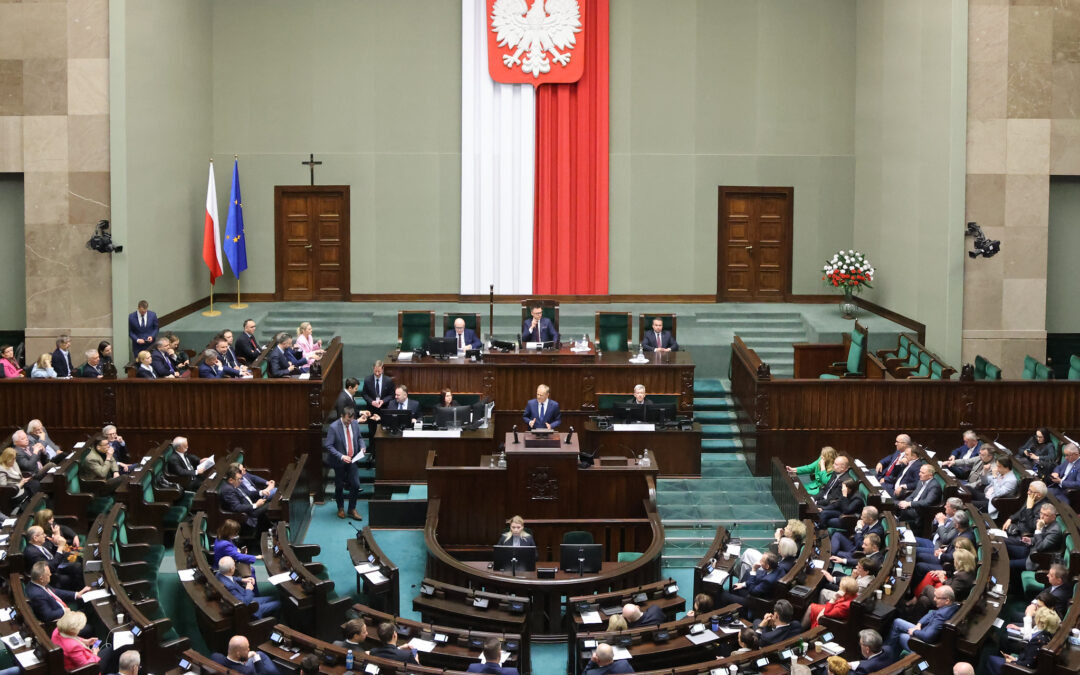
Poland will hold parliamentary elections a year from now. The outcome will decide who governs the country for the next four years – although, given how close the polls are, and with questions over coalition formation, it could also result in uncertainty, chaos, and even new elections being called.
Below, we explain how the elections work, which parties will be standing, what kind of outcomes are possible, and which issues may animate the campaign.
When will the election take place?
Assuming early elections are not called, the vote must take place on a non-working day in the last 30 days before the end of the current four-year parliamentary term, which began on 13 November 2023.
Because elections in Poland are held on Sundays, that gives four possible dates: 17, 24 or 31 October, or 7 November (though 1 November and 11 November, which are public holidays, are also theoretically possible).
It is the president, Karol Nawrocki, who will choose the date. He must do so no later than 90 days before the end of the current parliamentary term.
How does voting work?
The 460 members of the more powerful lower house, the Sejm, are elected through proportional representation, meaning that seats are distributed more or less on the basis of the share of the vote parties receive (using the so-called D’Hondt method for allocating seats from electoral lists put forward by each party). However, parties must receive at least 5% of the vote nationally to enter parliament (a figure that rises to 8% for coalitions of parties who stand on a single electoral list).
The 100 members of the upper-house Senate are chosen through a first-past-the-post system similar to how members of the US Congress or British House of Commons are elected, with the candidate in each district that receives the most votes winning the seat.
How is a government formed?
A government can only be formed if it has the support of a majority in the Sejm.
After the elections, the president designates a prime minister, who is tasked with forming a government – which would almost certainly be made up of a coalition of parties – that must then win a vote of confidence in the Sejm.
If they fail to do so (as happened in 2023), the Sejm votes to choose an alternative prime minister, who likewise must try to form a government that has the confidence of the Sejm.
Parliament has chosen @donaldtusk as Poland's new prime minister.
That paves the way for him to form a new government in the coming days, ending the eight-year rule of the national-conservative PiS party https://t.co/iZUKh2rxnP
— Notes from Poland 🇵🇱 (@notesfrompoland) December 11, 2023
If that fails, the president has a second chance to pick a prime minister, who must again win a confidence vote. If that does not work, then parliament is dissolved and new elections are called.
Who is likely to form the next government?
At the moment, it is incredibly difficult to say. Polls suggest an even split in support between parties generally aligned with Prime Minister Donald Tusk’s ruling coalition – which ranges from left to centre right – and the right-wing opposition. However, the 5% electoral threshold complicates the picture.
According to current polling averages compiled by Polish website eWybory and Politico Europe, Tusk’s centrist Civic Coalition (KO) leads with 32%. One of its coalition partners, The Left (Lewica), is on 7%, while two others, the centre-right Polish People’s Party (PSL) and centrist Poland 2050 (Polska 2050), are on around 3% and 1%, respectively. Another left-wing party, Together (Razem), which previously caucused with the ruling coalition but split in 2024, is on around 4%.
Meanwhile, the national-conservative Law and Justice (PiS), the largest opposition party, is on 20%. Two far-right opposition groups, Confederation (Konfederacja) and Confederation of the Polish Crown (KKP), have 14% and 9%, respectively. The right-wing Development Plus (Rozwój Plus), which broke away from PiS this year, is at around 5%.
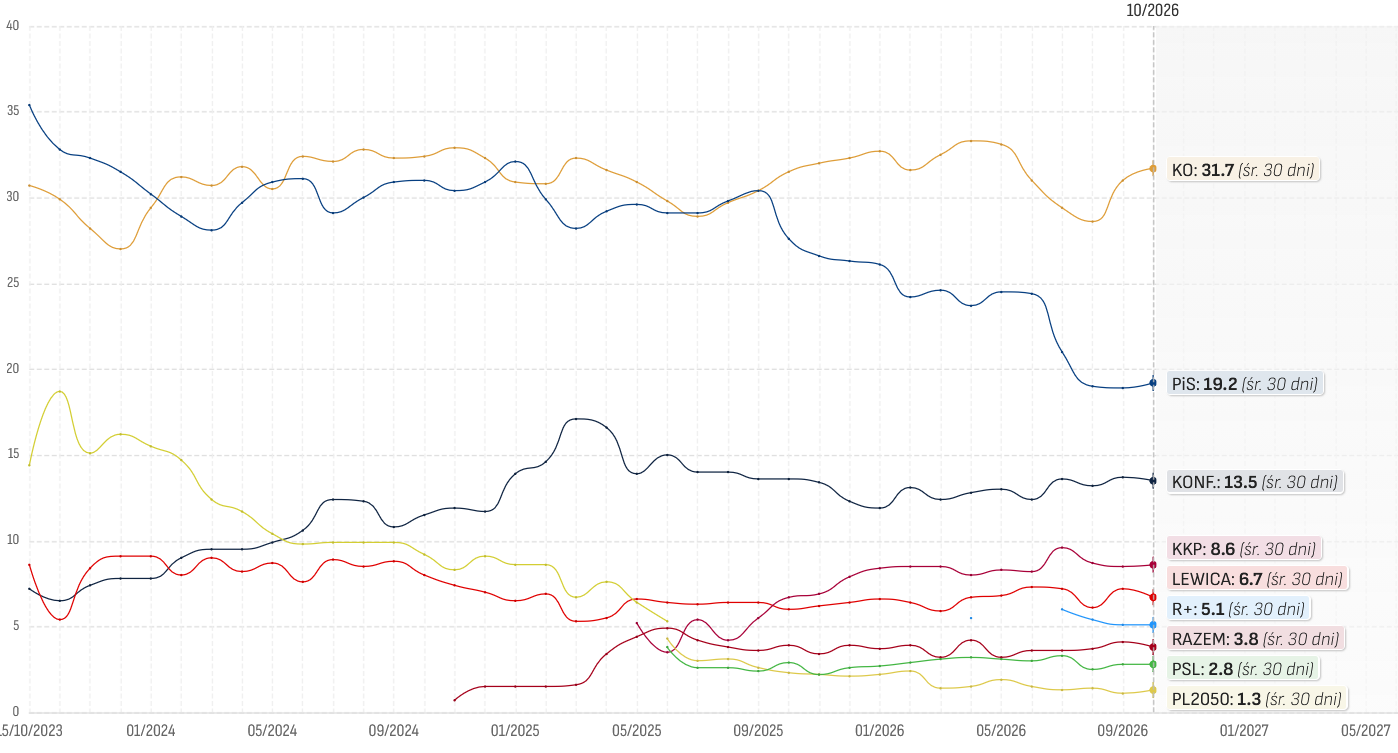
Rolling 30-day average support in polls for Poland’s main political parties (source: eWybory.eu)
If we treat those as two potential blocs, parties more or less aligned with the current government are on around 47% while the right-wing opposition is on 48%. However, PSL and Poland 2050 currently look likely to fall below the 5% threshold if they stand alone, meaning votes for them would not count. That would significantly harm Tusk’s chances of forming a new government. If Rozwój Plus stood alone and fell below the threshold, that would harm the opposition.
It is therefore likely that, as the elections draw nearer, parties that seem likely to fall below 5% will seek to join forces with other groups. In 2023, PSL and Poland 2050 stood together in the so-called Third Way (Trzecia Droga) alliance. But they have made clear they do not intend to do that again. That leaves them with limited options. They could join forces with KO on a single electoral list, but that does not guarantee that their voters will follow them. Indeed, some may baulk at voting for Tusk’s party.
The Polish People's Party's parliamentary survival is on a knife edge, and could determine whether @donaldtusk's coalition remains in power after next year's elections.@AleksSzczerbiak looks at the challenges facing PSL and how it may respond to them https://t.co/MmswSLNWJE
— Notes from Poland 🇵🇱 (@notesfrompoland) June 30, 2026
Meanwhile, there are some wildcards in the pack. KKP, led by radical-right extremist Grzegorz Braun, is shunned by the mainstream right for its antisemitism, anti-Americanism and sympathy towards Russia. PiS’s leader, Jarosław Kaczyński, has declared that he would not allow Braun to join government. Development Plus has taken a similar position. Both parties value relations with the US and the Trump administration, whose ambassador to Poland has reportedly pushed them to rule out working with Braun.
However, if KKP maintains its current level of support, it looks almost impossible for the opposition to form a parliamentary majority without it, meaning there would be a strong temptation to somehow work with Braun. Kaczyński’s determination to remove Tusk from power may outweigh his dislike of Braun and desire to keep the Americans onside.
The Together party – if it manages to pass the 5% threshold – could likewise represent a challenge for Tusk when forming a coalition, given that it has criticised the government for failing to keep promises on healthcare spending, public sector pay, and liberalising the abortion law.
There also remains the possibility of some elements from each camp joining the other side – either entire parties or individual MPs defecting – in order to help form a government.
PiS has long sought to tempt PSL to its side (and recent reports suggest that even President Donald Trump tried to persuade PSL’s leader, Władysław Kosiniak-Kamysz, to do so). It is conceivable that Rozwój Plus could work with parts of the current ruling camp, though its hatred of Tusk would make that very difficult.
All of the difficulties outlined above mean there is a significant chance that it will not be possible for anyone to form a government, necessitating fresh elections – something that has never happened before in Poland. If that happens, it would mean uncertainty and a lack of clear leadership at a time when Poland is facing major security challenges and a worsening fiscal situation.
What about the Senate?
The Senate, like the Sejm, is currently controlled by the ruling coalition. Indeed, Tusk has an even larger majority there than in the lower house, making it harder for the opposition to flip. Although the Senate is much weaker than the Sejm – and control of it does not determine who forms the government – it does have some powers that make it a useful asset.
It can slow down the passage of legislation, though not block it. The Senate also must approve the appointment of certain officials, such as the heads of the Supreme Audit Office (NIK) and the Institute of National Remembrance (IPN), as well as the Commissioner for Human Rights (RPO).
In a rare clash between Poland’s two houses of parliament, in both of which the government has a majority, the Senate has rejected a candidate chosen by the Sejm to become the new head of the state Institute of National Remembrance (IPN) https://t.co/QUsqfDNh4s
— Notes from Poland 🇵🇱 (@notesfrompoland) August 7, 2026
The upper house is also required to approve proposals by the president to hold national referendums. This year, the Senate has twice blocked moves by Nawrocki to hold a referendum on EU climate policies.
In a situation where Tusk’s coalition controlled the Sejm, and was therefore still in government, but the right-wing opposition held the Senate, that would give the president a powerful tool to call referendums on policies important to him and the opposition.
To that end, there have been calls for the right-wing and far-right opposition to form a so-called Senate pact, of the type that Tusk and his allies used to win control of the upper house in 2019 and 2023.
What that means in practice is that the parties forming the pact agree to stand only one candidate between them in each of the 100 Senate districts, making it more likely that they will scoop up votes from supporters of all the parties in the pact and win the winner-takes-all contest.
What role will Nawrocki play in all of this?
Presidents are in theory expected to be non-partisan. In practice, however, they will seek to boost parties or coalitions aligned with them, and with whom it will be easier to work.
Since Nawrocki was elected last year, relations and cooperation between the president and government have reached unprecedently low levels. Within just 10 months, Nawrocki had vetoed more bills than any previous president in history over their entire terms. He has made it abundantly clear that he would prefer to work with a government formed from the right-wing opposition.
During his first year, President Nawrocki has transformed his office into a centre of resistance to the government and become a unifying figure for the fragmented right.
But he faces new challenges moving towards the next election, writes @AleksSzczerbiak https://t.co/uNYrFOppSp
— Notes from Poland 🇵🇱 (@notesfrompoland) September 7, 2026
However, the extent to which he will be involved in the election campaign is unclear. Some figures on the right hope that Nawrocki will act as a figurehead, using his positive relations with parties across the right-wing opposition to bring them together.
In practical terms, this could involve him acting as the patron of a Senate pact (something the head of Nawrocki’s cabinet recently said the president was willing to do), as well as helping right-wing parties form a coalition government after the elections.
Nawrocki also continues to enjoy strong approval ratings among the conservative electorate, meaning that his presence during the election campaign could act as a boost for the opposition.
What issues are likely to feature in the campaign?
A major issue will be the question of sovereignty. The right-wing opposition accuses Tusk of being Brussels’ and Berlin’s lapdog, handing over ever more power to the EU and prioritising Germany’s interests over Poland’s.
The ruling coalition, meanwhile, argues that PiS is too beholden to the Trump administration and warns that the opposition is pushing Poland towards “Polexit” from the EU, which would leave the country isolated and vulnerable, as well as much poorer.
Those battle lines extend to security policy too, with the Tusk government shifting emphasis towards Europe as a defence partner but PiS insisting that only the US can truly guarantee Poland’s security. Poland’s desire to host a new permanent US military base has already become highly politicised. If progress stalls, the opposition will blame the government. If Washington confirms that the base will go ahead, Nawrocki will seek to take the credit, based on his good relationship with Trump.
On this point, though, it is worth noting the split within the opposition. While PiS and Rozwój Plus are strongly pro-American, Confederation and, to an even greater extent, KKP, are opposed to a greater US presence in Poland.
President @NawrockiKn says that a planned new permanent US military base in Poland is “confirmed” because his American counterpart, Donald Trump, is “famous for keeping his word”.
He also suggested that the new facility will be called “Fort Trump” https://t.co/uGGJSBe5nr
— Notes from Poland 🇵🇱 (@notesfrompoland) September 23, 2026
Where the right-wing opposition has been united, however, is on pushing for a tougher position towards Ukraine and Ukrainian refugees in Poland.
While tensions have calmed significantly since the crisis sparked in May by President Volodymyr Zelensky naming a military unit after a group that massacred Poles in World War Two, it is likely that relations with Ukraine and the large-scale presence of Ukrainians in Poland will remain important issues during the election campaign.
The ruling coalition, meanwhile, will be keen to emphasise its tough overall approach to immigration, which it says was out of control under the former PiS government. It can point to the falling number of new residence permits being issued, the growing number of deportations, and tougher measures on the Belarus border, including a ban on asylum claims.
Poland has forcibly removed 2,100 foreigners from the country this year, around twice as many as in 2024.
The figures come after the government introduced a tougher new migration policy last year, which has included more deportations of foreign criminals https://t.co/zOBxPLipy8
— Notes from Poland 🇵🇱 (@notesfrompoland) December 31, 2025
The economy, public finances and cost of living are also likely to be major issues.
As long as the current global energy crisis sparked by the conflict around Iran continues, the opposition will seek to place the blame for record fuel prices on the government. They will also cite large deficits and the ballooning public debt as evidence that Tusk is mismanaging the economy.
The ruling coalition will point to continued strong economic growth and blame Nawrocki, who has vetoed revenue-generating tax bills, for the fiscal situation.

Notes from Poland is run by a small editorial team and published by an independent, non-profit foundation that is funded through donations from our readers. We cannot do what we do without your support.
Main image credit: KPRM/Flickr (under CC BY-NC-ND 4.0)

Daniel Tilles is editor-in-chief of Notes from Poland. He has written on Polish affairs for a wide range of publications, including Foreign Policy, POLITICO Europe, EUobserver and Dziennik Gazeta Prawna.