Why are you now seeing adverts on our website for the first time? Click here to learn more.
Keep our news free from paywalls by making a donation to support our work!

Notes from Poland is run by a small editorial team and is published by an independent, non-profit foundation that is funded through donations from our readers. We cannot do what we do without your support.
This is a breaking news story and may be updated as further information becomes available.
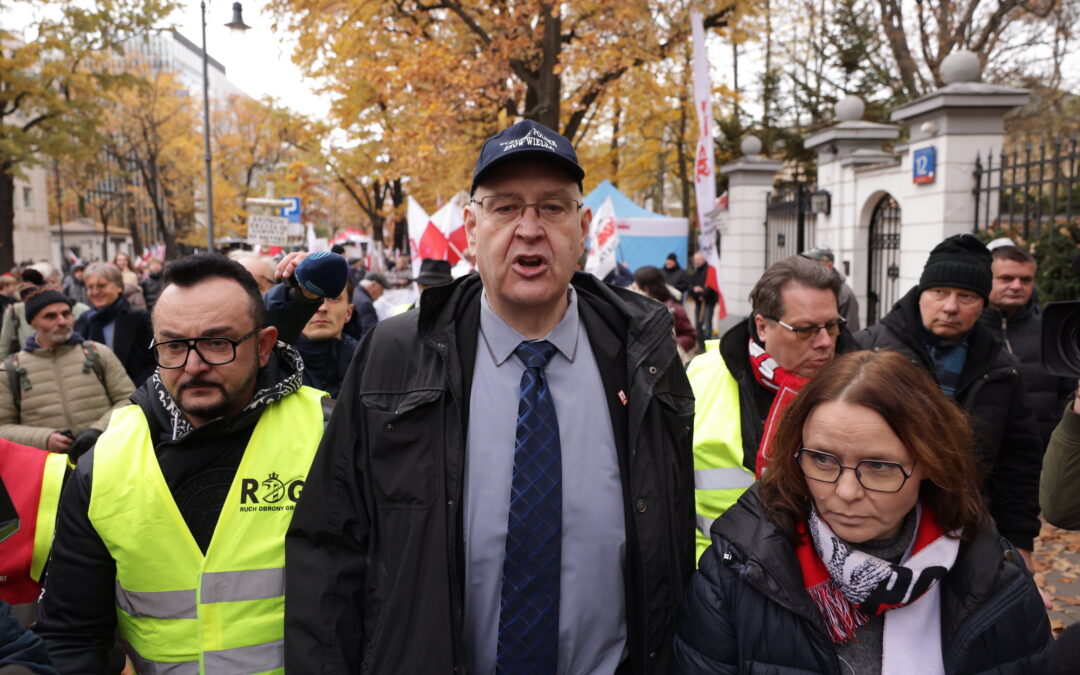
The government-backed judges who recently took control of Poland’s Constitutional Tribunal (TK) have announced that the court’s chief justice, Bogdan Święczkowski, has been stripped of legal immunity in order to face criminal charges.
Święczkowski, who was appointed to the TK under the former Law and Justice (PiS) government, has condemned their takeover as an illegal “coup d’état” and says that any decisions issued by them have no validity.
In a further development, the European Court of Human Rights (ECHR) announced yesterday that it has rejected a request by Święczkowski for an emergency order to suspend all proceedings against him at the TK.
Zgromadzenie sędziów w TK uchyliło immunitet Bogdana Święczkowskiego w czterech sprawach – komunikat na stronie TK. (PAP)#PAPinformacje pic.twitter.com/cuqaM11K6X
— Polska Agencja Prasowa/Polish Press Agency (PAP) (@PAPinformacje) November 18, 2026
In a statement issued on Wednesday evening on the tribunal’s website, it was announced that motions from the prosecutor general, Waldemar Żurek, to strip Swięczkowski and the deputy head of the court, Bartłomiej Sochański, of immunity had been approved.
The decision was made by the group of eight judges who dramatically took control of the TK on 30 October as riot police held back protesters outside. All of them were chosen by the government’s parliamentary majority this year, but opposition-aligned President Karol Nawrocki has refused to swear in five of them.
After taking over the tribunal, they declared that Święczkowski and Sochański had been suspended for their failure to properly fulfil their duties. They also launched internal disciplinary proceedings against the pair, with hearings in those cases due to take place later this week.
Separately, Żurek, who serves as justice minister in addition to being prosecutor general, filed multiple requests to the TK for Święczkowski and Sochański to be stripped of their immunity in order to face criminal charges. It is those that were approved today.
Among the crimes prosecutors wish to charge Święczkowski with are abuse of power and dereliction of duty for his refusal to allow five judges chosen by parliament this year to take up their seats on the court. Sochański is accused of the same offences.
Święczkowski has argued that he cannot admit those judges because, under Polish law, they are obliged to first swear an “oath before the president” and have not done so.
Prosecutors also allege that Święczkowski used violence against those five judges to physically prevent them from entering the judges’ chambers at the TK.
The International Commission of Jurists has criticised the takeover of Poland’s constitutional court, saying it “contravenes international standards on the independence of the judiciary”
But it also criticised the president for refusing to swear in judges https://t.co/2kBv3GT20d
— Notes from Poland 🇵🇱 (@notesfrompoland) November 4, 2026
Further allegations against Święczkowski relate to his time serving as national prosecutor under the former PiS government. Prosecutors say that he abused his powers by making unauthorised use of material gathered from surveillance.
They also accuse him of abusing his power by “maliciously” reassigning prosecutors to different locations as a form of punishment despite there being no legal basis for doing so.
However, although the TK today approved the lifting of Święczkowski and Sochański’s immunities, it did not consent to them being detained and held in pretrial arrest.
It also rejected two additional requests from Żurek to lift Święczkowski’s immunity for other alleged claims. The TK found the motions contained “formal deficiencies”.
Skierowałem do Trybunału Konstytucyjnego kolejny, szósty już wniosek o uchylenie immunitetu Bogdanowi Święczkowskiemu, dołączając go do pięciu wniosków przekazanych w piątek. Dzisiejsza sprawa dotyczy zakupu systemu szpiegowskiego Hermes w czasie, gdy pełnił funkcję Prokuratora…
— Waldemar Żurek (@w_zurek) November 3, 2026
Święczkowski immediately rejected today’s decisions, saying that they had no legal validity. He describes the eight judges who have taken control as “usurpers”.
However, on Tuesday, Święczkowski suffered another setback in his struggle to retain control over the TK after the European Court of Human Rights announced that it had rejected a request from him and Sochański for an interim measure ordering that all proceedings against them be suspended.
The ECHR found that “the applicants had failed to demonstrate an imminent risk of irreparable harm to the core of their rights”.
The decision stands in contrast to one made in May this year by the ECHR, when it ordered that the five judges Nawrocki has refused to swear in be admitted to the TK. Święczkowski ignored that order, arguing that the ECHR did not have the authority to issue it.
European Court rejects request for interim measure in case concerning Constitutional Court of Poland.
🔗 https://t.co/I15bGXeeKF— ECHR CEDH (@ECHR_CEDH) November 17, 2026
Święczkowski has received backing from some other Polish institutions. President Nawrocki continues to recognise Święczkowski as the chief justice of the TK and has condemned the government-backed judges’ takeover of the court.
The chief justice of the Supreme Court (a separate body from the TK), Zbigniew Kapiński, has also sided with Święczkowski and Nawrocki. Speaking to broadcaster RMF on Wednesday morning, Kapiński said that any decisions made by the eight judges who have taken over the TK “have no legal force”.
Kapiński’s own status has also been subject to dispute. He was appointed to the Supreme Court under the PiS government through a judicial body overhauled in a manner that rendered it illegitimate, according to various European and Polish court rulings.
On Monday, the central bank, whose governor is a longstanding associate of PiS leader Jarosław Kaczyński, announced that it was suspending all outgoing payments from the TK’s bank accounts due to uncertainty over who holds legitimate control over the court.
Poland’s central bank has frozen outgoing transfers from the bank accounts of the Constitutional Tribunal, citing conflicting claims over who has the authority to manage the court following a takeover by a group of judges backed by the government https://t.co/ZYkzoneojO
— Notes from Poland 🇵🇱 (@notesfrompoland) November 17, 2026
The recent dramatic events at the TK follow a decade-long crisis around the Polish judiciary, triggered by the contested judicial reforms and appointments made by the former PiS government and PiS-aligned former President Andrzej Duda.
The current government – a coalition ranging from left to centre right led by Prime Minister Donald Tusk that came to power in 2023 – has refused to recognise the legitimacy of the TK due to the presence of unlawfully appointed judges.
As a result, Tusk’s government has ignored the TK’s rulings and, until this year, refused to even nominate new judges to fill vacancies that arose on the court’s 15-person bench. That changed in March, when the ruling coalition began filling the backlog of empty seats.
The eight judges it has appointed now have a majority on the 15-person court, although five of them have not been sworn in by Nawrocki. The remaining seven judges, including Święczkowski and Sochański, were appointed when PiS was in power.
Notes from Poland is run by a small editorial team and published by an independent, non-profit foundation that is funded through donations from our readers. We cannot do what we do without your support.
Main image credit: Dawid Zuchowicz / Agencja Wyborcza.pl

Daniel Tilles is editor-in-chief of Notes from Poland. He has written on Polish affairs for a wide range of publications, including Foreign Policy, POLITICO Europe, EUobserver and Dziennik Gazeta Prawna.