Keep our news free from ads and paywalls by making a donation to support our work!

Notes from Poland is run by a small editorial team and is published by an independent, non-profit foundation that is funded through donations from our readers. We cannot do what we do without your support.
By Leo Greenberg
Speaking to Fox News in late October, Ukrainian President Volodymyr Zelensky admitted a widely known but uncomfortable truth: Ukraine needs its refugees back.
“We need 9.5 million people – who lost their homes, who are abroad, everywhere – we need them to come back to Ukraine…to rebuild their country,” he said.
Zelensky:
We need 9.5 million people who lost their housing, who are abroad everywhere — we need them to come back to Ukraine, just to live and to build their country. pic.twitter.com/Xu2Ld4eGOu
— Clash Report (@clashreport) October 21, 2026
Unfortunately for Ukraine, all signs point in the opposite direction: Ukrainians abroad are deferring or abandoning thoughts of return.
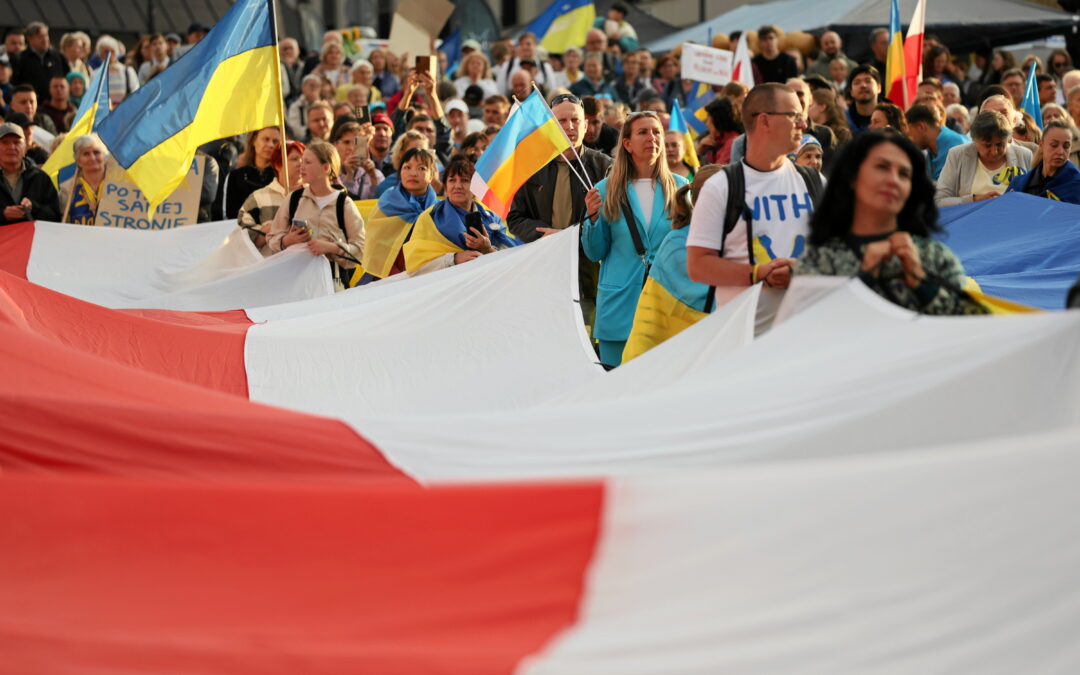
A large proportion of those refugees – almost one million of them – live in Poland, where Ukrainians, including migrants who arrived before 2022, have provided an economic and demographic boon. But their continued stay has also posed social and political challenges, as a country with no history of mass immigration grapples with the new reality of a sizable non-citizen minority.
This has left the refugees themselves in a state of limbo: torn between a homeland that wants them back, and to which many would like to return, but where conditions do not allow for it; and an adopted home where they have created new lives but where social tensions and logistical hurdles have meant persistent uncertainty.
A new reality sets in
When Solomiia Pischana, a Ukrainian woman in her late twenties, fled from Kyiv to Poland in the wake of Russia’s full-scale invasion in 2022, she hoped to go back that same year.
When Kyiv was secured by Ukrainian forces, a return seemed possible. In late 2022, Pischana started travelling back home to see family and friends. “I was really living between two countries. I thought a lot about going back.”
Yet quickly, a new reality set in on her visits: “In winter it became basically impossible to stay there – the constant explosions.” In Poland, by contrast, “everyone put the emphasis on helping me, on helping Ukrainians.”
In a photo essay, we look at the lives of three of the million or so Ukrainian refugees who remain in Poland one year on from Russia's invasion: Liudmyla, a mother; Vlad, an amputee soldier; and Viktoria, a high-school student https://t.co/kdOpEgt2LB
— Notes from Poland 🇵🇱 (@notesfrompoland) February 21, 2023
For many Ukrainians, Pischana’s story will feel familiar. When Russia launched its full-scale invasion of Ukraine, Poland became the main waystation for Ukrainians on their way out. Millions crossed the border, and while many went on to other destinations in Europe and beyond, initially more than one million remained in Poland.
The Polish state reacted quickly, assigning more than a million special identification numbers for Ukrainian refugees – known as “PESEL-UKR” – and enrolling them in the same housing and benefits systems used by Polish citizens.
So too did Polish society, with a majority of Poles working in some way to assist Ukraine or arriving refugees, and many hosting refugees in their homes.
Around 77% of Poles have been involved in helping refugees from Ukraine, for which purpose they spent around €2 billion out of their own pockets, a new study by @PIE_NET_PL has found https://t.co/xWu8JWNMui
— Notes from Poland 🇵🇱 (@notesfrompoland) July 28, 2022
For Ukraine, the exodus of around six million refugees meant a raft of problems. Some 650,000 military-age men left the country, while schools had to figure out how to provide remote instruction for two million children abroad.
Most of all, the refugee crisis worsened Ukraine’s demographic challenges. Before 2022, Ukraine’s population of 42 million had already been shrinking and ageing. Now, Ukraine’s minister for social policy estimates that just 22-25 million people remain in Ukrainian-controlled territory. Two thirds of Ukrainian businesses are short of workers.
Initially, many hoped for a brief war. But, as the reality of a long, grinding conflict dawned, it became clear that Ukraine could no longer plan for an imminent influx of able-bodied adults: surveys by Kyiv’s Centre for Economic Strategies show that the proportion of refugees intending to return dropped from 74% in November 2022 to 43% in January 2026.
“Rather chaotic” attempts to connect with refugees
This reality has meant that, while Ukraine needs its people back, it also knows that it cannot compel people to return to a life defined by rolling blackouts and the ever-present threat of drones and ballistic missiles.
As a result, Ukraine’s efforts to encourage and support refugee return have been haphazard and limited.
Ukraine has one deputy minister, Ilona Havronska, who is armed with just 150 million hryvnia (13.1 million zloty, €3 million) in this year’s state budget to maintain connections with refugees abroad and support their return.
Havronska has sought to create a network of “Unity Hubs,” paid for by foreign governments, where Ukrainian refugees can confer with trained consultants about returning home. Such facilities have opened in Stockholm, Prague and Berlin, with the latter receiving 5,000 visits since opening in May.
⚡️Ukraine, Germany agree to open 'Unity Hub' for Ukrainian refugees in Berlin.
"This is a professional space that brings together community, business, and cultural initiatives," National Unity Minister Oleksii Chernyshov said.https://t.co/rlTq3MpOd0
— The Kyiv Independent (@KyivIndependent) February 15, 2025
So far, however, no hub has opened in Poland, whose interior ministry told Notes from Poland: “To be frank, the Ukrainian side, Minister Havronska, they haven’t approached us much about this recently.”
Ukraine’s other major effort, a digital platform called “Dodomu” (“Homeward”), allows users to make a return plan and check off items on a digital to-do list, such as transferring medical files, verifying IDs, and registering children in Ukrainian schools.
Since launching in June, Dodomu has been used by 4,500 people in Poland, of whom 600 have completed a questionnaire about their possibility of return.
Ukraine’s efforts to reach out to refugees abroad have been “rather chaotic”, according to Olena Babakova, a Polish-Ukrainian journalist and researcher who studies migration.
However, a survey by the UNHCR suggests that it may not make much difference: Ukrainian refugees ranked “support for return” as less important to their decision-making than security, economic opportunities, and housing in Ukraine. Nevertheless, for older refugees and those from now-occupied territories in eastern Ukraine, large numbers cited additional information as one of their key needs.
Valentina Bryl, a Ukrainian who has lived in Poland since before 2022 and is now an HR specialist in Wrocław, notes that returning to Ukraine would mean she would have to “start everything from the beginning – my job, my life. It’s not just about safety.”
So while Bryl says that she visits Ukraine often – taking the 25-hour rail journey from Wrocław to Kharkiv to see her husband, who is serving at the front – she hasn’t made use of Dodomu or thought about the Unity Hubs. She has no intention of moving back.
From welcome to wariness in Poland
Yet for the million or so Ukrainian refugees in Poland, as well as the hundreds of thousands of Ukrainian economic migrants who came before 2022, a growing consideration is not only the conditions in Ukraine, but also the environment they face in their adopted homeland.
Poland welcomed refugees in 2022 and has supported them since. It has also benefited economically from their presence, with Ukrainian refugees estimated to have raised national GDP by 2.4% in 2025.
Ukrainian refugees boosted Poland’s GDP by 2.4% in 2025, the equivalent of €21.5bn, according to a report by the UN @Refugees agency and @Deloitte
At the same time, their growing presence in the labour market had no negative impact on employment or wages https://t.co/lcsuIwBzpy
— Notes from Poland 🇵🇱 (@notesfrompoland) October 8, 2026
However, there have been growing social and political tensions. During the 2025 presidential election, even liberal candidates proposed restricting child benefits for Ukrainian refugees.
The eventual winner, right-wing candidate Karol Nawrocki, in one of his first acts as president, vetoed an extension of Ukrainians’ temporary protections, before signing a revised extension that restricted benefits.
Those political changes reflect shifting attitudes in society. A June 2026 report from the Institute of Political Critique (IKP) described last year’s election campaign as a “Rubicon”, citing testimony from Ukrainian refugees that the public environment had become more hostile and historical issues had surfaced.
Pischana told Notes from Poland that, while she is “surrounded by good people” in Poland, she has noticed that “old topics like the Volhynia massacre are coming up much more”, referring to the mass slaughter of Poles by Ukrainian nationalists in World War Two. “Just walking down the street and speaking Ukrainian, it’s started to feel a bit more dangerous,” she added.
Police data show that the number of reported hate crimes against Ukrainians in Poland was 30% higher in the first half of this year than in the same period of 2025.
The number of reported hate crimes against Ukrainians in Poland is up 30% so far this year, police data show.
The figures come following recent high-profile cases of verbal and physical attacks against Ukrainians, who are Poland's largest immigrant group https://t.co/pcTsJddDz7
— Notes from Poland 🇵🇱 (@notesfrompoland) July 17, 2026
Myroslava Keryk, who leads Ukraiński Dom, a hub that provides services to Ukrainian refugees in Warsaw, told Notes from Poland that her staff have faced growing harassment.
She described a slew of AI-generated videos depicting them demanding Poles pay greater taxes to support refugees, as well as sexualised, fake accounts made of her employees on online apps.
Poland’s government has condemned the recent spate of hate crimes and accused the opposition and Nawrocki of stirring up such social vitriol. Meanwhile, it has begun preparing for Ukrainian refugees’ longer-term stay.
Ukrainian refugees’ current PESEL-UKR status is tied to the EU’s temporary protections, now set to expire in March 2028. So this year, the government introduced a new “CUKR” status, valid for three years of residence after it is granted. Some 75,000 Ukrainians have already submitted applications.
President Nawrocki has signed into law a government bill ending the special status granted in 2022 to Ukrainian refugees, who will now be treated on the same legal basis as other foreigners.
Nawrocki said he is "ending the era of unconditional privileges" https://t.co/BzY7wrdl49
— Notes from Poland 🇵🇱 (@notesfrompoland) February 20, 2026
This new status, however, is only a step on the path to long-term stability. CUKR, unlike most refugees’ current “UKR” status, counts toward the five years of legal stay required to apply for long-term EU resident status. However, its three-year duration means holders need to secure two additional years of legal protection in Poland before applying for long-term residency.
Polish state policies have not always made things easy for refugees. New restrictions on benefits and on travel outside of Poland have made refugees careful. Despite that, many appreciated the legal and logistical clarity of Poland’s approach, typified by the new CUKR status.
Refugees’ primary fears have concerned their social environment, not their legal status. Babakova put it neatly: “Ukrainians in Poland feel very connected to Ukrainian society, but not the state. At the same time, they have come to trust the Polish state, but not Polish society.”
The citizenship question
At the same time, a growing number of Ukrainians are thinking of obtaining citizenship, which would allow them to travel more freely and vote in Polish elections.
An August survey of Ukrainian refugees in Poland found that a plurality (35%) listed obtaining citizenship as the “most desired form of assistance” to make their lives easier.
In 2025, a record 19,000 foreigners, more than half of whom (10,000) were Ukrainian, were granted citizenship in Poland.
Poland granted citizenship to a record 19,135 foreigners in 2025, up 17% from the previous year and almost five times higher than a decade ago.
Over half of recipients were Ukrainians, followed by Belarusians, Russians, Vietnamese and Turks https://t.co/FoyWd5UPJx
— Notes from Poland 🇵🇱 (@notesfrompoland) May 15, 2026
But since then, Poland has moved to restrict access to citizenship – to make it “an earned privilege, not a formal certificate”, in the words of the interior ministry.
The plans include extending the required period of legal residence from five to eight years, requiring a loyalty declaration, mandating advanced knowledge of Polish, and introducing an exam on Polish history and values.
Pischana wants to become a Polish citizen: “I’ve thought that it would be logical […] I’ve lived for years in Poland. I know the language.” She added that her university thesis focuses on Polish history: she’s writing a comparison of Ukrainian and Polish songs with political or social themes, from the 1980s to the present day.
Kamil Kisiel, deputy director for the department of internal affairs and migration at Poland’s interior ministry, told Notes from Poland that the new citizenship laws, soon to be announced, will be tough: “For now, being more restrictive is the way to go, so that we can manage people’s expectations”.
The proportion of Poles who hold a negative view of relations with Ukraine has risen to the highest level ever recorded by state research agency CBOS
Meanwhile, the proportion who believe reconciliation with Ukraine is possible is at its lowest ever level https://t.co/YYBCFkVxNr
— Notes from Poland 🇵🇱 (@notesfrompoland) August 12, 2026
Kisiel was also up front that the Polish government does not envision many Ukrainians in Poland becoming citizens. No more than a few tens of thousands of Ukrainians have obtained Polish citizenship in the past decade, and those who arrived in 2022 are not yet eligible to apply.
Instead, Kisiel highlighted, “long-term EU residence is…the sort of stability people should expect”.
Karina, a Ukrainian woman who has been in Poland since she was 15 and did not want her surname published, says that she wants Polish citizenship as it offers “a chance to travel around the European Union, go to Spain. You can also go to America, because a Polish passport gives you visa-free travel; unfortunately, with a Ukrainian one you can’t.”
Head in Poland, heart in Ukraine
Barring a major change in the course of the war, Ukraine may even become one of the countries, including Ireland and Armenia, whose diasporas are as large or larger than their domestic population – a scenario that Havronska, the Ukrainian deputy minister, told Notes from Poland she is planning for.
At the same time, social tensions and citizenship restrictions in Poland reflect the fact that refugees are challenging Poland’s identity: since the eradication and movement of Jews, Ukrainians and Germans during and after World War Two, Poland has been a largely monoethnic nation, accustomed to one language, one faith, and one national identity. The approximately 1.5 million Ukrainians in Poland have changed that.
For Pischana, her head is in Poland while her heart remains in Ukraine, saying that she feels more attached to the culture of her homeland. “It’s a pity I can’t develop in my own country, because there’s room to do it there,” she says.
For Bryl, it’s been harder to keep close to Ukraine: “I have work, I have other responsibilities…You no longer want to read, you don’t want to get angry at some bad news”.
At the beginning, she said, she felt she had a fully Ukrainian life – just one that was put on pause. But, she adds, “when it’s already been going on for five years, and it’s still unknown how long it’ll go on, well, it’s hard to keep it on pause.”
Notes from Poland is run by a small editorial team and published by an independent, non-profit foundation that is funded through donations from our readers. We cannot do what we do without your support.
Main image credit: Slawomir Kaminski / Agencja Wyborcza.pl

Leo Greenberg is an assistant editor at Notes from Poland. Based in Kyiv, he writes about global politics, Europe and America, and the war in Ukraine.