Keep our news free from ads and paywalls by making a donation to support our work!

Notes from Poland is run by a small editorial team and is published by an independent, non-profit foundation that is funded through donations from our readers. We cannot do what we do without your support.
Poland recorded the European Union’s second-largest budget deficit in relation to the size of its economy last year. The new figures from Eurostat come as experts, rating agencies and the EU itself have expressed growing concern over Polish public finances.
The deficit reached 7.3% of GDP in 2025, more than double the EU average of 3.1% and second only to Romania (7.9%). Among the 27 member states, 22 posted a deficit, with the exceptions being Portugal, Greece, Ireland, Denmark and Cyprus.
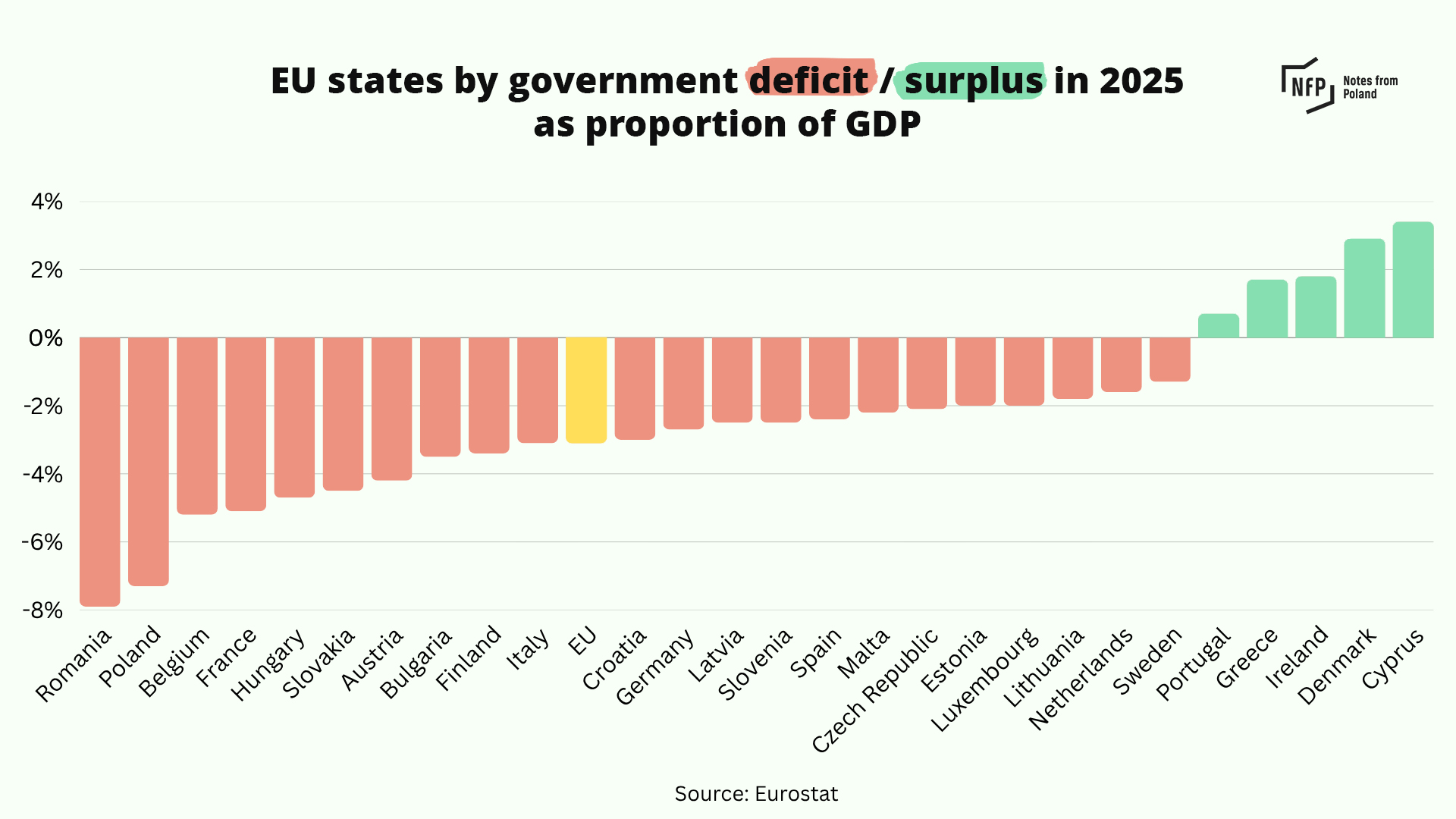
Poland’s deficit is well above the 3% limit outlined in the EU’s Stability and Growth Pact and has been for a number of years, amid increased spending on social programmes and defence. In 2022, it stood at 3.4% of GDP, rising every year since then: to 5.2% in 2023, 6.4% in 2024 and now 7.3% in 2025.
As a consequence, in 2024, the EU placed Poland under its excessive deficit procedure, which requires measures to reduce the shortfall. At the time, the Polish government said that it planned to bring the deficit down to 5.5% of GDP in 2025. Instead, it has increased further.
Poland’s rising deficits were a major factor in two of the big three international credit rating agencies, Fitch and Moody’s, last year switching Poland’s outlook from neutral to negative, indicating that they may lower the country’s score in future.
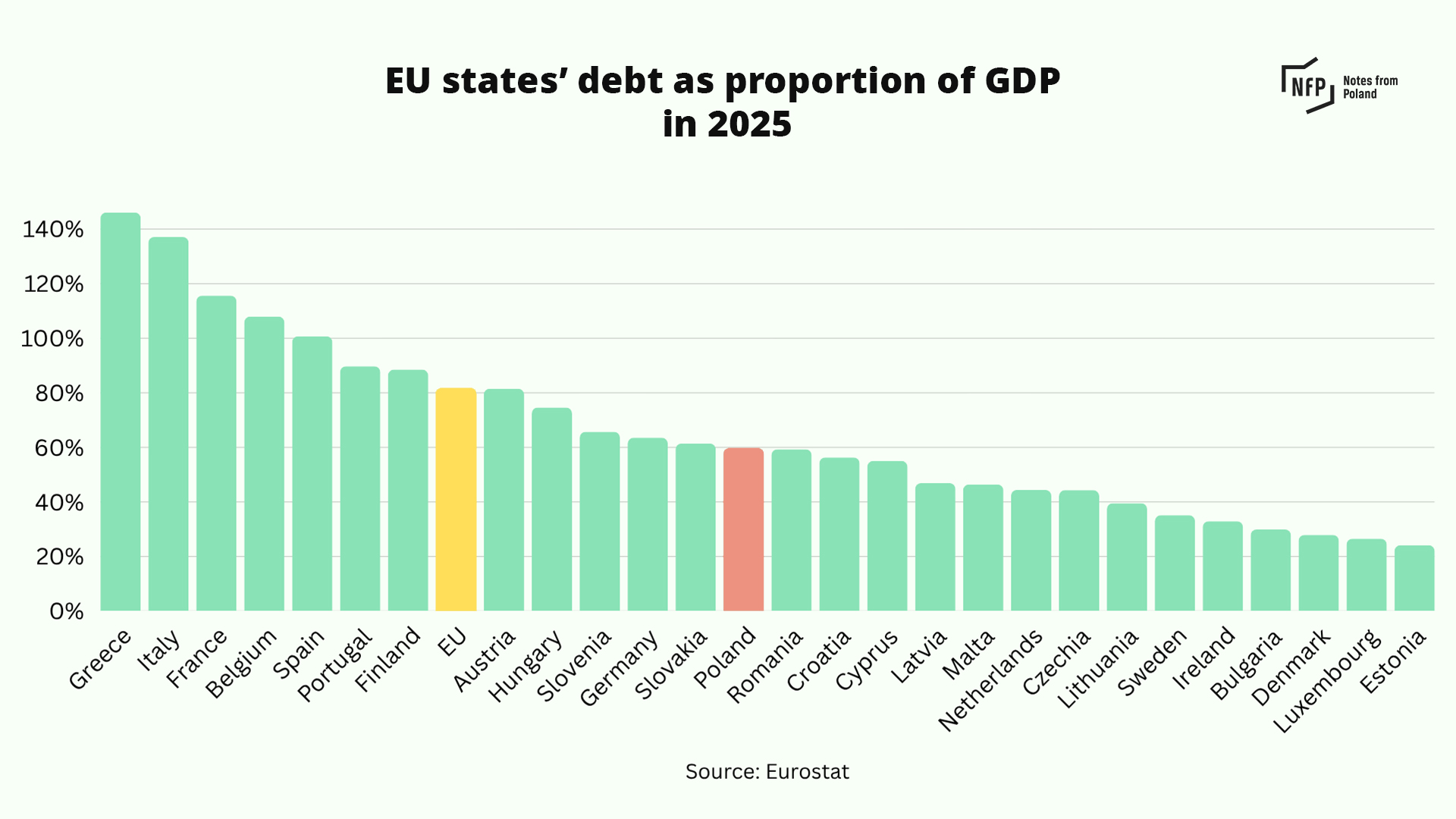
Despite its consistently high deficits, Poland’s level of public debt remains relatively low. In 2025, debt stood at 59.7% of GDP, well below the EU average of 81.7% and also below the ceiling of 60% outlined in the Stability and Growth Pact.
However, Eurostat’s data show that Poland’s debt is rising quickly, increasing by nearly 11 percentage points since 2022. In the fourth quarter of 2025, Poland recorded the EU’s third-largest annual increase in public debt.
According to the Polish finance ministry’s debt management strategy published in September, the upward trend is expected to continue, with debt projected to reach 75% of GDP by 2029.
Debt has grown rapidly due to a mix of external shocks and domestic policy decisions. The COVID-19 pandemic in 2020 forced the government to abandon plans for a balanced budget and increase borrowing to support the economy.
Russia’s full-scale invasion of Ukraine in 2022 prompted a huge rise in defence spending, from 2.4% of GDP in that year to a planned 4.8% in 2026.
However, analysts say that the largest contributor to the widening deficit has been expanded social spending introduced under the former Law and Justice (PiS) government and continued under the current administration, which came to power at the end of 2023.
At the same time, borrowing costs have risen as new debt is issued at higher interest rates, increasing the cost of servicing existing obligations.
Poland's debt has been growing at the second-fastest rate in the EU this year, and is set to continue rising.
What is behind this trend – and should we be worried – asks Alicja Ptak in the latest of her series of articles and podcasts on Poland’s economy https://t.co/1pvnb2ZxoY
— Notes from Poland 🇵🇱 (@notesfrompoland) November 30, 2025
Plans to reduce the deficit have been complicated by political tensions between the government and opposition-aligned President Karol Nawrocki, who can veto laws and has opposed several fiscal measures, including tax increases. He did, however, consent to a new levy on banks.
In January, when Nawrocki signed the state budget for 2026, he criticised its impact on the level of debt, noting that it is the second year in a row in which the deficit is equivalent to almost a third of total spending.
Tensions between the government and president led Fitch to warn last month that “a prolonged period of political gridlock will limit Poland’s capacity to implement policies…[needed] to address wider fiscal pressures leading to large fiscal deficits and rapidly rising debt”.
Ratings agency Fitch has again warned that the "political gridlock" between Poland's government president – such as the current clash over EU defence loans – is hindering efforts to tackle "large fiscal deficits and rapidly rising debt" https://t.co/JSqwwayTdm
— Notes from Poland 🇵🇱 (@notesfrompoland) March 18, 2026
Notes from Poland is run by a small editorial team and published by an independent, non-profit foundation that is funded through donations from our readers. We cannot do what we do without your support.
Main image credit: Lukasz Radziejewski/Unsplash

Alicja Ptak is deputy editor-in-chief of Notes from Poland and a multimedia journalist. She has written for Clean Energy Wire and The Times, and she hosts her own podcast, The Warsaw Wire, on Poland’s economy and energy sector. She previously worked for Reuters.