Keep our news free from ads and paywalls by making a donation to support our work!

Notes from Poland is run by a small editorial team and is published by an independent, non-profit foundation that is funded through donations from our readers. We cannot do what we do without your support.
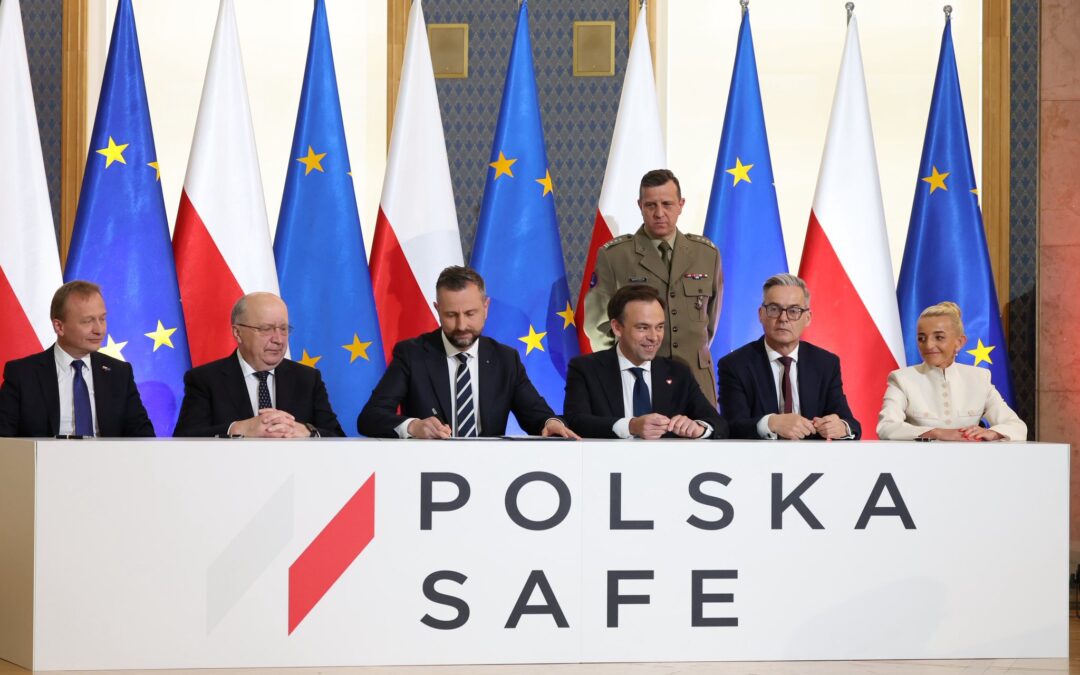
Poland has signed an agreement with the European Commission to receive €43.7 billion (185 billion zloty) in loans over the next four years for defence spending under the European Union’s SAFE programme.
It is the first of 19 member states that have applied for SAFE funds to sign an agreement. Poland is also by far the largest recipient of funds under the programme. Signing the agreement immediately unlocks 15% of the total, around €6.5 billion, as an advance payment.
Umowa #PolskaSAFE podpisana! 🇵🇱 pic.twitter.com/meos4JWMf2
— Adam Szłapka (@adamSzlapka) May 8, 2026
“This is a great moment for Poland, for Europe and for the safety of our children and grandchildren,” said defence minister Władysław Kosiniak-Kamysz at Friday’s signing ceremony, alongside finance minister Andrzej Domański and the European defence and budget commissioners, Andrius Kubilius and Piotr Serafin.
Kubilius likewise hailed the step as a “monumental occasion” that will “make all of us in Europe safer”. He praised Poland for being “a leader in Europe in taking responsibility on defence” of the entire continent.
The Polish government says that the loans – which are equivalent to almost the entire annual defence budget – are on far more favourable terms than Poland could obtain itself and will significantly bolster security.
It also claims that almost 90% of the money will be spent domestically, providing a major boost to the Polish defence industry.
However, the right-wing opposition Law and Justice (PiS) party and PiS-aligned President Karol Nawrocki have been highly critical of SAFE, arguing that it saddles the country with decades of debt on uncertain terms and gives the EU greater power to interfere in Poland’s domestic affairs.
In March, Nawrocki vetoed a government bill intended to facilitate the receipt and disbursement of the SAFE funds. He proposed an alternative that involved using funds generated from central bank profits. But the government, as well as many experts, dismissed the idea as unrealistic.
Instead, the government launched a “plan B” to disburse the SAFE money through the Armed Forces Support Fund, an existing instrument. However, it warned that this may require some of the funds to be diverted away from non-military security spending (such as the border guard) and incur greater administrative costs.
In late April, after assessing Poland’s plans, the European Commission issued a loan agreement to Poland to borrow the full €43.7 billion that it had been designated. Commission President Ursula von der Leyen described Poland as “an essential pillar of Europe’s security architecture”.
The EU has issued a loan agreement for Poland to borrow €43.7 billion for defence spending under the SAFE programme.
"Poland is an essential pillar of Europe's defence architecture," declared @vonderleyen. "You keep our eastern flank safe" https://t.co/bukooCqonv
— Notes from Poland 🇵🇱 (@notesfrompoland) April 24, 2026
“There is no cheaper, more effective source of funding for the modernisation of the Polish army than the SAFE programme,” finance minister Andrzej Domański told Polsat News on Friday ahead of the signing ceremony.
He confirmed that interest rates on the loans are not known in advance. They depend on the terms available at the time the European Commission borrows the money on the markets, because each tranche of SAFE funds is issued as a separate loan.
But Domański said that the loans would always be on more advantageous terms than Poland could independently obtain.
Domański also noted that the interest rate, which would currently be “probably slightly above 3%”, is “clearly cheaper than what our predecessors [the PiS government] borrowed from the United States or South Korea” to finance arms purchases from those two countries.
Poland has been NATO's biggest importer of arms over the last five years, according to new data from @SIPRIorg.
Over 90% of Polish imports have come from South Korea and the United States https://t.co/jij0nfbhFc
— Notes from Poland 🇵🇱 (@notesfrompoland) March 9, 2026
Now that the loan agreement has been concluded, the next stage will be for the Polish government to sign, by the end of May, around 40 contracts for arms purchases using the SAFE funds. The remaining money will then arrive in twice-yearly tranches each April and October, up to 2030.
Under the terms of SAFE, at least 65% of the funds must be spent within Europe. Nawrocki and PiS have argued that this restricts choice when making procurement decisions and risks harming relations with the US and South Korea, which are currently Poland’s main two arms suppliers.
State assets minister Wojciech Balczun told Business Insider Polska this week that the Polish Armaments Group (PGZ), a state defence holding company, will be the largest recipient of the funds, with dozens of entities owned by it set to benefit from procurement contracts.
Among the priorities for the spending are Poland’s East Shield project to bolster defences on its borders with Russia and Belarus, as well as the creation of a new anti-drone system.
Poland has signed an agreement for a new anti-drone system that it claims will be the first of its kind in Europe.
The network is intended to protect Poland’s eastern borders, where last year around 20 Russian drones crossed in an unprecedented incursion https://t.co/WhWhJxDwXA
— Notes from Poland 🇵🇱 (@notesfrompoland) January 30, 2026
Notes from Poland is run by a small editorial team and published by an independent, non-profit foundation that is funded through donations from our readers. We cannot do what we do without your support.
Main image credit: PremierRP/X

Daniel Tilles is editor-in-chief of Notes from Poland. He has written on Polish affairs for a wide range of publications, including Foreign Policy, POLITICO Europe, EUobserver and Dziennik Gazeta Prawna.