Keep our news free from ads and paywalls by making a donation to support our work!

Notes from Poland is run by a small editorial team and is published by an independent, non-profit foundation that is funded through donations from our readers. We cannot do what we do without your support.
Poland’s commissioner for human rights has written to the government expressing concern that a ban on asylum claims by most migrants who irregularly cross the border from Belarus, which was initially declared to be a temporary solution, remains in place after more than a year.
“Since a measure that so severely restricts constitutional rights of individuals has, after a year in force, failed to bring the crisis under control, it is worth considering whether it should be replaced with another one that is neutral or at least less severe from the perspective of foreigners’ rights,” wrote Marcin Wiącek.
RPO wystąpił do MSWiA w sprawie przedłużającego się czasowego ograniczenia prawa cudzoziemców do złożenia wniosku o udzielenie ochrony międzynarodowej na granicy z Republiką Białorusi.
Skoro środek tak daleko ograniczający konstytucyjne prawa jednostek po roku nie doprowadził do… pic.twitter.com/T3I7ZueFYz
— Biuro Rzecznika Praw Obywatelskich (@BiuroRPO) May 25, 2026
Poland has been experiencing a migration crisis on its eastern border since 2021, when Belarus began encouraging and assisting tens of thousands of people – mainly from Asia and Africa – to cross irregularly into the European Union.
Last year, in an effort to discourage crossings, Poland suspended the right to claim asylum by people who cross the border from Belarus, saying that the measure was intended “to combat illegal migration, which is an element of hybrid aggression against Poland, and to combat international crime”.
The measures, introduced under a newly passed law, did include certain exceptions for vulnerable people. Poland must still accept claims from minors, pregnant women, people who require special healthcare, and those deemed at “real risk of harm” if returned over the border.
Despite this, the asylum ban was criticised by both the United Nations High Commissioner for Refugees (UNHCR) and Poland’s own commissioner for human rights as a violation of European and international law, which requires countries to accept asylum claims.
The suspension of asylum rights can only be introduced for up to 60 days in cases where the interior minister deems that “instrumentalisation of migration” is taking place, that it “constitutes a serious and real threat to security”, and that the restriction of asylum rights is necessary to counter the threat.
However, that 60-day period can be renewed by parliament at the request of the government, and there is no limit to how many times that can happen. As a result, the asylum ban has been in place continually since March 2025. Last week, it was renewed for a seventh time.
“This decision reflects the continuing migratory pressure on our eastern border generated by the Belarusian regime,” wrote the interior minister.
🟢 KOMUNIKAT | Czasowe i terytorialne zawieszenie prawa do azylu przy granicy polsko-białoruskiej przedłużone o następne 60 dni
Bezpieczeństwo Polek i Polaków jest priorytetem, dlatego na wniosek MSWiA, rząd zdecydował o dalszym przedłużeniu ograniczenia prawa do złożenia… pic.twitter.com/hZ09yjmkum
— MSWiA 🇵🇱 (@MSWiA_GOV_PL) May 21, 2026
The ministry added that the asylum ban was “clearly effective” because it “discourages migrants from choosing the route through our country and combats migratory pressure”.
As evidence, it noted that, between 27 March 2025, when the asylum ban was introduced, and 19 May 2026, 621 people who had crossed from Belarus sought to make asylum claims. Of those, 480 were rejected under the new law, while 141 from vulnerable people were accepted.
By comparison, in the one-month period before the ban was introduced, from 27 February to 26 March 2025, asylum applications for 189 people were accepted at the border.
In the two months since Poland suspended asylum rights for migrants entering from Belarus, the numbers of attempted border crossings and applications for international protection have significantly fallen, according to data from the Polish border guard https://t.co/gAyxUIrA55
— Notes from Poland 🇵🇱 (@notesfrompoland) May 27, 2025
However, in a letter to interior minister Marcin Kierwiński, human rights commissioner Wiącek pointed to an apparent contradiction between the interior ministry declaring the ban a success but insisting that migratory pressures continue.
Wiącek, who was appointed to his position by parliament in 2021, recalled that, when the asylum ban was first being discussed last year, he had expressed “fundamental reservations as to its compliance with both the constitution of Poland and numerous acts of international law binding on Poland”.
“These reservations remain valid,” he said, but added that they are now compounded by the fact that what was presented as a “temporary” solution has now been in place for over a year.
“When such an exceptional situation persists despite the instrument being used, the question arises as to whether it is the appropriate means to achieve the intended goal,” wrote Wiącek, though he added that he “does not question the need to ensure the protection of national security”.
Poland's recent decision to suspend asylum rights is "correct under European law", says the EU's migration commissioner.
During a visit to the Polish-Belarusian border, he thanked Poland for protecting the EU’s eastern frontier from “weaponised” migration https://t.co/4mKWXABhO2
— Notes from Poland 🇵🇱 (@notesfrompoland) April 26, 2025
Despite concerns from legal experts about the asylum ban, last October the provincial administrative court in Białystok effectively endorsed the measures when rejecting a complaint from a Sudanese man whose attempt to claim asylum had been denied under the new rules.
The judge found that, while foreigners retain the right to seek protection, Poland has a constitutional duty to safeguard its borders and that the temporary asylum restrictions are justified when such crossings pose “a serious and real threat” to national security.
She noted that migrants can seek to lawfully enter Poland through other routes, but often choose those involving Belarus or Russia, thereby deciding to “cooperate with countries that use instrumentalisation, and often also with international criminal groups involved in migrant smuggling”.
“The behaviour of a foreigner who uses refugee law in a manner inconsistent with its purpose does not deserve protection,” said the judge. “Such behaviour should be considered a gross abuse of the law, unacceptable in a democratic state governed by the rule of law and in European legal culture.”
A court has ruled that Poland's recently introduced partial suspension of the right to asylum is justified and lawful.
It rejected a complaint by a Sudanese man who had been denied the right to claim asylum after crossing irregularly from Belarus https://t.co/jx3s1AxRgG
— Notes from Poland 🇵🇱 (@notesfrompoland) October 10, 2025
Notes from Poland is run by a small editorial team and published by an independent, non-profit foundation that is funded through donations from our readers. We cannot do what we do without your support.
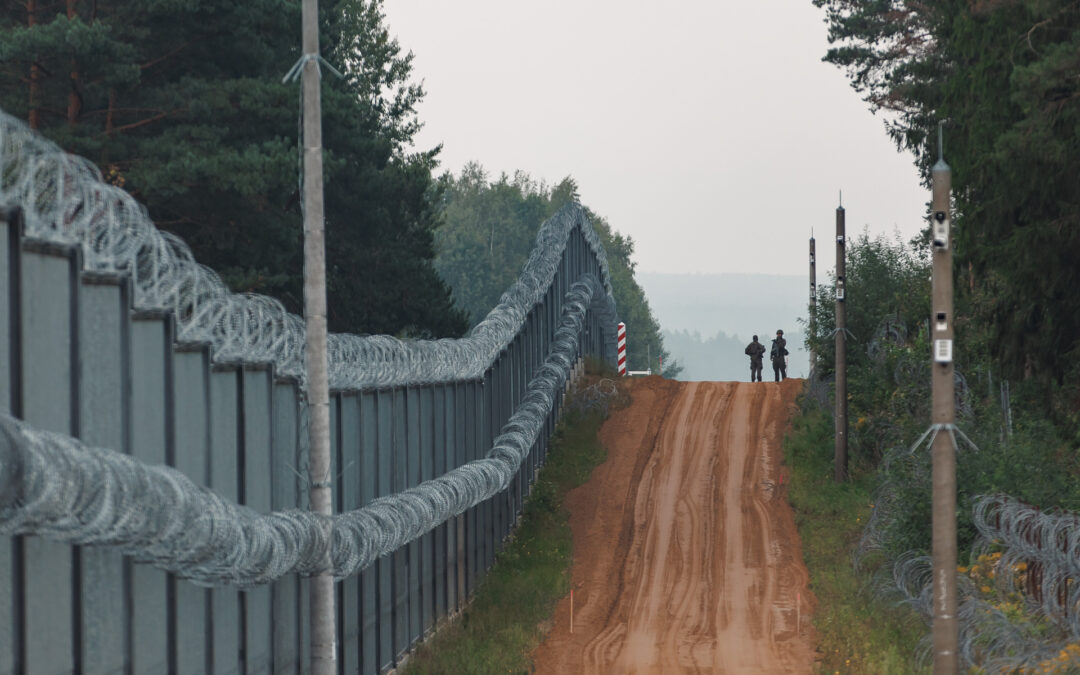
Main image credit: KPRM/Flickr (under CC BY-NC-ND 4.0)

Daniel Tilles is editor-in-chief of Notes from Poland. He has written on Polish affairs for a wide range of publications, including Foreign Policy, POLITICO Europe, EUobserver and Dziennik Gazeta Prawna.