
Keep our news free from ads and paywalls by making a donation to support our work!

Notes from Poland is run by a small editorial team and is published by an independent, non-profit foundation that is funded through donations from our readers. We cannot do what we do without your support.
Poland issued first residence permits to almost half a million immigrants in 2025, which was the third-highest figure in the European Union, behind Spain and Germany but ahead of Italy and France.
However, the number of permits issued by Poland fell for the fourth year running, as the country continued to tighten its migration rules. Previously, between 2017 and 2022, Poland had led the EU figures for six years running, reaching a peak of almost one million permits in 2021.
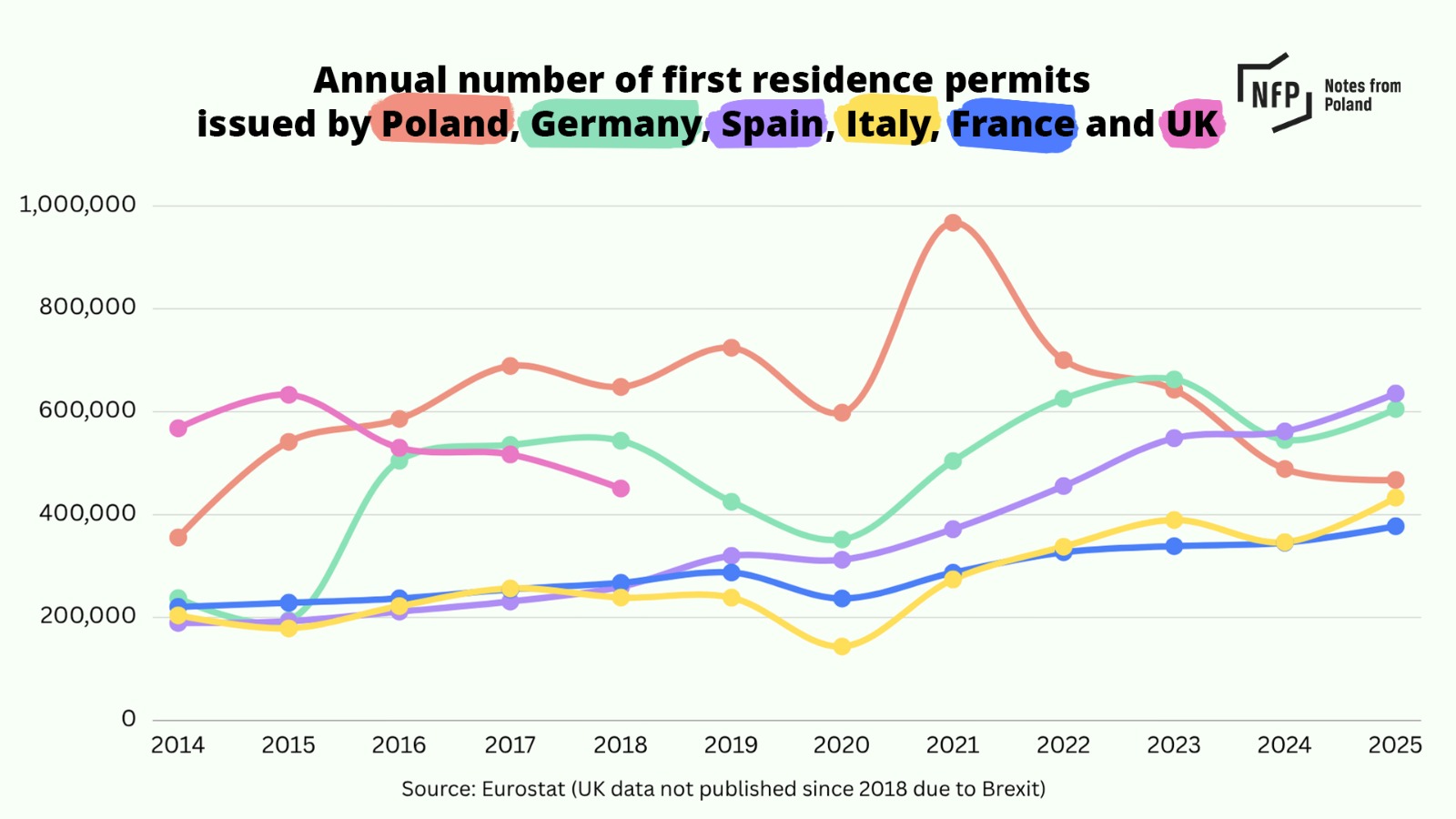
The new data, released on Friday by Eurostat, the EU’s statistical agency, show that Poland issued 467,314 first residence permits to immigrants from outside the EU in 2025.
As was the case last year, Spain (635,438) issued the most, followed by Germany (605,292). Poland was then followed by Italy (433,099) and France (377,462).
However, whereas in those four other countries the number of permits rose in 2025 (by 13.1% in Spain, 11.1% in Germany, 25.0% in Italy and 9.2% in France), in Poland the figure fell by 4.4%.
That decline has come amid a tougher new migration strategy by the current government, a coalition that ranges from left to centre right, led by Prime Minister Donald Tusk.
Ahead of elections in 2023, Tusk, then in opposition, accused the national-conservative Law and Justice (PiS) government, which had ruled Poland since 2015, of allowing “uncontrolled” migration, including through widespread abuses of the visa system.
Shortly after coming to power in those elections, Tusk, a former president of the European Council, declared that the “survival of Western civilisation” depends upon preventing mass migration.
His government has since introduced tougher entry requirements for foreign workers and students, suspended asylum rights for migrants who irregularly cross the border from Belarus, and stepped up deportations of immigrants who have committed crimes or entered the country unlawfully.
Poland has introduced tougher new rules regulating the entry of foreign students and immigrant workers.
“This is another step towards regaining control over migration and increasing the safety of Poles," says the government https://t.co/gYdikpc6pL
— Notes from Poland 🇵🇱 (@notesfrompoland) June 2, 2025
The new 2025 data show that, in relative terms (the number of permits issued in relation to countries’ populations), Poland was only ninth in the EU (12.8 permits per 1,000 people), behind Malta (56.9), Cyprus (46.7), Portugal (27.3), Lithuania (18.5), Ireland (13.4), Croatia (13.2), Luxembourg (13.1) and Spain (12.9).
That marks a significant decline since 2021, when Poland issued 967,345 permits, which was the highest in the EU in absolute terms but also second-highest in relation to population.
In 2025, as in previous years, Poland issued the most first residence permits to Ukrainians (241,126, 51.6% of the total), who are by far the country’s largest immigrant group.
They were followed by Belarusians (128,468, 27.5%), Georgians (10,249, 2.2%), Indians (9,230, 2%) and Turks (7,533, 1.6%) – the same top five nationalities as in 2024.
Indians are now the third-largest group of foreign workers in Poland, followed by Colombians, according to new data from the country’s Social Insurance Institute (ZUS).
Ukrainians remain by far the largest immigrant group, followed by Belarusians https://t.co/hNiOqmeUfX
— Notes from Poland 🇵🇱 (@notesfrompoland) August 11, 2026
Following a decade of unprecedented mass migration, the number of foreigners with residence permits in Poland this year passed two million for the first time, making up just over 5% of the country’s population. Around 1.5 million of those are Ukrainians.
In June, the number of foreigners working in Poland reached 1.14 million, making up almost 7% of the workforce. While Ukrainians constitute two thirds of the total, the fastest-growing nationalities are Colombians and Indians, who are now the third- and fourth-largest groups of foreign workers.
The rise in migration has come as Poland’s economy has boomed but the country has also faced a demographic crisis, with a shrinking, ageing population and one of the lowest birth rates in the world.
In 2023, the state Social Insurance Institution (ZUS) calculated that, in order to maintain its ratio of working-age population to retirees, Poland would need to attract almost two million immigrant workers over the following decade. However, it admitted that that target was “unrealistic”.
Notes from Poland is run by a small editorial team and published by an independent, non-profit foundation that is funded through donations from our readers. We cannot do what we do without your support.
Main image credit: KAS (under CC BY-SA 4.0)

Daniel Tilles is editor-in-chief of Notes from Poland. He has written on Polish affairs for a wide range of publications, including Foreign Policy, POLITICO Europe, EUobserver and Dziennik Gazeta Prawna.