
Keep our news free from ads and paywalls by making a donation to support our work!

Notes from Poland is run by a small editorial team and is published by an independent, non-profit foundation that is funded through donations from our readers. We cannot do what we do without your support.
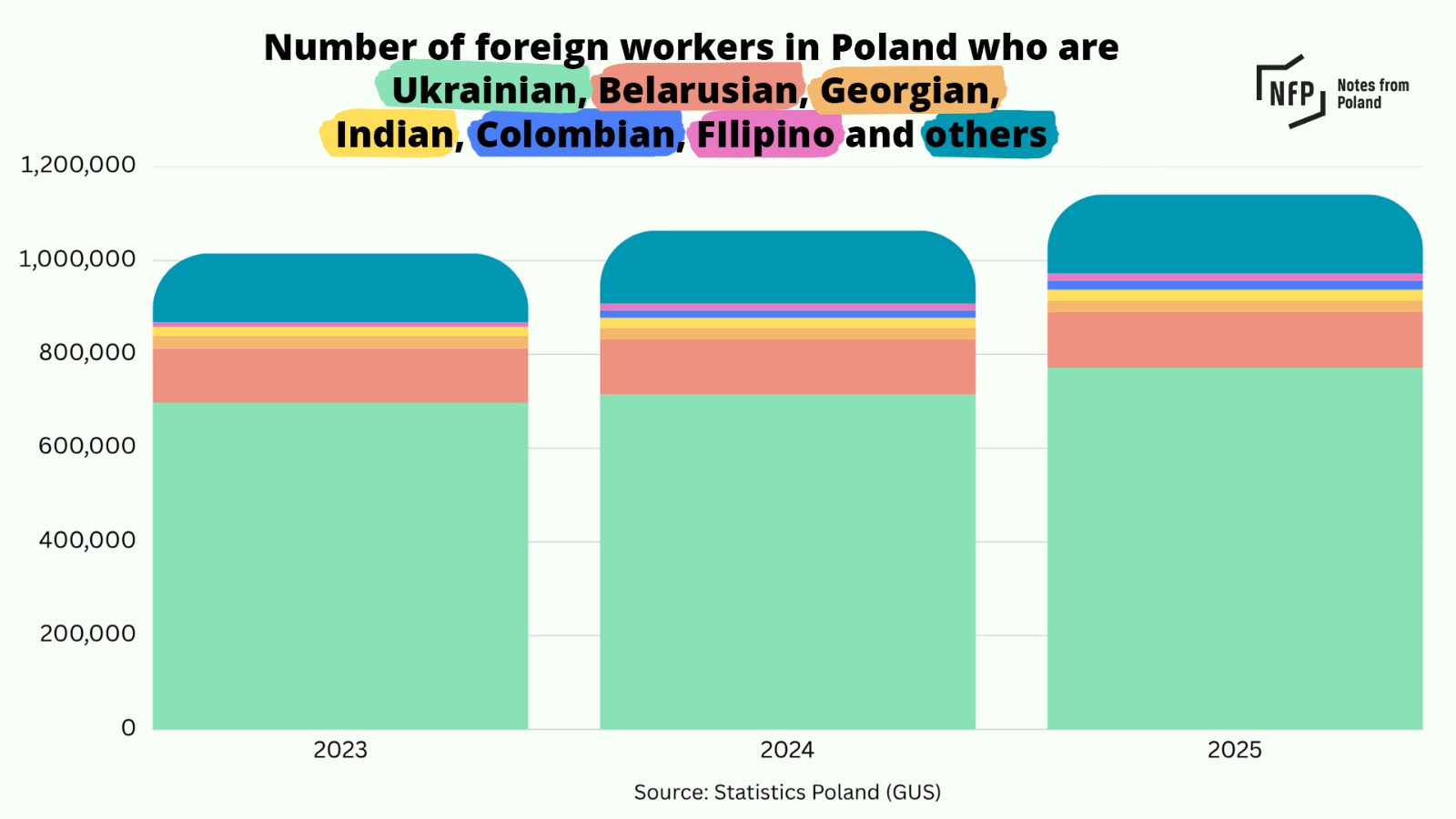
The number of foreigners working in Poland reached 1.14 million by the end of 2025, 7.2% higher than a year earlier, new data from Statistics Poland (GUS), a state agency, show. Immigrants now make up almost 7% of all workers.
Ukrainians remain by far the largest group, representing over two thirds (67.6%) of foreign workers. However, the nationalities that saw the largest increases in 2025 were Colombians (whose number rose by 21.3%) and Indians (9.1%), with Ukrainians (8.1%) in third.
Poland was for a long time a country of emigration, with Poles heading west in search of better opportunities. But over the last decade, the country has experienced immigration on a scale that is unprecedented in its history and is among the highest in Europe.
For six years running, between 2017 and 2022, it issued more first residence permits to immigrants from outside the European Union than did any other member state.
Those numbers were bolstered further by the mass arrival of refugees from neighbouring Ukraine after Russia’s full-scale invasion in 2022.
The latest data show that there were 771,800 Ukrainians employed in Poland as of 31 December 2025. The second largest national group were 118,900 Belarusians, followed by Georgians (24,210), Indians (23,004), Colombians (19,261) and Filipinos (15,053).
By sector, the highest concentration of foreign workers was in administrative and support service activities, where they accounted for 25.3% of employment. This category, however, includes employment agencies and job placement services.
Foreign workers also made up 17.8% of those employed in accommodation and food service activities, and 15.1% in transport and storage.
The number of foreigners with residence permits in Poland has reached two million, making up just over 5% of the country’s population, new government data show.
The largest national group by far are Ukrainians, followed by Belarusians and Indians https://t.co/SI09WtR7hR
— Notes from Poland 🇵🇱 (@notesfrompoland) April 26, 2026
Much of the surge in immigration came during the rule of the national-conservative Law and Justice (PiS) government from 2015 to 2023, despite its strong anti-migrant rhetoric.
The current government, a more liberal coalition led by Prime Minister Donald Tusk, came to power pledging to reduce immigration, which it said had got out of control under PiS.
Under Tusk’s government, in 2024, Poland issued the lowest number of residence permits to non-EU immigrants in a decade. In 2025, the government introduced tougher entry requirements for foreign workers and students. It has also stepped up deportations of foreigners who have broken the law.
However, as the new GUS figures show, the number of foreign workers has continued to increase, with Poland’s booming economy and difficult demographic situation creating high demand for labour.
Poland has forcibly removed 2,100 foreigners from the country this year, around twice as many as in 2024.
The figures come after the government introduced a tougher new migration policy last year, which has included more deportations of foreign criminals https://t.co/zOBxPLipy8
— Notes from Poland 🇵🇱 (@notesfrompoland) December 31, 2025
Notes from Poland is run by a small editorial team and published by an independent, non-profit foundation that is funded through donations from our readers. We cannot do what we do without your support.
Main image credit: Jakub Zerdzicki/Pexels

Alicja Ptak is deputy editor-in-chief of Notes from Poland and a multimedia journalist. She has written for Clean Energy Wire and The Times, and she hosts her own podcast, The Warsaw Wire, on Poland’s economy and energy sector. She previously worked for Reuters.