Keep our news free from ads and paywalls by making a donation to support our work!

Notes from Poland is run by a small editorial team and is published by an independent, non-profit foundation that is funded through donations from our readers. We cannot do what we do without your support.
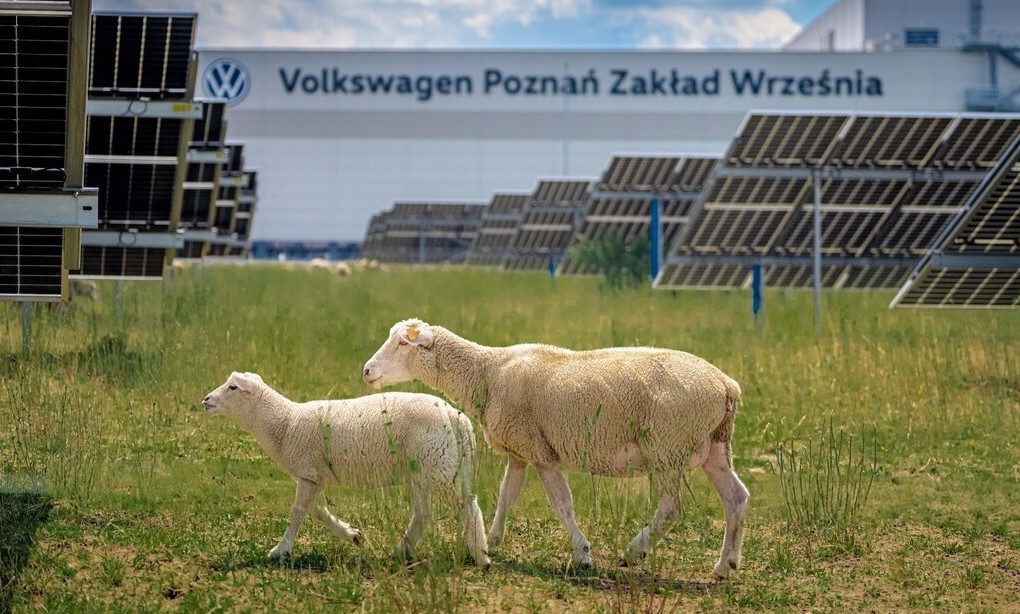
Carmaker Volkswagen has deployed a herd of 100 sheep to keep grass under control at a solar farm that powers one of its factories in Poland, providing a greener alternative to mechanical mowing.
The project, which is being run in partnership with a local university, will also contribute to research on agrivoltaics, the name given to the use of land for both solar generation and agriculture. Scientists will assess the impact of the practice on animal welfare and the wider ecosystem.
In 2016, Volkswagen opened a major plant near Poznań, Poland’s fifth-largest city. The facility employs around 3,000 people and mainly produces VW’s Crafter van.
In 2023, the company opened a solar farm next to the plant. On sunny days, its 31,000 photovoltaic panels can power the whole factory, though over the year as a whole it supplies around 25% of its electricity.
Volkswagen has now announced that, earlier this year, it welcomed around 100 sheep to the solar farm. They are grazing on the 27 hectares of land around the panels as an alternative to mechanical mowing.
“The animals adapted very well to the new conditions,” says Justyna Nowak-Gajek, the owner of the flock. She explains that the sheep are splitting into smaller groups and “grazing peacefully”, whereas herds that feel unsafe tend to stick closer together.
Meanwhile, scientists from the Poznań University of Life Sciences (UPP) are studying the impact of the project on the animals’ welfare and behaviour, as well as the functioning of the entire ecosystem.
“We are checking, among other things, whether shade created by the panels reduces heat stress in animals, improving their comfort and living conditions,” says Joanna Składanowska-Baryza from the university’s Faculty of Veterinary Medicine and Animal Sciences.
“At the same time, we are analysing changes in the microclimate, vegetation and soil to identify solutions that facilitate the effective combination of energy production with agricultural activities.”
Volkswagen has chosen Poland as the location for a new €1.7bn plant producing materials for electric vehicle batteries.
The investment has been welcomed by the Polish government, which is providing €350 million in grants for the project https://t.co/xh0LuzHOyq
— Notes from Poland 🇵🇱 (@notesfrompoland) October 10, 2023
The study is expected to inform the wider practice of agrivoltaics, which aims to “create [solar] installations that coexist with their surroundings and bring additional benefits to the environment and local communities”, says Quanta Energy, the firm that constructed Volkswagen’s solar farm.
“The photovoltaic farm now produces more than just green energy,” adds Marzena Pillich-Grońska, director of the Volkswagen plant. “It has also become a place where we support biodiversity, local agriculture, and the development of scientific knowledge.”
In recent years, a number of Polish cities, including Kraków and Katowice, have also recruited sheep and goats as a greener alternative to mechanical cutting of grass on municipal land.
Various firms operating in Poland have been investing in renewables to supply themselves with energy. In 2024, the largest chocolate maker in Poland, Mondelez Polska, said it would spend $1 million (3.8 million zloty) on solar installations at its production sites in the country.
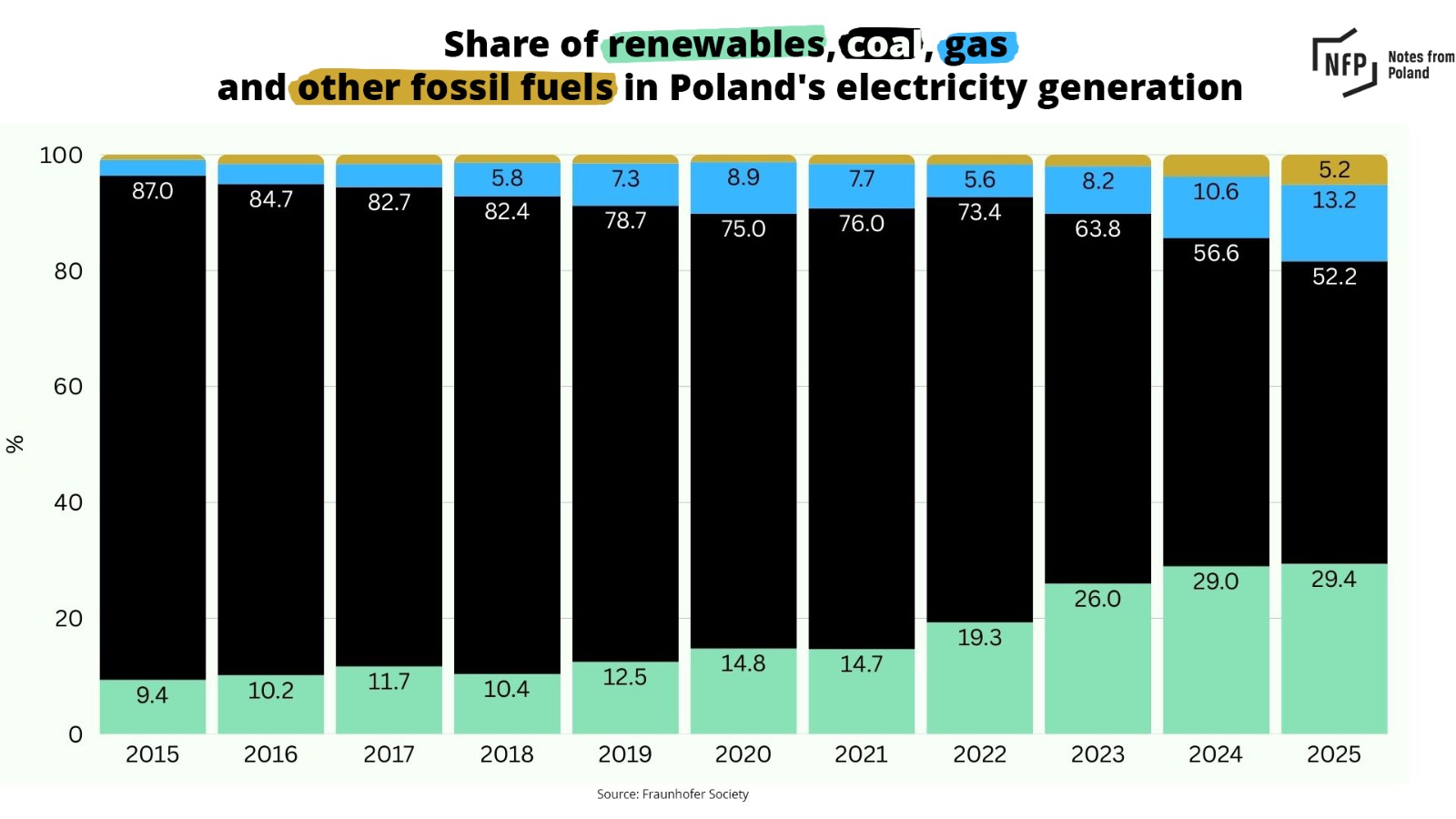
Successive Polish governments have also been seeking to bolster green energy. Last year, the country generated 29.4% of its electricity from renewables, up from 9.4% a decade earlier. Onshore wind led the way with 14.2%, followed by solar at 12.1% and biomass at 1.8%.
However, in 2023, a group of business associations and international companies, including Google, Amazon, Mercedes and Ikea, warned the government that there must be more rapid development of green energy in order to attract continued investment in Poland.
However, since then, figures show a period of stagnation, despite the current government pledging to accelerate Poland’s green transition after taking power from its conservative predecessor in 2023.
Notes from Poland is run by a small editorial team and published by an independent, non-profit foundation that is funded through donations from our readers. We cannot do what we do without your support.
Main image credit: VW (press materials)

Olivier Sorgho is senior editor at Notes from Poland, covering politics, business and society. He previously worked for Reuters.