Keep our news free from ads and paywalls by making a donation to support our work!

Notes from Poland is run by a small editorial team and is published by an independent, non-profit foundation that is funded through donations from our readers. We cannot do what we do without your support.
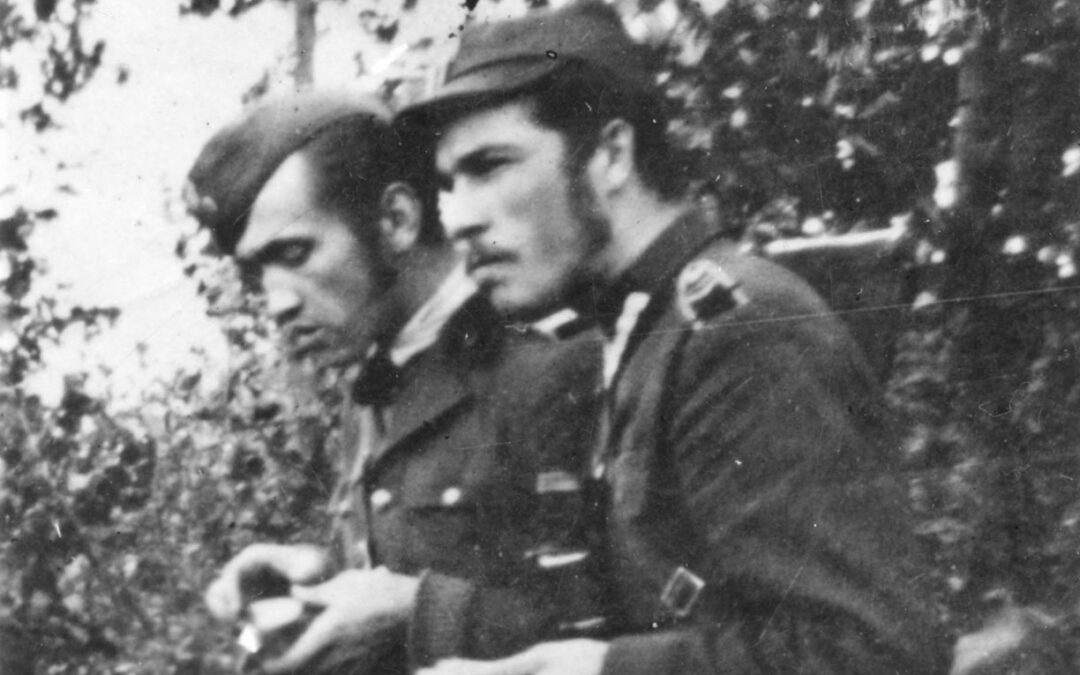
Poland’s state Institute of National Remembrance (IPN) has identified the remains of Mieczysław Dziemieszkiewicz (pictured above on the right), a prominent figure in the underground resistance that fought against the Soviet-installed communist authorities in the years after World War Two.
Dziemieszkiewicz, who was killed by the communist security services in 1951 and dumped in an unmarked mass grave, was identified through a combination of historical detective work and genetic testing, including exhuming the remains of his deceased mother and sister to obtain DNA samples.
“Once again, we can say that the communist authorities did not win. Heroes prevail,” declared Krzysztof Szwagrzyk, deputy head of the IPN. “Even in the most difficult situations, we must seek the truth, find those of whom no trace was supposed to remain, and restore their names.”
While World War Two officially came to an end in 1945, tens of thousands of Poles, known as the “cursed soldiers” (żolnierze wyklęci), continued to fight against the Soviets and the communist regime they installed in Poland.
While most had laid down arms by 1947, some continued fighting well beyond then, including Dziemieszkiewicz, who operated under the nom de guerre “Rój” (meaning “swarm”).
Dziemieszkiewicz, who was 20 years old when the war ended, came from a family that had been part of Poland’s wartime resistance. His anti-communist views were hardened when his elder brother, Roman, was killed by Red Army soldiers in 1945.
After being conscripted that year into the Soviet-backed Polish People’s Army, Dziemieszkiewicz defected and joined the underground resistance forces, where he rose to command a unit tasked with eliminating regime officials and members of the communist Polish Workers Party (PPR).
Dziemieszkiewicz’s group killed around two dozen members of the communist security services and more than 20 informants, according to the IPN.
In 1950, the communist authorities intensified efforts to dismantle Dziemieszkiewicz’s unit, using threats and blackmail to recruit hundreds of agents and informants in an effort to locate the resistance fighters.
Eventually, one such informant gave up Dziemieszkiewicz’s location in exchange for a promise to release her parents from captivity. Dziemieszkiewicz found himself surrounded by several hundred soldiers and was killed while trying to escape.
After his body had been identified by his family, Dziemieszkiewicz was buried in a section of Powązki Cemetery in Warsaw where the remains of those killed by the communist security services were placed en masse in unmarked graves.
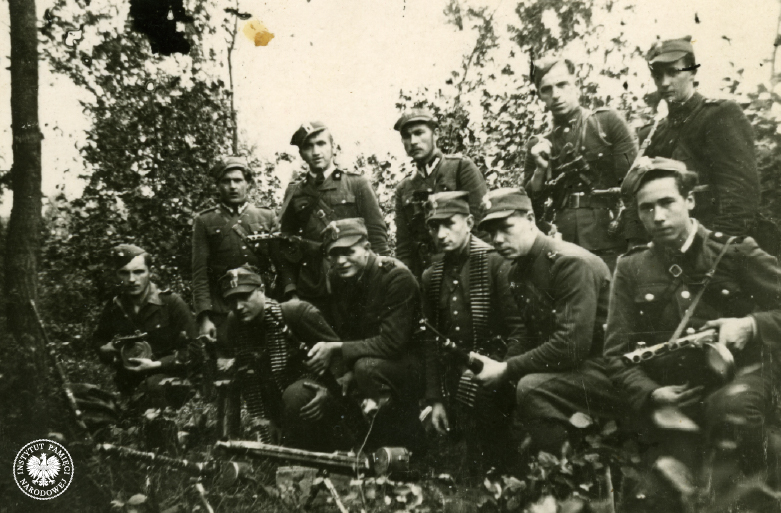
Dziemieszkiewicz and his unit (source: IPN)
Exhumations by the IPN, which was established after the fall of communism to investigate communist and Nazi crimes in Poland, have located over 200 complete bodies at that site as well as several thousand bone fragments.
During that work, one set of remains was found buried with an eagle symbol and remnants of a black cloth. IPN researchers realised that the item was similar to a beret that appeared in posthumous photographs of Dziemieszkiewicz’s body taken by the communist security services.
That prompted them to carry out genetic testing on the remains and compare them to samples taken from Dziemieszkiewicz’s mother and sister, who were buried in a cemetery in the town of Maków Mazowiecki.
“We have found ‘Rój’, commander of one of the longest-fighting units of the independence underground,” declared the IPN on Friday, announcing the confirmation of his identity. They described Dziemieszkiewicz as “legend in life and a symbol of the fight against communist oppression”.
The identification was announced today during a press conference at @PrzystanekH.
The identification is the result of many years of work carried out by the IPN. It was preceded by extensive archival and investigative research, the analysis of forensic evidence, archaeological… https://t.co/Rcf4wemJFc pic.twitter.com/XgMUAgSQc6
— Institute of National Remembrance (@ipngovpl_eng) July 24, 2026
At a conference announcing the findings, the IPN noted that Dziemieszkiewicz’s remains had been located right next to those of another prominent anti-communist resistance fighter, Zygmunt Szendzielarz, who fought under the nom de guerre “Łupaszko”.
“It is an incredible situation that two great and distinguished soldiers of the Polish underground lie next to each other in this part of the Powązki Cemetery,” said Szwagrzyk.
However, Szendzielarz, who was executed by the communist authorities in 1951, has a contested legacy, given evidence that his unit was involved in the massacre of dozens of Lithuanian civilians. Some other “cursed soldiers” have faced similar accusations of war crimes.
While it was often IPN historians who uncovered evidence of such actions, the institution has more recently begun to honour those figures, particularly under the rule of the national-conservative Law and Justice government between 2015 and 2023.
Opposition MPs walked out of parliament yesterday as the chamber commemorated an underground officer who fought against Nazi-German occupation and the imposition of communism in Poland, but has also been accused of a war crime against civilians https://t.co/MIY7krOxTw
— Notes from Poland 🇵🇱 (@notesfrompoland) February 9, 2022
Dziemieszkiewicz himself, however, like most of the cursed soldiers, has not faced such accusations.
In 2007, President Lech Kaczyński posthumously awarded Dziemieszkiewicz the Commander’s Cross with Star of the Order of Polonia Restituta, one of Poland’s highest honours. In 2020, his image was featured on a commemorative silver coin issued by the National Bank of Poland.
Through a combination of brutal repression and offering amnesties, the communist authorities managed to end most resistance efforts by 1947. However, the last “cursed soldier” to die in combat, Józef Franczak, was killed in 1963, 18 years after the end of the war.
Notes from Poland is run by a small editorial team and published by an independent, non-profit foundation that is funded through donations from our readers. We cannot do what we do without your support.
Main image credit: IPN BU 0255/118 t. 5

Daniel Tilles is editor-in-chief of Notes from Poland. He has written on Polish affairs for a wide range of publications, including Foreign Policy, POLITICO Europe, EUobserver and Dziennik Gazeta Prawna.