Keep our news free from ads and paywalls by making a donation to support our work!

Notes from Poland is run by a small editorial team and is published by an independent, non-profit foundation that is funded through donations from our readers. We cannot do what we do without your support.
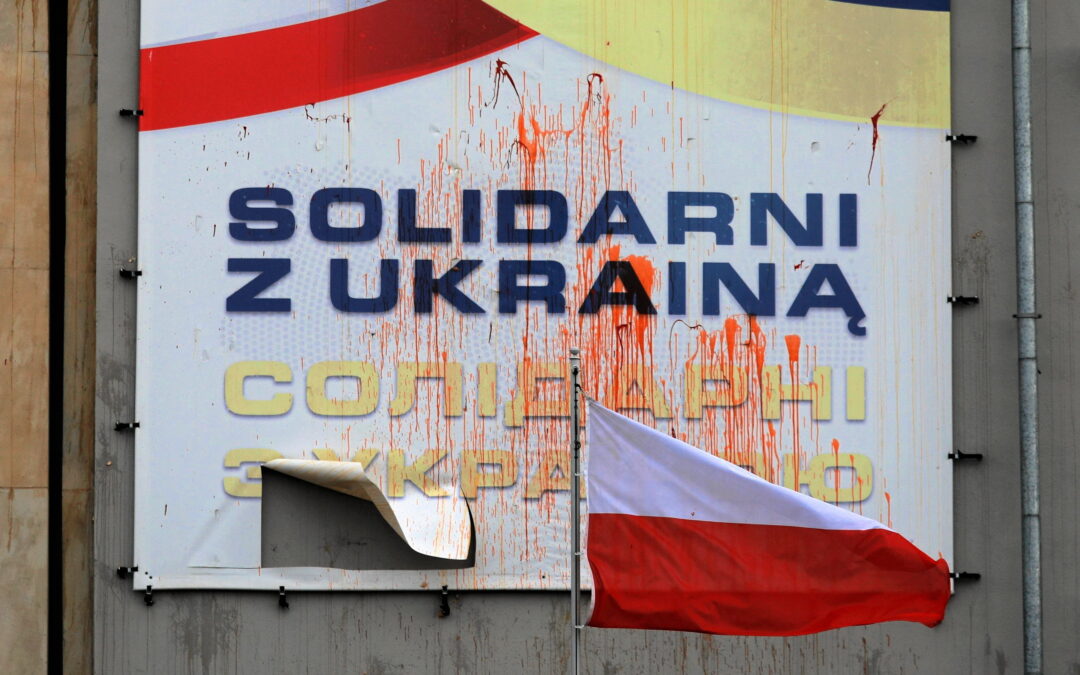
The number of reported hate crimes against Ukrainians in Poland was 30% higher in the first half of this year compared to the same period in 2025, newly reported police data show.
The figures come following a number of recent high-profile cases of verbal and physical attacks against Ukrainians – who are Poland’s largest immigrant group – as well as ongoing diplomatic tensions between Kyiv and Warsaw.
🔴Coraz więcej ataków na Ukraińców w Polsce – wynika z danych @PolskaPolicja https://t.co/6ZnKFILbdL
— Rzeczpospolita (@rzeczpospolita) July 17, 2026
The new data, which were reported by the Rzeczpospolita daily, show that police received 180 reports of hate crimes against Ukrainians in the first half of 2026, which was around 30% higher than in the same period last year and around 35% more than in 2024.
If the same trend continues, there would be around 360 such reports by the end of the year, more than the 275 recorded in 2025 and 267 in 2024.
However, Rzeczpospolita notes that the figures relate to reported incidents of hate crimes, rather than confirmed cases. On the other hand, experts point out that many such incidents are never even reported to the police.
“It is generally assumed that hate crimes are underreported,” Jacek Kucharczyk, head of the Institute of Public Affairs, a think tank, told the newspaper. “Some victims don’t want to report a crime because they’re simply afraid.”
Ukrainians are by far Poland’s largest foreign national group, with around 1.6 million living in the country. While Poland welcomed Ukrainian refugees in 2022, there has been growing negative sentiment towards them recently, indicated in polls and through anti-Ukrainian rhetoric from prominent politicians.
In particular, two far-right opposition parties, Confederation (Konfederacja) and Confederation of the Polish Crown (KKP), have used anti-Ukrainian rhetoric, while the largest opposition group, the national-conservative Law and Justice (PiS), has recently taken a tougher line towards Ukraine.
Kucharczyk told Rzeczpospolita that the “toxic atmosphere” around Ukrainians is now spreading from political rhetoric into real-life consequences, as seen in the new police data. He added that Russia also seeks to stoke and exploit such sentiment.
An 18-year-old Ukrainian will stand trial in Poland accused of working on behalf of Russia to stir tension between Poland and Ukraine by painting dozens of inscriptions in public places glorifying the Ukrainian Insurgent Army, which massacred Poles in WWII https://t.co/0w0gVYiGpp
— Notes from Poland 🇵🇱 (@notesfrompoland) July 16, 2026
In May, five Polish teenagers were detained in Warsaw over a violent attack on a group of young Ukrainians. The city’s mayor, Rafał Trzaskowski, blamed the anti-Ukrainian rhetoric of right-wing politicians for “encouraging thugs” to carry out these kinds of attacks.
Tensions with Ukraine have since ramped up even further, amid a diplomatic dispute sparked by President Volodomyr Zelensky’s decision to name a military unit after a Ukrainian nationalist group that led massacres of Poles during World War Two.
Earlier this month, two Polish far-right activists were charged over an incident in which they confronted a Ukrainian woman who runs a business that offers assistance to other Ukrainian immigrants.
Last week, a man was detained after being recorded hurling xenophobic obscenities at Ukrainian children on a bus in the city of Bielsko-Biała. That latter incident prompted Ukraine’s foreign minister, Andrii Sybiha, to call on “Polish politicians to stop inciting hatred against Ukrainians”.
Ukraine’s foreign minister has called on "Polish politicians to stop inciting hatred against Ukrainians” after an incident in which a man was filmed shouting xenophobic obscenities at Ukrainian girls on a bus in Poland.
The perpetrator has been detained https://t.co/AfGCNqtJbj
— Notes from Poland 🇵🇱 (@notesfrompoland) July 13, 2026
Figures from Poland’s government, which is a coalition ranging from left to centre right, have also condemned recent incidents of hate towards Ukrainians. Prime Minister Donald Tusk called last week’s incident in a bus “disgusting” and warned of the potential “disastrous consequences” of inciting national hatred.
Interior minister Marcin Kierwiński promised that the state would deal with “any form of aggression”, but also blamed the right-wing opposition for stirring antipathy.
However, PiS spokesman Rafał Bochenek accused the government of “cynically exploiting” the incident in Bielsko-Biała “for political purposes”. He said it was, in fact, Tusk and Kierwiński who were “responsible for the brutalisation of public life in Poland”.
Meanwhile, Ukraine’s ambassador to Poland, Vasyl Bodnar, hailed the fact that “the entire political class” in Poland had condemned the incident on the bus and expressed hope that the recent wave of attacks is a “temporary symptom” that “will pass”, reports the Polish Press Agency (PAP).
Two Polish far-right activists have been charged over an incident in which they confronted a Ukrainian woman who runs a business providing services to immigrants.
One of the two men was separately charged this year with espionage on behalf of Russia https://t.co/SdhlXUhym2
— Notes from Poland 🇵🇱 (@notesfrompoland) July 10, 2026
Notes from Poland is run by a small editorial team and published by an independent, non-profit foundation that is funded through donations from our readers. We cannot do what we do without your support.
Main image credit: Krzysztof Ćwik / Agencja Wyborcza.pl

Olivier Sorgho is senior editor at Notes from Poland, covering politics, business and society. He previously worked for Reuters.