Keep our news free from ads and paywalls by making a donation to support our work!

Notes from Poland is run by a small editorial team and is published by an independent, non-profit foundation that is funded through donations from our readers. We cannot do what we do without your support.
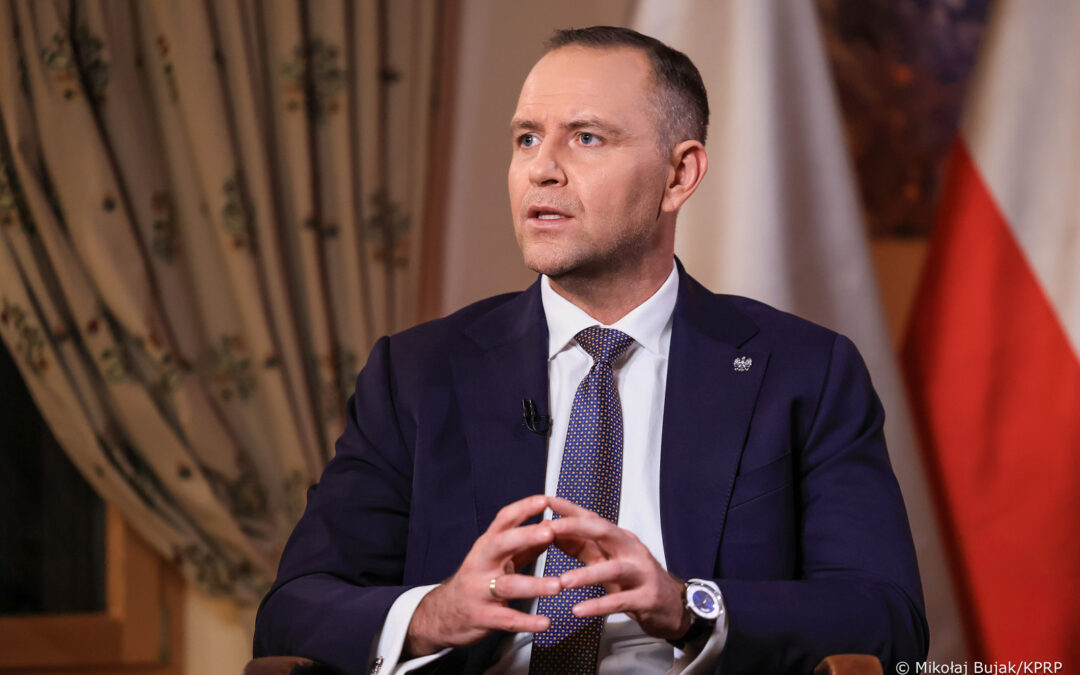
President Karol Nawrocki, who is aligned with the right-wing opposition, has vetoed a government bill that would have allowed unmarried partners, including same-sex couples, to sign an agreement granting them certain rights.
The proposed law would have marked the first time that Poland had recognised same-sex relationships in domestic law. However, Nawrocki argued that such a move would threaten the institution of marriage, which is enshrined in the constitution.
— Kancelaria Prezydenta RP (@prezydentpl) July 17, 2026
The measures in question were approved by both houses of parliament in May and June with the support of Prime Minister Donald Tusk’s ruling coalition, which ranges from left to centre right.
The proposed laws would have allowed couples, both same-sex and opposite-sex, to enter into a new type of contract, signed before a notary and then submitted to the registry office.
It would have granted them some of the rights available to married couples, including joint property and tax settlement, access to their partner’s medical information, exemption from inheritance and gift taxes, and the right to decide about their partner’s burial if they died.
However, the two main opposition parties – the national-conservative Law and Justice (PiS) and far-right Confederation (Konfederacja) – voted against the legislation, and Nawrocki himself also made clear that he intended to veto it.
The government’s majority in parliament has approved a bill that would grant same-sex partners some of the rights available to married couples.
However, President Nawrocki, who is aligned with the right-wing opposition, has made clear he will veto the law https://t.co/hx8viUN6QH
— Notes from Poland 🇵🇱 (@notesfrompoland) May 29, 2026
On Friday morning, the president confirmed he would not be signing into law the two bills passed by parliament that would have introduced the new system.
He said that the measures would effectively “introduce civil partnerships through the back door”, and that such partnerships are “intended to replace or substitute the institution of marriage”.
“As the guardian of the constitution, I cannot accept a solution that would lead to the loss of the special status of marriage defined in article 18 of the constitution as a union between a woman and a man, placed under the protection and care of the Republic of Poland,” he added.
Nawrocki also argued that the proposed measures were contrary to the principles of social justice because they would have granted such couples some of the privileges of marriage but without all of the same obligations. He also noted that the proposed new type of contract could be terminated far more easily than a marriage.
“Marriage, which best secures family stability, cannot become one of many equally valid options offered by the state administration,” declared the president. “The family is a community fundamental to the survival of the nation.”
However, Nawrocki added that, as he has previously said, he remains open to legislation that would grant loved ones rights relating to healthcare and various administrative issues. But only if it “does not create an alternative to marriage” or “introduce ideological changes to family law”.
Poland has begun recognising foreign same-sex marriages. But the legal consequences for such couples remain unclear, especially as Polish law does not allow any form of same-sex union
We asked five experts for their view on what this will mean in practice https://t.co/h2KHmW8sMI
— Notes from Poland 🇵🇱 (@notesfrompoland) June 19, 2026
Nawrocki’s decision was condemned by Tusk, who called it “an expression of contempt toward people and their right to happiness and a normal life”.
The government’s plenipotentiary for equality, Katarzyna Kotula, accused the president of “turning his back on the two million Poles living today in informal relationships”.
However, she pledged that “the veto will not halt social change”. If such change “cannot go through the door, then [it will go] through the window”.
Kotula noted that Poland has already begun legally recognising same-sex marriages conducted in other European Union member states, after being ordered to do so by the European Court of Justice. While “not all benefits are yet available” to such couples, “this is something that I intend to deliver”, she added.
Prezydenckie weto to wyraz pogardy wobec ludzi i ich prawa do szczęścia i normalnego życia.
— Donald Tusk (@donaldtusk) July 17, 2026
However, the government’s ability and willingness to take such action, even when it cannot be vetoed by Nawrocki, is hampered by internal disagreements over the issue within Tusk’s coalition.
The Left (Lewica), from which Kotula hails, and Tusk’s centrist Civic Coalition (KO) party are generally in favour of strengthening LGBT+ rights. But they have met with resistance from more conservative elements in the coalition, in particular the centre-right Polish People’s Party (PSL).
The measures vetoed today by Nawrocki were already a compromise within the government: earlier plans to introduce same-sex civil partnerships were watered down to instead simply allow same-sex couples to sign a contract granting them certain rights.
However, opinion polls show that the Polish public itself is in mostly in favour of recognising same-sex relationships. State research agency CBOS last year found its highest-ever level of support for the introduction of civil partnerships, with 62% of Poles in favour.
State research agency @CBOS_Info has found its highest-ever level of support in Poland for the introduction of same-sex civil partnerships.
Over 62% are now in favour, up from 52% last year and just 25% in 2011, when the question was first asked https://t.co/Y9ydpbwsoU
— Notes from Poland 🇵🇱 (@notesfrompoland) November 14, 2025
Notes from Poland is run by a small editorial team and published by an independent, non-profit foundation that is funded through donations from our readers. We cannot do what we do without your support.
Main image credit: Mikołaj Bujak/KPRP

Daniel Tilles is editor-in-chief of Notes from Poland. He has written on Polish affairs for a wide range of publications, including Foreign Policy, POLITICO Europe, EUobserver and Dziennik Gazeta Prawna.