Keep our news free from ads and paywalls by making a donation to support our work!

Notes from Poland is run by a small editorial team and is published by an independent, non-profit foundation that is funded through donations from our readers. We cannot do what we do without your support.
Polish state energy giant Orlen posted a record profit in the first half of 2026, as turmoil in the Middle East boosted earnings in the fuel sector, despite Polish government measures to cushion the rise in consumer prices. Orlen has also this year seen its highest ever proportion of revenue from foreign markets.
The results come amid a political dispute over a government plan to impose a windfall tax on excess profits from fuel sales, aimed at recouping billions spent on consumer subsidies. Orlen would be the biggest target of the tax, but the plan has been obstructed by opposition-aligned President Karol Nawrocki.
W pierwszym półroczu Orlen zarobił na czysto 15,8 miliarda złotych. Trzy razy więcej niż przed rokiem.https://t.co/qJS81csI0H
— TVN24 BiS (@TVN24BiS) August 6, 2026
On Thursday, Orlen reported consolidated net profit of 15.9 billion zloty (€3.7 billion) for the first six months of the year, almost tripling from the 5.7 billion zloty recorded in the same period of 2025. Revenue rose to 152.2 billion zloty from 134.4 billion zloty.
CEO Ireneusz Fąfara acknowledged that the figures came amid exceptional market conditions. Energy prices jumped globally in March, after the US and Israel began to attack Iran and Tehran responded by blocking the Strait of Hormuz, a key export route.
Fąfara noted that, despite this, Poland had maintained some of Europe’s lowest fuel prices. He said that Orlen had prioritised fuel availability and competitive domestic prices while taking advantage of stronger margins abroad, where it brought in an “absolutely record level of revenue from foreign markets”.
In the first half of 2026, foreign markets accounted for 35.7% of Orlen’s revenue, up from 33.8% a year earlier. The bulk came from Germany, the Czech Republic, Lithuania and Austria, where Orlen operates petrol stations, as well as from trading activities in markets such as the Netherlands and Switzerland.
Pierwsze półrocze 2026 roku ORLEN zamyka rekordowym zyskiem z rynków zagranicznych. Wynik netto całej Grupy w II kwartale wyniósł 7,7 mld zł. Wypracowane wyniki finansowe pozwoliły na wypłatę rekordowej dywidendy dla akcjonariuszy oraz dalsze finansowanie największego programu… pic.twitter.com/ohcxksuv4G
— ORLEN (@GrupaORLEN) August 6, 2026
Orlen has expanded rapidly in recent years, as it has swallowed up other state-owned energy firms and sought to diversify away from its traditional focus on oil towards gas, renewables and hydrogen.
In March this year, Orlen’s market valuation rose to its highest ever level of €35.2 billion, up from €7 billion in early 2022. As a result, it overtook the market capitalisation of Russian energy giant Gazprom.
Mateusz Czyżkowski, an analyst at brokerage XTB, attributed Orlen’s record profits this year to “skilful balancing between geopolitical conditions and local pressures”, including government-imposed fuel price caps that squeezed margins.
“The global commodities market in the second quarter of 2026 was strongly buoyed by tensions between Iran and Israel and ongoing disruptions to shipping through the Strait of Hormuz…This significant geopolitical premium boosted profits in [Orlen’s] Upstream & Supply segment,” he wrote in a note.
The announcement of record profits comes as Orlen finds itself at the centre of a political dispute over the government’s proposed windfall tax, which would introduce a 60% levy on excess profits from liquid fuel sales.
The measure was expected to raise around 4 billion zloty, which would have offset most of the roughly 4.7 billion zloty the government spent on keeping fuel prices lower for consumers amid the crisis in the Middle East by, among other things, cutting VAT and introducing a maximum daily price.
However, although the tax was approved by the government’s majority in parliament in July, President Nawrocki refused to sign it into law, instead referring it to the constitutional court for review – a process that has no time limit and can take years.
President @NawrockiKn has obstructed a planned windfall tax on fuel companies by sending it to the constitutional court, where it could stay for years
The tax aimed to offset fuel price protection costs after the Iran war surgehttps://t.co/UojVuYhvdV
— Notes from Poland 🇵🇱 (@notesfrompoland) July 27, 2026
According to government calculations, Orlen would account for around 60% of the tax base if the measures eventually come into force. However, at his press conference on Thursday, Fąfara emphasised that the company supports the windfall tax.
“We have viewed this solution positively from the very beginning. I believe it is in the interest of the company, our customers, and the country,” he said. However, Fąfara rejected suggestions that Orlen could unilaterally reduce pump prices by sacrificing margins.
“We cannot lower prices in defiance of the market and global prices…If we lowered prices below parity, there would be a shortage of fuel,” he warned, adding that artificially low prices would encourage speculative exports and fuel tourism.
Prices at petrol stations jumped today in Poland after the government ended the last of the support measures introduced to cushion consumers from the energy crisis caused by the war in Iran.
Some places saw prices rise by as much as 14%https://t.co/mUfWUyDMle
— Notes from Poland 🇵🇱 (@notesfrompoland) July 1, 2026
Prime Minister Donald Tusk used Orlen’s record profit announcement to reiterate criticism of the Nawrocki for obstructing the windfall tax.
“Taxing such extraordinary profits made by oil companies, not just Orlen, was intended to bring down prices at petrol stations. That is precisely what Karol Nawrocki blocked. Remember this when you’re tanking up,” Tusk wrote on social media.
Nawrocki’s office has, however, rejected the idea that an increased tax on fuel companies would somehow reduce fuel prices, arguing that, if anything, it would have the opposite effect if companies pass some of the costs onto consumers.
Zysk Orlenu w pierwszym półroczu był wyższy od zeszłorocznego o 10 miliardów! Opodatkowanie takich nadzwyczajnych zysków koncernów paliwowych, nie tylko Orlenu, miały służyć obniżeniu cen na stacjach. To właśnie zablokował @NawrockiKn Pamiętajcie przy tankowaniu.
— Donald Tusk (@donaldtusk) August 6, 2026
Notes from Poland is run by a small editorial team and published by an independent, non-profit foundation that is funded through donations from our readers. We cannot do what we do without your support.
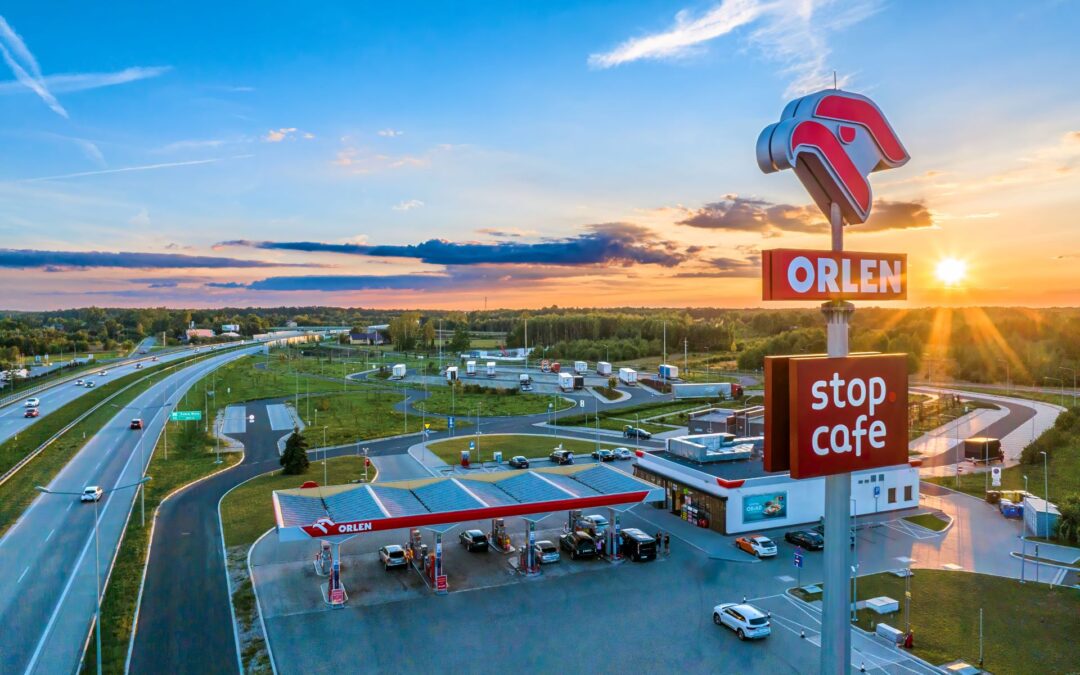
Main image credit: Orlen press materials

Alicja Ptak is deputy editor-in-chief of Notes from Poland and a multimedia journalist. She has written for Clean Energy Wire and The Times, and she hosts her own podcast, The Warsaw Wire, on Poland’s economy and energy sector. She previously worked for Reuters.