Keep our news free from ads and paywalls by making a donation to support our work!

Notes from Poland is run by a small editorial team and is published by an independent, non-profit foundation that is funded through donations from our readers. We cannot do what we do without your support.
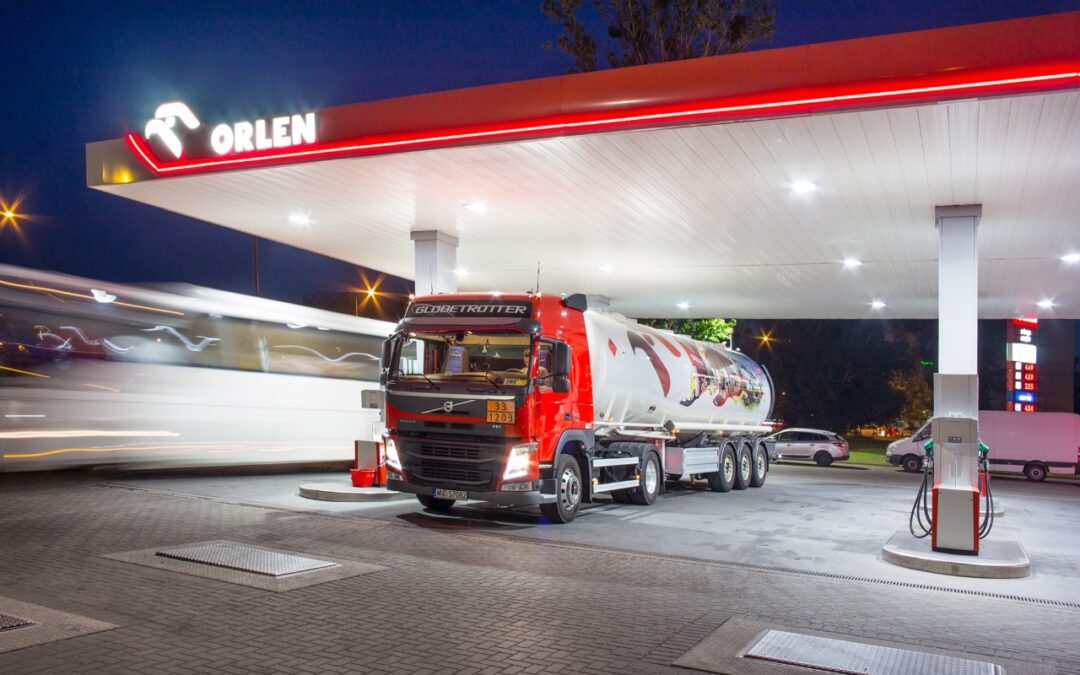
Poland’s government has approved a one-off tax on excess profits earned by fuel companies following a surge in energy prices triggered by the war in Iran. State energy giant Orlen is expected to bear the bulk of the levy.
The proposed tax, which still requires parliamentary approval and the signature of opposition-aligned President Karol Nawrocki, would apply to profits generated between March and December 2026. The government expects the measure to raise around 4 billion zloty (€940 million).
💬 Premier @donaldtusk ⤵️
Dzisiaj podejmiemy decyzję o podatku od nadzwyczajnych zysków. Firmy w dużej mierze sfinansują koszt akcji CPN, same na tym nie stracą, ale też nie zarobią. pic.twitter.com/Gtb8eDVJPI— Kancelaria Premiera (@PremierRP) June 16, 2026
Under the draft law, which was approved by the cabinet on Tuesday, excess profits would be defined as revenue from liquid fuel sales exceeding the amount that would have been generated using a company’s average 2025 fuel sales margin, increased by 20%. Such windfall gains would be taxed at a rate of 60%.
Announcing the plans, the finance ministry said the levy was intended as a response to “exceptional economic and geopolitical conditions that have led to above-average financial results in a specific segment of the fuel sector, not resulting from improved operational efficiency…but from a supply shock.”
“Against this backdrop, a certain structural injustice becomes clearly apparent,” they added, with the economic costs falling on the state budget while fuel companies benefit from exceptionally high margins. “The proposed regulation aims to eliminate this fundamental asymmetry.”
The government initially proposed a tax rate of 75%, but reduced it to 60% following consultations with industry representatives.
The Polish Organisation of Oil Industry and Trade (POPiHN) had argued that the rate should match the 33% solidarity contribution imposed on coal mining companies in 2022, when fuel prices also rose sharply following Russia’s invasion of Ukraine.
Fuel companies ANWIM, Unimot Paliwa, Danske Gas and Citronex Trans Energy noted the windfall tax would be imposed in addition to Poland’s 19% corporate income tax. Under the original 75% proposal, the combined burden would have reached 94%, which they described as a de facto confiscation of assets, reported Business Insider Polska.
The government has approved plans for a windfall tax of 33% on excess profits made by coal firms last year amid the energy crisis.
It expects the one-off levy to bring in 2bn zloty (€450m), which will be used to lower electricity prices for households https://t.co/QxS70cD114
— Notes from Poland 🇵🇱 (@notesfrompoland) July 11, 2023
According to a regulatory impact assessment, state energy giant Orlen is expected to account for about 60% of the tax base for the windfall tax, with the remaining 40% generated by other market participants.
However, for the tax to come into force, it must be approved by parliament, where Prime Minister Donald Tusk’s ruling coalition holds a majority, and signed by Nawrocki, who is aligned with the right-wing opposition and has vetoed government bills at a record rate.
Nawrocki has previously opposed several fiscal measures, including tax increases, complicating the government’s efforts to address a sharp rise in public debt. He did, however, approve a new levy on banks.
Karol Nawrocki has now issued more vetoes than any other president in Polish history
Three vetoes on Thursday took his total to 37 in just ten months since taking office, surpassing the 35 issued by Aleksander Kwaśniewski during his ten years as president https://t.co/xf27K8Fyn6
— Notes from Poland 🇵🇱 (@notesfrompoland) June 12, 2026
Global fuel prices began rising sharply in late February after the United States and Israel launched attacks on Iran, fuelling instability across the Middle East, a region that accounts for a significant share of global oil and gas production.
Iran then launched retaliatory strikes on Israel, US bases and American allies in the region. It also effectively closed the Strait of Hormuz, where normally around 20% of global oil and liquefied natural gas (LNG) supplies are transported out of the Middle East.
In response to rising fuel costs, Poland introduced a series of measures to limit the impact on consumers, including cuts in VAT and excise duties on fuels and the introduction of a price cap to prevent companies from absorbing gains resulting from the tax cuts.
The finance ministry estimates that the fuel excise duty cut, which ended on 15 June, cost the state about 700 million zloty a month, while the VAT reduction, set to expire at the end of this month, reduced revenues by another 900 million zloty per month.
Poland has introduced maximum retail prices for petrol and diesel as part of measures to shield consumers from the surge in fuel costs caused by the conflict in the Middle East.
Retailers caught selling above the cap face fines of up to 1 million zloty https://t.co/g9FjdpUXm0
— Notes from Poland 🇵🇱 (@notesfrompoland) March 31, 2026
Notes from Poland is run by a small editorial team and published by an independent, non-profit foundation that is funded through donations from our readers. We cannot do what we do without your support.
Main image credit: Orlen (press materials)

Alicja Ptak is deputy editor-in-chief of Notes from Poland and a multimedia journalist. She has written for Clean Energy Wire and The Times, and she hosts her own podcast, The Warsaw Wire, on Poland’s economy and energy sector. She previously worked for Reuters.