Keep our news free from ads and paywalls by making a donation to support our work!

Notes from Poland is run by a small editorial team and is published by an independent, non-profit foundation that is funded through donations from our readers. We cannot do what we do without your support.
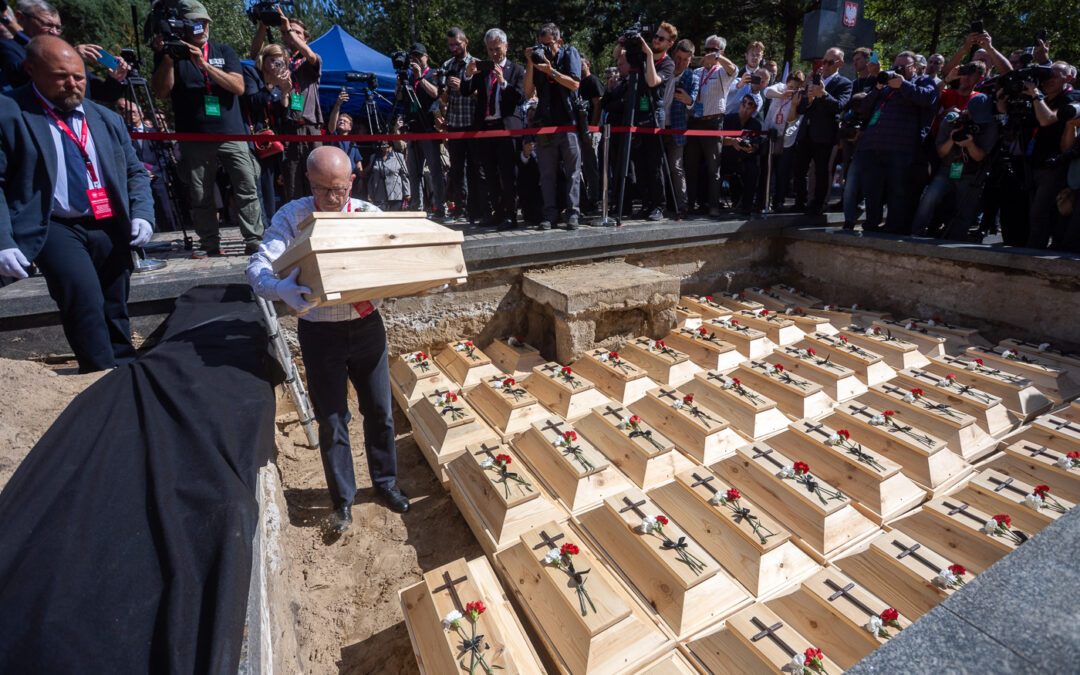
The remains of 55 Poles – around half of them children – massacred by Ukrainian nationalists in World War Two have been reburied at a ceremony in Ukraine attended by political and religious figures from both countries.
The victims, many of whose bones show signs of brutal deaths, were exhumed this summer after Ukraine recently ended a moratorium on searches for tens of thousands of victims of the so-called Volhynia massacres who are believed to remain buried in unmarked mass graves.
“This is an important moment for [the victims’] families, but also the Polish state, because this funeral follows decades of waiting,” said Polish culture minister Marta Cienkowska at the ceremony in Ostrówki (Ostrovky in Ukrainian), a depopulated former village that, before the war, was part of Poland and now lies in Ukraine.
“Poland has the right and obligation to speak about the crimes committed against its citizens. It has the obligation to commemorate the victims, search for their remains, and provide them with a dignified burial…We will continue this work…everywhere that the graves of the victims of the Volhynian crimes still remain.”
Pogrzeb ofiar Zbrodni Wołyńskiej w Ostrówkach i Woli Ostrowieckiej
Na cmentarzu w Ostrówkach na terytorium Ukrainy odbyła się uroczystość pogrzebowa 55 ofiar zbrodni dokonanej 30 sierpnia 1943 roku. W uroczystości, zorganizowanej w 83. rocznicę tragicznych wydarzeń,… pic.twitter.com/4dXPOj4m7y
— Ministerstwo Kultury i Dziedzictwa Narodowego (@kultura_gov_pl) August 30, 2026
Others to attend the reburial included deputy Ukrainian culture minister Ivan Verbytskyi; Vitaly Skomarovsky, the bishop of Lutsk and president of Ukraine’s Roman Catholic episcopate; Piotr Zgorzelski, the deputy speaker of the Sejm, Poland’s lower house of parliament; and former Polish Prime Minister Mateusz Morawiecki.
Karol Polejowski, the deputy head of Poland’s state Institute of National Remembrance (IPN), which led the exhumation work, said that the presence of Ukrainian representatives “fills me with optimism for the future”.
While Polish President Karol Nawrocki did not attend, one of his advisors, Jakub Banaszek, read a letter on his behalf, quoted by the Polish Press Agency (PAP).
“We will never forget those who died in agony simply because they were Poles,” wrote Nawrocki. “We will not cease our efforts to ensure that all our compatriots murdered by members of the OUN-UPA are properly buried and commemorated.”
✝️ W 8⃣3⃣. rocznicę zbrodni dokonanej przez ukraińskich szowinistów, na cmentarzu w Ostrówkach pochowaliśmy ofiary ludobójstwa na Wołyniu.
🔻🔻🔻 pic.twitter.com/5oh3uiCKX4
— Instytut Pamięci Narodowej (@ipngovpl) August 30, 2026
The Volhynia massacres, in which around 100,000 Poles were killed, were led by the Ukrainian Insurgent Army (UPA), which was a partisan group founded by a faction of the Organisation of Ukrainian Nationalists (OUN) faithful to nationalist leader Stepan Bandera.
They sought to ethnically cleanse areas that they saw as Ukrainian territory by wiping out other ethnic groups, in particular the large Polish population.
Massacres took place in dozens of villages, including Ostrówki and the neighbouring Wola Ostrowiecka (Volya Ostrovetska in Ukrainian), where on 30 August 1943 the UPA killed over 1,000 Poles and razed the villages to the ground.
Exhumations previously took place on the site of the two villages in the 1990s, and again in 2011 and 2015, uncovering the remains of hundreds of victims. However, hundreds more are believed to remain buried.
In 2017, Ukraine imposed a ban on searches for victims on its territory in response to the dismantling of a monument to the UPA in Poland. However, in a diplomatic breakthrough last year, it allowed them to resume, including granting permission in December for work in Ostrówki and Wola Ostrowiecka.
In April this year, mass graves were discovered there, with exhumations then beginning in July. Earlier this month, the IPN announced the results of that work.
They uncovered the remains of 55 victims, 26 of them children (mostly under 12 years of age, with the youngest a few months old) and 20 women. In the Volhynia massacres as a whole, the majority of victims were women and children.
The remains of a further 55 victims of massacres by Ukrainian nationalists during WWII have been exhumed in Ukraine.
Around half were children, and most show signs of brutal deaths, including skulls pierced with farming tools https://t.co/LbLPzJcG1b
— Notes from Poland 🇵🇱 (@notesfrompoland) August 8, 2026
The locations and conditions of the remains reveal much about the manner of their death. Most were buried “at random” without coffins, which is consistent with contemporary accounts that they were killed in a barn and then thrown into a mass burial pit.
Most of the remains, in particular skulls, show signs of injuries that are also consistent with contemporary accounts, which said that victims were ordered to lie on the ground before being killed with farm tools, including hammers for slaughtering cattle.
Material from the bones has been secured for genetic testing, which was recently used for the first time to identify massacre victims exhumed at another location in Ukraine last year.
Poland has for the first time used DNA testing to identify the remains of Poles massacred by Ukrainian nationalists in WWII.
“After more than 80 years, families are receiving the answer they have awaited for generations,” says the culture minister https://t.co/c1gM3kQ83s
— Notes from Poland 🇵🇱 (@notesfrompoland) July 14, 2026
The Volhynia massacres have long been a point of tension between Poland, which recognises them as a genocide, and Ukraine, which rejects that label. The decision by Kyiv to allow exhumations to resume last year was regarded as a major step towards reconciliation.
However, that process was undermined in May this year, when Ukrainian President Volodymyr Zelensky decided to name a military unit after the “heroes of the UPA”. That prompted an angry response from Warsaw, where Zelensky’s counterpart Karol Nawrocki stripped him of Poland’s highest honour.
In his letter read at Sunday’s ceremony, Nawrocki warned those who “continue the tradition of Banderite ideology” that they “place themselves outside the community of citizens of the free, civilised world” and are sending “a clear sign of hostility towards Poland and Poles”.
President Zelensky has signed a law establishing a national pantheon to commemorate Ukrainian heroes, prompting Poland to again warn that Ukraine "will have a huge problem" integrating into the EU if it honours figures associated with massacres of Poles https://t.co/fN7Zgbovvu
— Notes from Poland 🇵🇱 (@notesfrompoland) August 24, 2026
Since the crisis broke out in May, there have been efforts to reach a diplomatic solution. Last month, Zelensky pointed specifically to the exhumation work in Ostrówki and Wola Ostrowiecka as evidence that “Ukraine is doing its part to fairly establish the facts about those who were killed in those years”.
Subsequently, he announced a five-point plan to alleviate the crisis, including allowing more exhumations and opening up historical archives. Poland welcomed the move but said that it would wait to see how it was implemented in practice.
Earlier this month, Zelensky signed a law establishing a new national pantheon of Ukrainian heroes. Poland has warned that the inclusion of figures associated with the massacres could have consequences for Ukraine’s ambitions to join the European Union.
A survey conducted this month by Rating Group, a Ukrainian research agency, which asked Ukrainians to name their country’s greatest hero found that Bandera was the fourth most popular choice, having been chosen by 11% of respondents.
Notes from Poland is run by a small editorial team and published by an independent, non-profit foundation that is funded through donations from our readers. We cannot do what we do without your support.
Main image credit: Sławek Kasper/IPN (under CC BY-SA 4.0)

Daniel Tilles is editor-in-chief of Notes from Poland. He has written on Polish affairs for a wide range of publications, including Foreign Policy, POLITICO Europe, EUobserver and Dziennik Gazeta Prawna.