Keep our news free from ads and paywalls by making a donation to support our work!

Notes from Poland is run by a small editorial team and is published by an independent, non-profit foundation that is funded through donations from our readers. We cannot do what we do without your support.
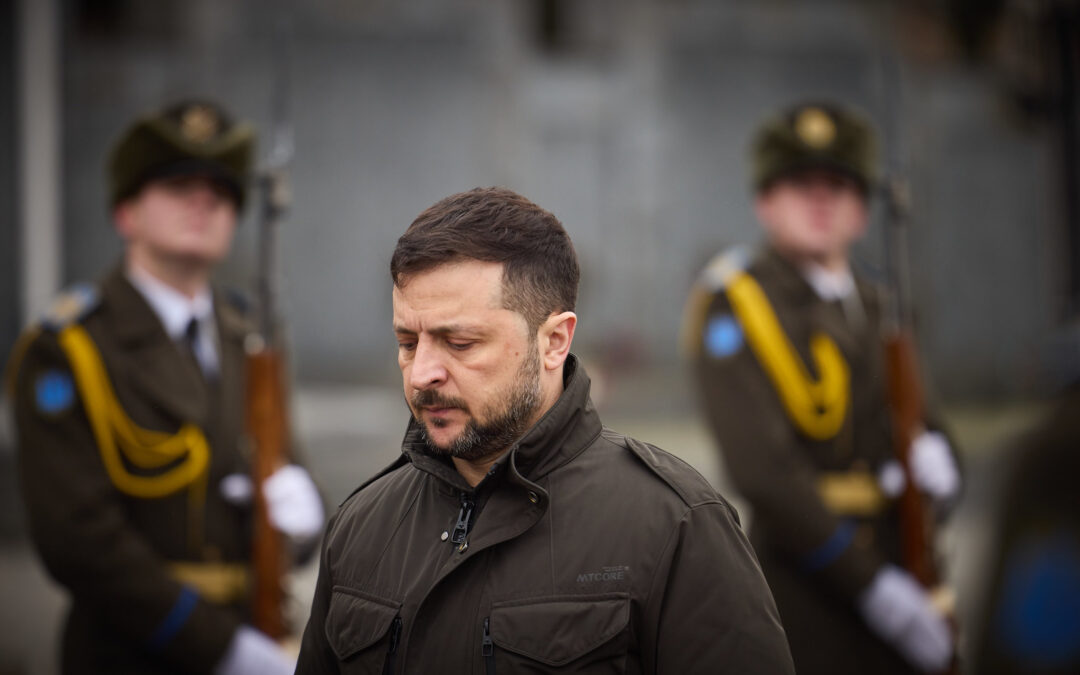
Polish President Karol Nawrocki has announced that he will strip his Ukrainian counterpart, Volodymyr Zelensky, of Poland’s highest honour in response to Zelensky naming a military unit after a group that led massacres of ethnic Poles during World War Two.
The decision follows weeks of anger in Poland over the issue and failed efforts by Warsaw and Kyiv to reach a diplomatic solution. It also comes days before Zelensky is due to visit Poland for a major international conference on Ukraine’s postwar recovery.
Nawrocki’s move was immediately condemned by the Ukrainian foreign minister, Andrii Sybiha, who called it “reckless” and a “strategic mistake” that would “only benefit Moscow”.
Decyzja Prezydenta RP Karola Nawrockiego w sprawie odebrania Orderu Orła Białego Prezydentowi Ukrainy Wołodymyrowi Zełenskiemu. pic.twitter.com/8gr1iRhM3y
— Kancelaria Prezydenta RP (@prezydentpl) June 19, 2026
“I have decided to revoke the Order of the White Eagle from the President of Ukraine,” declared Nawrocki, a conservative who took office last year, in an announcement on Friday evening.
However, he emphasised that “this decision is not directed against the Ukrainian people” and “does not signify a change in the strategic direction of Polish security policy”.
“We have supported and continue to support Ukraine because we know that Russian aggression poses a threat to the security of Poland and all of Europe,” said the Polish president. “Nothing has changed in this assessment.”
The controversy began in late May, when Zelensky’s office announced that he had renamed a special forces unit in honour of the Ukrainian Insurgent Army (UPA).
The UPA is widely revered in Ukraine for its role in fighting against Moscow-backed Soviet rule. However, in Poland it is associated with the Volhynia massacres, in which up to 100,000 Polish civilians – mostly women and children – were slaughtered, often with great brutality.
Poland has officially recognised the massacres as a genocide. But Ukraine rejects that label, and also argues that the massacres took place in the context of long-standing anti-Ukrainian policies by the prewar Polish state and that Polish partisan units massacred Ukrainian civilians during the war.
President @NawrockiKn has announced plans to strip @ZelenskyyUa of the Order of the White Eagle, Poland’s highest honour, after the Ukrainian president named a military unit after a group that led massacres of ethnic Poles during WWII https://t.co/kdfpMhnina
— Notes from Poland 🇵🇱 (@notesfrompoland) May 29, 2026
Shortly after Zelensky’s decision was announced, Nawrocki declared that he intended to strip the Ukrainian president of the Order of the White Eagle, which he had received from Nawrocki’s predecessor, Andrzej Duda, in 2023.
That prompted Ukraine to seek dialogue with Poland in an effort to defuse the situation. The head of Zelensky’s office, Kyrylo Budanov, visited Poland for talks with Nawrocki’s staff and the Polish government in an effort to find a solution.
However, there has been no diplomatic breakthrough, with Poland insisting that Ukraine must rename the unit, something Kyiv has so far been unwilling to do.
Ukraine's foreign minister has called for dialogue with Poland over President Zelensky's decision to name a military unit after the UPA, which led massacres of Poles during WWII.
He insists there was "absolutely no anti-Polish intent" behind the decision https://t.co/QtKeFCo3XR
— Notes from Poland 🇵🇱 (@notesfrompoland) June 3, 2026
“Facts are not subject to negotiation; they do not change with political circumstances or necessities,” said Nawrocki in his announcement today. “The facts are that at least 100,000 Polish citizens were murdered by the UPA.”
“They were not soldiers on the battlefield. They were defenceless civilians. They were murdered brutally and savagely,” added the Polish president, who is an academic historian by training and previously headed Poland’s state Institute of National Remembrance (IPN).
“That is why the Ukrainian authorities’ decision to glorify the UPA is not only outrageous. It is also incomprehensible and deeply disappointing. It hurts not only our historical memory. It also undermines the trust built up over the years. It strikes at the very foundation of reconciliation.”
Poland's state historical institute has criticised remarks by the head of its Ukrainian counterpart about massacres of Poles by Ukrainians in WWII.
He said they are regarded in Ukraine as a "local episode" and suggested they do not constitute a genocide https://t.co/MAi6RhpRDL
— Notes from Poland 🇵🇱 (@notesfrompoland) February 11, 2026
Shortly after Nawrocki’s announcement, Ukraine’s foreign minister, Sybiha, wrote on social media that the Polish president’s decision was “a strategic mistake from which only Moscow benefits”.
“We regret that emotions have prevailed in Warsaw and forced Polish politicians to take unjustified, impulsive and contemptuous steps not even towards President Zelensky, but primarily towards the Ukrainian state,” he added.
Sybiha pointed to recent efforts by Poland and Ukraine to resolve their differences over difficult periods of their mutual history, including Kyiv permitting the resumption of efforts to exhume Polish victims of the Volhynia massacres who remain buried in unmarked mass graves in Ukraine.
Poland is next week due to host the Ukraine Recovery Conference, a major international gathering devoted to supporting Ukraine’s recovery after the war with Russia ends. Zelensky is due to attend the event in the Polish city of Gdańsk, though that may now be at risk following Nawrocki’s decision.
While the right to award and withdraw the Order of the White Eagle is the prerogative of the president, there has been legal debate over whether a countersignature from Prime Minister Donald Tusk is also necessary.
Tusk and his government are ardently opposed to Nawrocki on domestic political affairs. However, they have also been highly critical of Zelensky’s decision.
Nevertheless, Tusk has taken a less confrontational line than Nawrocki, expressing hope that a diplomatic solution can be reached and warning that Russia is the only beneficiary of Polish-Ukrainian tensions.
Three hours after Nawrocki made his announcement, Tusk wrote on social media: “The conflict between Poland and Ukraine delights Putin and shocks our allies. The task of Presidents Zelensky and Nawrocki is to calm emotions, not to stoke tensions. The front line runs elsewhere.”
Konflikt między Polską i Ukrainą cieszy Putina i szokuje naszych sojuszników. Zadaniem prezydentów Zelenskiego i Nawrockiego jest tonowanie emocji, a nie podsycanie napięcia. Linia frontu przebiega gdzie indziej.
— Donald Tusk (@donaldtusk) June 19, 2026
Notes from Poland is run by a small editorial team and published by an independent, non-profit foundation that is funded through donations from our readers. We cannot do what we do without your support.
Main image credit: President of Ukraine/Flickr

Daniel Tilles is editor-in-chief of Notes from Poland. He has written on Polish affairs for a wide range of publications, including Foreign Policy, POLITICO Europe, EUobserver and Dziennik Gazeta Prawna.