Keep our news free from ads and paywalls by making a donation to support our work!

Notes from Poland is run by a small editorial team and is published by an independent, non-profit foundation that is funded through donations from our readers. We cannot do what we do without your support.
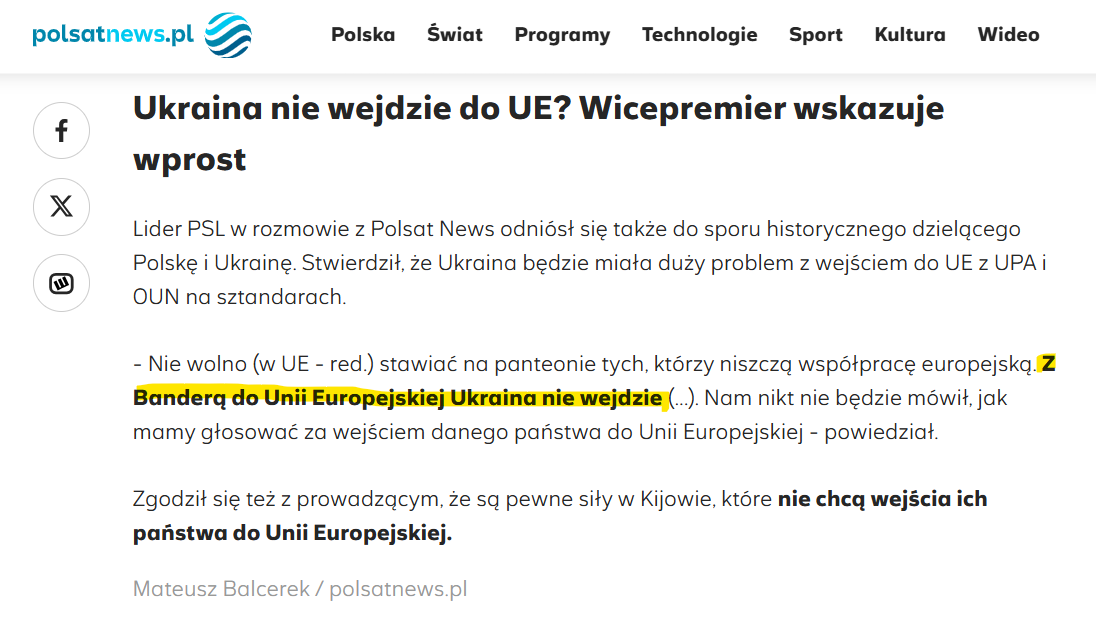
Polish, Ukrainian and English-language media outlets have widely reported this week that Poland’s deputy prime minister, Władysław Kosiniak-Kamysz, said in an interview on Monday that: “With Bandera, Ukraine will not enter the EU.”
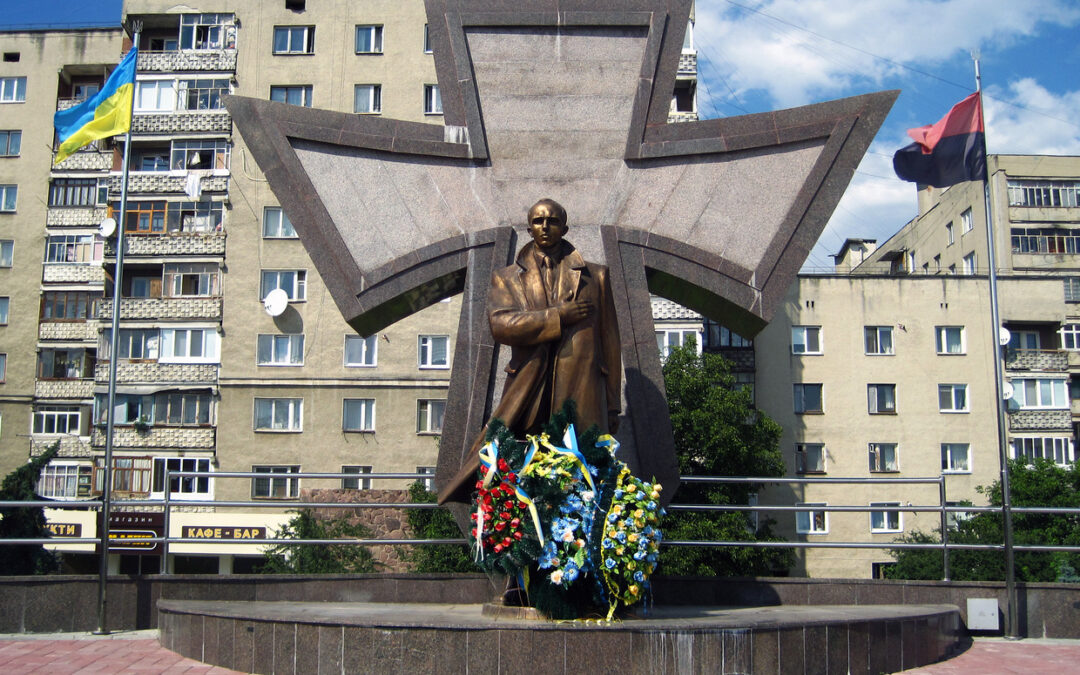
The alleged quote refers to Ukrainian nationalist leader Stepan Bandera, who is revered by some in Ukraine as a symbol of the struggle for independence but whose followers were also responsible for massacres of Poles, Jews and others during World War Two.
However, Kosiniak-Kamysz did not actually say the words attributed to him. They were spoken by the person interviewing him. Below, we explain what was actually said during the interview and how it has come to be misinterpreted.
"Poland threatens to block Ukraine's European integration: "With Bandera, Ukraine will not join the EU." Deputy Prime Minister and Minister of National Defense of Poland Wladyslaw Kosiniak-Kamysz stated that Poland will not agree to Ukraine's accession to the European Union… pic.twitter.com/2AApBV8qTM
— Ivan Katchanovski (@I_Katchanovski) June 30, 2026
First, the context. Poland and Ukraine have been embroiled in a dispute since late May, when President Volodymyr Zelensky named a military unit after the “heroes of the Ukrainian Insurgent Army (UPA).
In Ukraine, the UPA is remembered primarily for its role in fighting for Ukrainian independence from Moscow-imposed Soviet rule. In Poland, however, it is associated with the Volhynia massacres, in which the UPA led the slaughter of around 100,000 ethnic Polish civilians, mostly women and children.
In response to Zelensky’s decision to rename the unit, Polish President Karol Nawrocki stripped him of Poland’s highest honour, the Order of the White Eagle. That led Zelensky to cancel a planned trip to Poland to attend the Ukraine Recovery Conference that was held in the city of Gdańsk last week.
Then, last Sunday, the situation escalated further when Zelensky announced plans to create a new Ukrainian National Pantheon that would include great historical figures. “No one will dictate which heroes we should honour,” he declared.
Zelensky’s actions in recent weeks have prompted many Polish politicians – especially among the right-wing opposition but also some figures from the more liberal ruling coalition – to suggest that Poland should respond by blocking Ukraine’s accession process to join the European Union.
In an interview on Monday with Polsat, a leading Polish broadcaster, Kosiniak-Kamysz was asked about this. According to widespread media reports, he responded by saying: “With Bandera, Ukraine will not enter the EU.”
The quotation appeared in reports by major Polish outlets, including Gazeta Wyborcza, Onet, Radio Zet and Interia.
It was also repeated by English-language publications such as the Kyiv Independent and New Voice of Ukraine, as well as by Ukrainian-language media, including Hromadske Radio, Ukrainska Pravda and the Ukrainian service of Polish Radio.
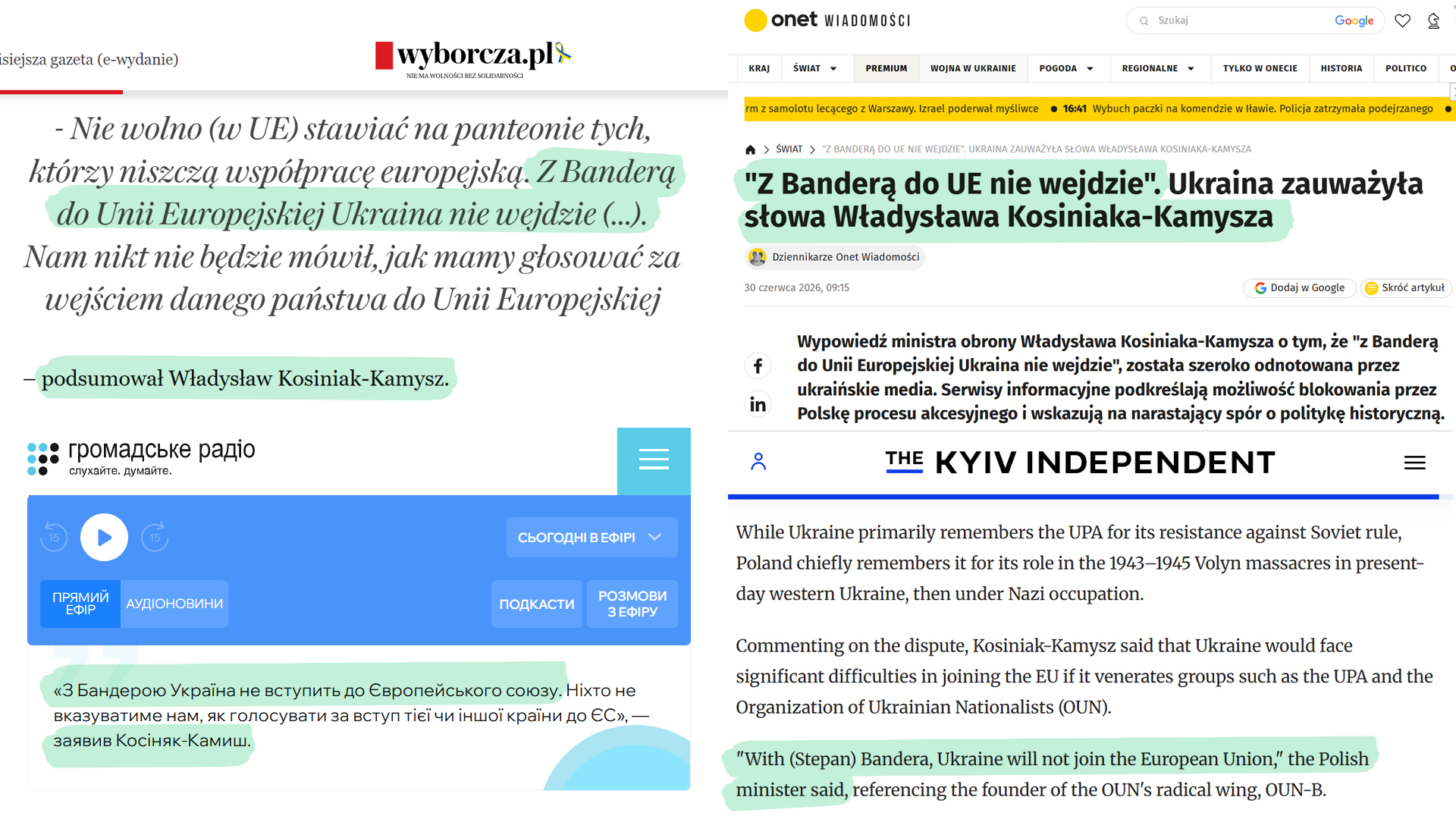
However, if one watches the interview, which is available for free on the Polsat News website, it reveals that the words “With Bandera, Ukraine will not enter the EU” were actually spoken by the interviewer, Marek Tejchman, as part of a question to Kosiniak-Kamysz.
Kosiniak-Kamysz did not answer by endorsing that proposition. Instead, he referred to comments previously made by Zelensky.
“It’s like President Zelensky said: ‘No one will tell us who we can honour,’ just like no one will tell us how to vote on the entry of any state into the European Union,” Kosiniak-Kamysz said.
Earlier in the interview, he had also warned that, in the EU, “you can’t build a pantheon to those who destroy European cooperation”, and that countries seeking membership should “not build national identity…on events or people or systems that in some way raise objections or pain among EU partners or sow falsehoods”.
– Ja zaproponowałem partnerskie podejście. MiG-i za drony (…), nie ma MiG-ów dla Ukrainy, bo nie ma dronów – powiedział w programie "Gość Wydarzeń" wicepremier @KosiniakKamysz. @mtejchman #GoscWydarzen https://t.co/vVyjVg4xlN
— PolsatNews.pl (@PolsatNewsPL) June 29, 2026
But nowhere in his remarks did Kosiniak-Kamysz mention Bandera or explicitly say that Ukraine could not enter the EU if it honours him.
So, why did Polish and international media attribute those words to him? The apparent source of the error is Polsat News’ own written report accompanying the interview.
While the embedded video correctly showed the full exchange, the article attributed the interviewer’s words about Bandera to Kosiniak-Kamysz and presented them as a direct quotation of him.
Subsequent reports by Polish and international media appear to have repeated the wording from the article rather than the video itself.
Stepan Bandera was the leader of a radical faction of the Organisation of Ukrainian Nationalists (OUN-B) during World War Two. It was the OUN-B that, in turn, established the UPA.
Poland has long condemned the continued commemoration of Bandera and the organisation he led by some officials and institutions in modern-day Ukraine.
Nawrocki and the right-wing Polish opposition with which he is aligned have proposed laws banning the propagation of “Banderism” in Poland by placing it alongside the other prohibited ideologies of Nazism, fascism and communism.
Ukraine has criticised a law proposed by Poland's president that would criminalise promotion of historical Ukrainian nationalist ideologies, equating them with Nazism and communism
It warns of "retaliatory measures" if the bill is passed https://t.co/TaX2Vj5z8v
— Notes from Poland 🇵🇱 (@notesfrompoland) October 2, 2025
In order for a new member state to join the EU, the consent of all existing member states is needed. Leading Polish politicians have long warned that they would not allow Ukraine to enter until issues relating to Polish-Ukrainian history are resolved, including Kosiniak-Kamysz himself in 2024.
Last year, while campaigning for the presidency, Nawrocki likewise said that he “does not envision Ukraine in either the EU or NATO until important civilisational issues for Poland are resolved”.
“A country that is not able to account for a very brutal crime against 120,000 of its neighbours cannot be part of international alliances,” added Nawrocki.
Poland will not allow Ukraine to join the EU until the issue of the Volhynia massacres in WWII is "resolved", says the Polish deputy PM
The massacres, in which Ukrainian nationalists killed ethnic Poles, have long caused tensions between the two countries https://t.co/cPEArLdvDL
— Notes from Poland 🇵🇱 (@notesfrompoland) July 24, 2024
Notes from Poland is run by a small editorial team and published by an independent, non-profit foundation that is funded through donations from our readers. We cannot do what we do without your support.
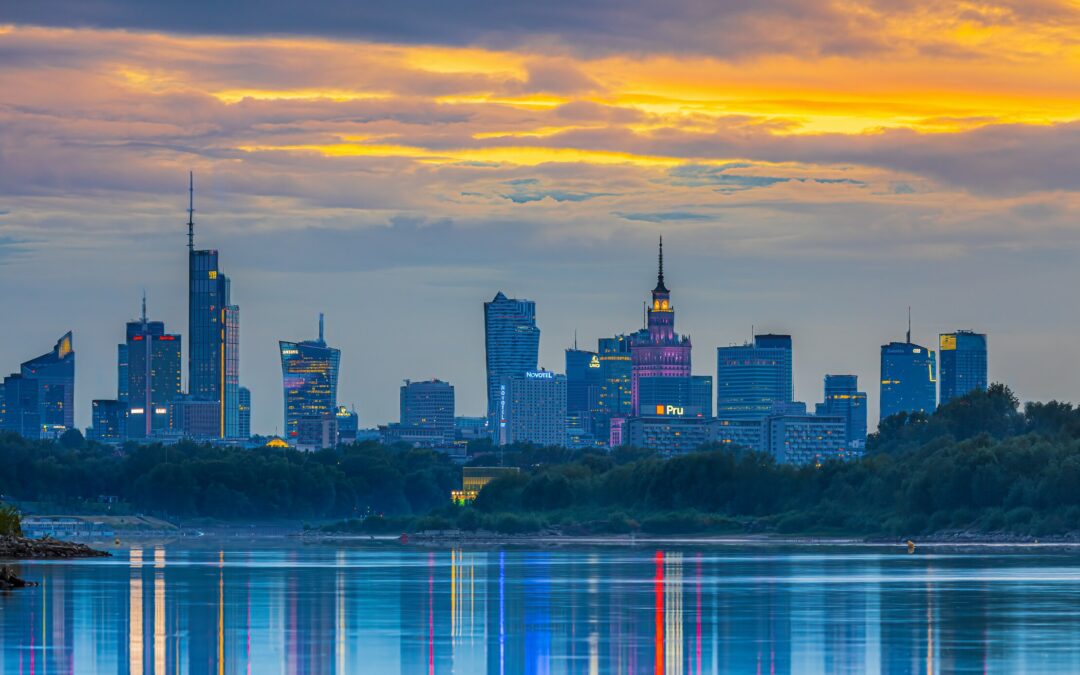
Main image credit: Vart/Wikimedia Commons (under CC BY 3.0)
Alicja Ptak is deputy editor-in-chief of Notes from Poland and a multimedia journalist. She has written for Clean Energy Wire and The Times, and she hosts her own podcast, The Warsaw Wire, on Poland’s economy and energy sector. She previously worked for Reuters.