Keep our news free from ads and paywalls by making a donation to support our work!

Notes from Poland is run by a small editorial team and is published by an independent, non-profit foundation that is funded through donations from our readers. We cannot do what we do without your support.
Demonstrations took place in around 25 Polish cities on Sunday against a “growing wave of hate and violence” against Ukrainians, who are Poland’s largest immigrant group.
The protests came after police data showed a significant increase in reported hate crimes against Ukrainians in Poland so far this year, including a number of high-profile incidents of verbal and physical aggression.
Sunday’s demonstrations, which took place under the slogan “Do Not Be Indifferent”, were organised by the Committee for the Defence of Democracy (KOD), an NGO, with support from other groups, including Amnesty International.
“[This is] a nationwide campaign aimed at expressing opposition to the growing wave of hate, xenophobia, nationalism and violence directed against Ukrainians and members of other minorities,” wrote KOD ahead of the events.
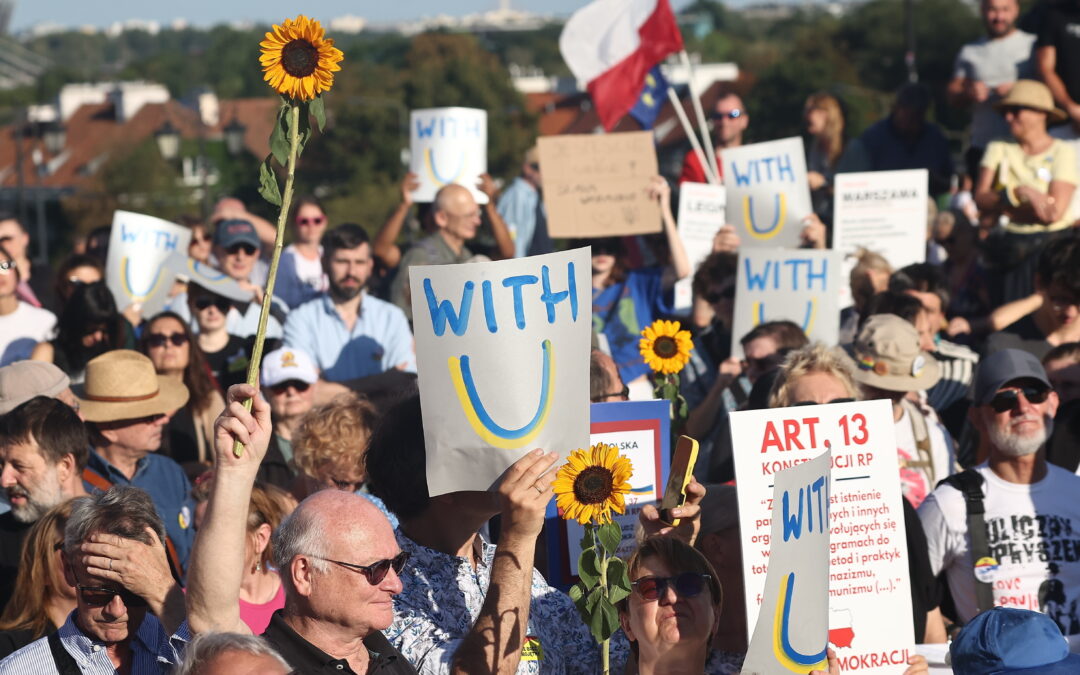
On Sunday, hundreds gathered on Warsaw’s Castle Square carrying Ukrainian and Polish flags and many waving signs saying “With U”, with the letter “U” coloured in Ukrainian national colours.
#Siódemka
Plac Zamkowy w Warszawie, protest w ramach:🛑 NIE BĄDŹMY OBOJĘTNI!
WSPÓLNIE PRZECIWKO NIENAWIŚCI!
W wielu miastach Polski wyszliśmy na ulice, żeby jasno powiedzieć: nie ma zgody na hejt, przemoc i agresję wobec Ukraińców.
W ostatnim czasie coraz częściej słyszymy… pic.twitter.com/kOfq4zBuGT
— Piotr #FBPE Fijałkowski (@piotr4913) August 9, 2026
In Wrocław, Poland’s third-largest city, local media reported that around 150 people attended a demonstration, carrying placards saying “Let’s defend our neighbours from the aggression and stupidity of others” and “Putin is the enemy, Ukraine is our neighbour”.
In Gdańsk, on Poland’s northern coast, around 300 people gathered, according to local media. However, they were also met with a small counter-demonstration of around a dozen people, led by the New Hope party that is part of Poland’s far-right Confederation (Konfederacja) opposition group.
The counter-protesters held a banner declaring “Solidarity with victims of mass immigration” and “Down with Bandera”, a reference to historical Ukrainian nationalist leader Stepan Bandera, who in Poland is associated with the massacres of around 100,000 Poles by Ukrainians during World War Two.
Separately, on Friday, a group of NGOs organised a demonstration against anti-Ukrainian violence outside the prime minister’s chancellery, during which they delivered a petition, signed by over 11,000 people, calling for the government to take “decisive action against xenophobic attacks”.
Police data published last month showed that the number of reported hate crimes against Ukrainians in Poland was 30% higher in the first half of this year compared to the same period in 2025.
Among those incidents have been a number of high-profile cases, including two 11-year-old Ukrainian girls being verbally abused by a man on a bus in the city of Bielsko-Biała and a violent attack on young Ukrainians by a group of Polish teenagers in Warsaw.
Ukrainians are by far Poland’s largest foreign national group, with around 1.6 million living in the country. While Poland welcomed Ukrainian refugees in 2022, there has been growing negative sentiment towards them recently, indicated in polls and through anti-Ukrainian rhetoric from prominent politicians.
Tenions have been stoked further by a diplomatic crisis that began in May, when President Volodymyr Zelensky named a Ukrainian military unit after a group responsible for massacring Poles during World War Two. That prompted Polish President Karol Nawrocki to strip Zelensky of Poland’s highest honour.
The number of reported hate crimes against Ukrainians in Poland is up 30% so far this year, police data show.
The figures come following recent high-profile cases of verbal and physical attacks against Ukrainians, who are Poland's largest immigrant group https://t.co/pcTsJddDz7
— Notes from Poland 🇵🇱 (@notesfrompoland) July 17, 2026
In particular, two far-right opposition parties, Confederation and Confederation of the Polish Crown (KKP), have used anti-Ukrainian rhetoric, while the largest opposition group, the national-conservative Law and Justice (PiS), has recently taken a tougher line towards Ukraine.
Last week, PiS announced that, if it returns to power, one of its first actions would be to deport Ukrainian conscription-age men who are not in legal employment. At one of Sunday’s protests, in Kraków, a demonstrator responded with a placard declaring “Deport xenophobia”.
Poland’s more liberal ruling coalition has condemned anti-Ukrainian rhetoric from the right-wing opposition. Last month, Prime Minister Donald Tusk called for a “war against this violence”, saying that “thugs and hooligans have gained courage, audacity and political patronage” from the opposition.
Poland’s largest opposition party, the national-conservative PiS, has called for Ukrainian men of conscription age who are not legally working to be deported to Ukraine.
The idea was criticised by the government, which called it "absurd" and "disgusting" https://t.co/Z4kArDeLXl
— Notes from Poland 🇵🇱 (@notesfrompoland) August 7, 2026
Notes from Poland is run by a small editorial team and published by an independent, non-profit foundation that is funded through donations from our readers. We cannot do what we do without your support.
Main image credit: Kuba Atys / Agencja Wyborcza.pl

Olivier Sorgho is senior editor at Notes from Poland, covering politics, business and society. He previously worked for Reuters.