Keep our news free from ads and paywalls by making a donation to support our work!

Notes from Poland is run by a small editorial team and is published by an independent, non-profit foundation that is funded through donations from our readers. We cannot do what we do without your support.
Poland and Lithuania are jointly preparing plans for the evacuation of one million or more residents of the Baltic states into Poland in the event of a war or other major crisis, amid growing concern in the region over potential Russian aggression.
On Monday, the two countries’ interior ministers met to discuss the issue following a recent large-scale Lithuanian mobilisation exercise that also involved Polish officials. The pair also addressed their joint response to the migration crisis on the borders orchestrated by Russia’s ally Belarus.
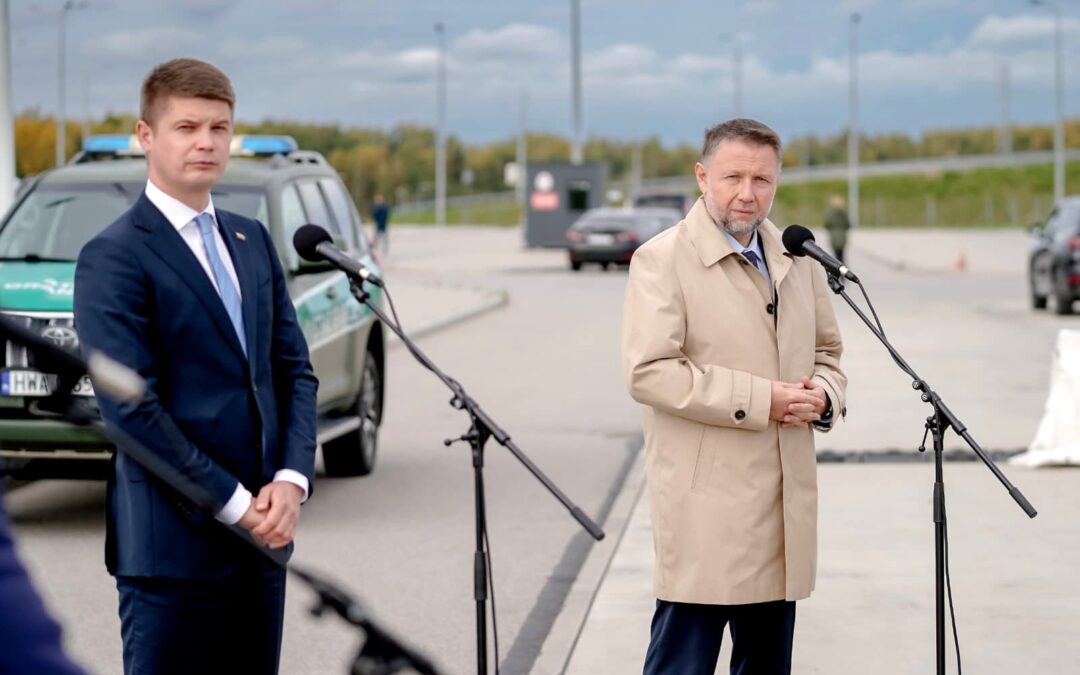
“In crisis situations, it is best to cooperate. It is best to prepare such plans through mutual understanding, thus attempting to address potential situations,” said Lithuanian interior minister Martynas Katelynas, speaking alongside his Polish counterpart, Marcin Kierwiński, at the Budzisko-Kalvarija border crossing.
“As for this crossing here, this place that connects us with Poland, this plan foresees approximately one million, and perhaps even more, refugees who will be able to be evacuated from our countries in the event of war,” he added.
The three Baltic states – Lithuania, Latvia and Estonia – are seen as a primary potential target for Russian aggression. NATO states, including Poland, have in recent months warned of the growing possibility of Moscow conducting some form of “provocation” against the alliance’s eastern members.
Lithuania last week finished a major exercise testing its national mobilisation system in the event of war or other crises. For the first time, it included elements relating to cross-border evacuation of civilians from the Baltic states to Poland.
Alongside thousands of Lithuanian officials, a 20-person Polish team, led by representatives of the interior ministry, took part in the exercise.
This has allowed Poland to develop “an agenda and action plan for what must be adjusted very quickly: cross-border evacuation plans, infrastructure and alternative border crossings in an emergency, as well as reception points”, said Kierwiński, adding that “we will begin intensive work” on implementation.
Poland already has extensive recent experience in receiving civilians fleeing conflict. In 2022, it became the primary destination for the millions of refugees fleeing Ukraine following Russia’s full-scale invasion.
Poland’s government and civil society quickly implemented measures to support the refugees, almost one million of whom remain in the country.
Almost 80% of Poles say they would want Poland to come to the aid of the Baltic states if they were attacked by Russia
The poll follows controversy over comments by a senior opposition figure casting doubt as to whether Poland should come to their defence https://t.co/l3dj02ETZ5
— Notes from Poland 🇵🇱 (@notesfrompoland) September 10, 2026
The two ministers also used their meeting to discuss their joint response to illegal migration. Both countries have been the target of a crisis engineered by Russia’s ally Belarus, which has encouraged and assisted tens of thousands of migrants – mainly from Asia and Africa – to try to cross into Poland, Lithuania and Latvia.
In response, Poland last year introduced checks on its borders with Lithuania and Germany. Those measures have been repeatedly extended, including last week, when Poland announced that they would remain in force until at least March 2027.
“Border controls with Germany and Lithuania allow us to catch people illegally crossing the border from the Baltic states,” said Kierwiński on Monday. “As soon as there are grounds to end these controls, we will discontinue them. But for now, we have decided that they will remain in place for at least another six months.”
Poland is reintroducing controls on its borders with Germany and Lithuania to prevent the “uncontrolled flow of migrants”, in particular those returned by Germany after entering illegally
"Poland’s patience is running out," says Prime Minister @donaldtusk https://t.co/Pttd3FvpHA
— Notes from Poland 🇵🇱 (@notesfrompoland) July 1, 2025
Katelynas emphasised that “Lithuania and Poland share a common goal: to ensure the protection of our borders and effectively prevent irregular migrants from moving through our countries and across the Schengen area”.
He also noted that an agreement between the two countries on cooperation between police, border guard and customs services is currently being finalised.
“Poland and Lithuania are like brothers and sisters who support each other and will continue to do so,” said Katelynas.
Kierwiński likewise expressed his satisfaction that the two countries “speak with one voice…because this part of Europe, the eastern flank of NATO and the EU, must speak with one voice to address and counter the threats posed by Russian imperialism and the difficult situation beyond our eastern border”.
EU chief @vonderleyen has thanked Poland for defending Europe from “cynical hybrid attacks” during a visit with PM @donaldtusk to the border with Belarus.
She emphasised the “urgency” of protecting the EU’s frontier from the “predator” Vladimir Putin https://t.co/O9bhmLha44
— Notes from Poland 🇵🇱 (@notesfrompoland) August 31, 2025
Last month, Poland’s prime minister, Donald Tusk, warned that, according to intelligence sources, Russia is planning drone and missile strikes on eastern NATO countries, which it would present as accidental.
Poland has already recently suffered airspace violations by Russian drones, a missile and a helicopter. It has also been the primary target for Russian sabotage operations in Europe.
In response, the Polish government has moved to expand the network of warning sirens along the Ukrainian border, launched a campaign informing the public how to respond to aerial threats, and started more clearly marking bomb shelters.
The Polish-Lithuanian border area, which sits between Belarus and the Russian exclave of Kaliningrad and is known as the Suwałki Gap, is seen as a potential target for Russia in the event of war. Poland and Lithuania held joint military exercises there in 2024 to test their defensive capabilities.
Notes from Poland is run by a small editorial team and published by an independent, non-profit foundation that is funded through donations from our readers. We cannot do what we do without your support.
Main image credit: MSWiA/X

Leo Greenberg is an assistant editor at Notes from Poland. Based in Kyiv, he writes about global politics, Europe and America, and the war in Ukraine.