Keep our news free from ads and paywalls by making a donation to support our work!

Notes from Poland is run by a small editorial team and is published by an independent, non-profit foundation that is funded through donations from our readers. We cannot do what we do without your support.
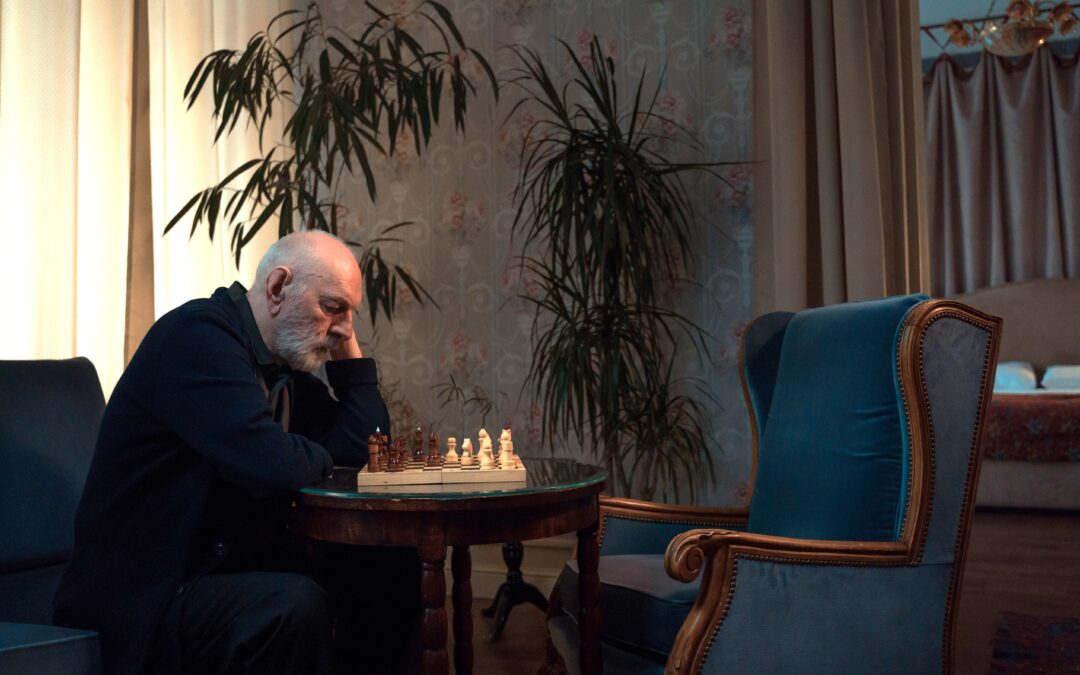
Over one third of households in Poland (35%) now consist of just a single person, up from 22% in 2006. Meanwhile, the proportion of households containing children has fallen to 25%, while the number of multigenerational households, in which elderly people live alongside children, has dropped significantly.
The Polish Economic Institute (PIE), which highlights the trends in a new report, says they are the result of both demographic and cultural shifts that are likely to continue in the coming years. It warns that the changes will bring increasing challenges for public policy relating to housing and care.
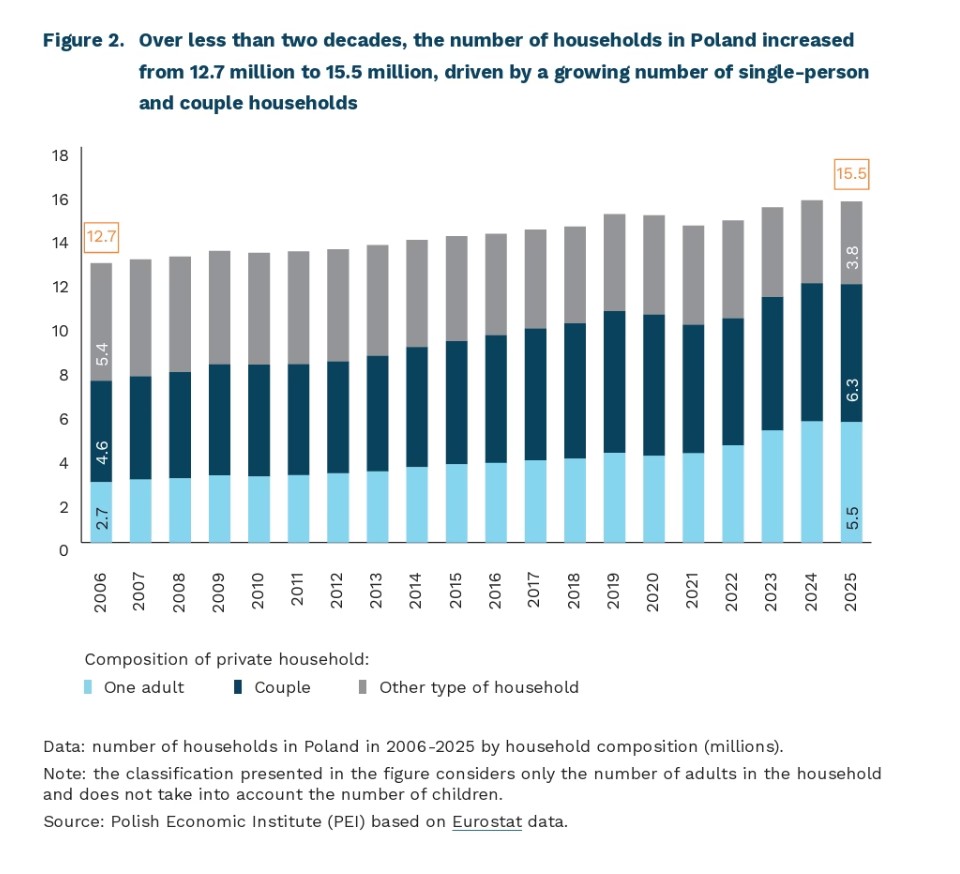
Source: Polish Economic Institute, Economic Weekly 24/2026.
PIE notes that, although Poland’s population is declining, the number of households (defined as at least one adult living in the same dwelling) increased from 12.7 million to 15.5 million between 2006 and 2025, according to Eurostat data.
Over the same period, the proportion of households containing children declined from 37% to 25%. And, although the proportion of households containing couples has risen from 36% to 40%, those consisting of couples without resident children rose from 18% to 25%.
Over the last two decades, Poland has seen a sharp decline in the number of births, which in 2025 fell to a new postwar low of around 238,000, down from 374,000 in 2006.
PIE notes that multigenerational living, once common in Poland, is become much rarer. In 2006, 15% of people aged 65 and over lived in households with children, compared with 6% in 2025. However, Poland’s figure remains above the European Union average of 3%.
Meanwhile, the proportion of over-65s living alone has increased from just under 10% to 13%.
At the same time, young people are more likely to be forming separate households, either alone or with a partner. The proportion of people aged 18-24 living alone rose from 3.5% to 9% between 2006 and 2025 while the share living as a couple increased from 6% to 11%.
Over half (53%) of people aged 25-34 in Poland now live with their parents, which is the fourth-highest level in the EU.
Poland's figure rose by eight percentage points between 2018 and 2023, the second-largest increase in the EU https://t.co/k5o0n3yv9q
— Notes from Poland 🇵🇱 (@notesfrompoland) February 3, 2026
PIE notes that these trends are “partly the result of cultural change and growing aspirations for independence, and partly a consequence of long-term demographic processes, including migration, rising life expectancy and declining fertility”.
The institute also warns that the shifts will “create increasing challenges for public policy”. The weakening of family support networks will mean that “a growing share of caregiving responsibilities is likely to shift from families to public institutions and the market for care services”.
Meanwhile, “the growing demand for residential independence will place increasing pressure on housing policy”. Poland has already been suffering housing pressures in recent years, with some of the fastest-rising costs in the EU for buying or renting property.
“Poland remains among the EU countries with the highest levels of housing overcrowding, a situation in which the number of occupants is too high relative to the available living space,” writes PIE. “Growing aspirations for residential independence are colliding with limited access to adequate housing.”
Poland recorded the largest increase in housing prices (19.3%) among all European countries last year, while Kraków had the biggest rise (28.1%) among cities.
Meanwhile, housing prices in Warsaw are now higher than in Rome, finds a new @Deloitte report https://t.co/Rt9GScX4Vx
— Notes from Poland 🇵🇱 (@notesfrompoland) September 2, 2025
Limited access to affordable housing has also contributed to the growing reluctance among young Poles to start a family, according to many experts. Poland’s fertility rate – meaning the average number of children that are born to a woman over her lifetime – fell to a new record low of 1.068 in 2025.
That is one of the lowest figures anywhere in the world and well below the so-called “replacement rate” – the figure needed to ensure that the population does not decline – which is generally defined as 2.1.
However, over the last decade, Poland has also seen levels of immigration that are unprecedented in its history and among the highest in Europe. There are now two million legal foreign residents in Poland, representing 5% of the population.
Poland’s fertility rate, already one of the lowest in the world, fell to a new record low of 1.07 in 2025, deepening concerns over the country's shrinking and ageing population https://t.co/OMGC1MpA5l
— Notes from Poland 🇵🇱 (@notesfrompoland) May 28, 2026
Notes from Poland is run by a small editorial team and published by an independent, non-profit foundation that is funded through donations from our readers. We cannot do what we do without your support.
Main image credit: cottonbro studio/Pexels

Alicja Ptak is deputy editor-in-chief of Notes from Poland and a multimedia journalist. She has written for Clean Energy Wire and The Times, and she hosts her own podcast, The Warsaw Wire, on Poland’s economy and energy sector. She previously worked for Reuters.