Keep our news free from ads and paywalls by making a donation to support our work!

Notes from Poland is run by a small editorial team and is published by an independent, non-profit foundation that is funded through donations from our readers. We cannot do what we do without your support.
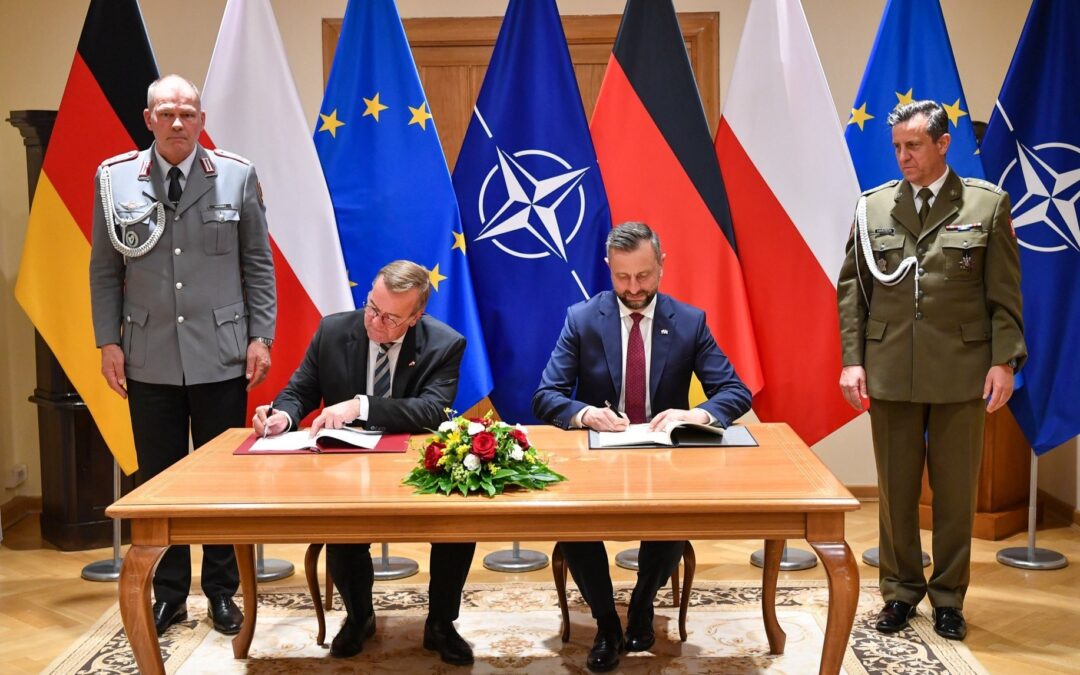
Poland and Germany have signed a bilateral security agreement that will see the two neighbours and NATO allies increase cooperation in areas such as military mobility, logistics infrastructure, maritime security in the Baltic Sea, and cybersecurity.
“We are adding another element to building a new security architecture in Europe,” declared Polish defence minister Władysław Kosiniak-Kamysz at the signing ceremony in Warsaw on Wednesday.
His German counterpart, Boris Pistorius, said that the agreement would see their two countries stand “shoulder to shoulder, as equals”. Both he and Kosiniak-Kamysz emphasised that an important element of the pact would be to bolster security on NATO’s eastern flank.
Minister obrony Niemiec Boris Pistorius: Bardzo dziękuję całemu zespołowi za współpracę przy tym porozumieniu, które dzisiaj zostało podpisane. To nowe porozumienie uwzględnia nie tylko nową sytuację, jeżeli chodzi o bezpieczeństwo. Otwieramy nowy rozdział naszej współpracy,… pic.twitter.com/MiHpkyzdEL
— Ministerstwo Obrony Narodowej 🇵🇱 (@MON_GOV_PL) June 17, 2026
Today’s agreement was concluded on the anniversary of Poland and Germany signing the Treaty of Good Neighbourship and Friendly Cooperation in 1991, which marked a breakthrough in relations between two countries that have a long and often difficult history.
That landmark treaty was followed in 2011 by an intergovernmental agreement to cooperate on defence within the EU and NATO frameworks. The new document signed on Wednesday effectively updates the 2011 agreement, adding further areas of cooperation.
However, unlike a treaty signed by Poland with France last year, it does not include any mutual security guarantees beyond existing commitments as members of NATO.
Poland and France have signed a treaty upgrading relations, including mutual security guarantees.
"Today we talk to the French as an equal partner," declared @donaldtusk.
The treaty “opens a new era” for Poland, France and Europe, said @EmmanuelMacron https://t.co/9pHOQVx4lI
— Notes from Poland 🇵🇱 (@notesfrompoland) May 9, 2025
Speaking to broadcaster RMF today, Polish deputy defence minister Paweł Zalewski said that the new agreement focused in particular on cooperation between the Polish and German armed forces, including measures facilitating the transit of German troops through Poland.
Zalewski said that this was particularly important in the context of pressure from the United States for Europe to take more responsibility for its own security, meaning that the defence of NATO’s eastern flank would increasingly fall upon Poland and Germany.
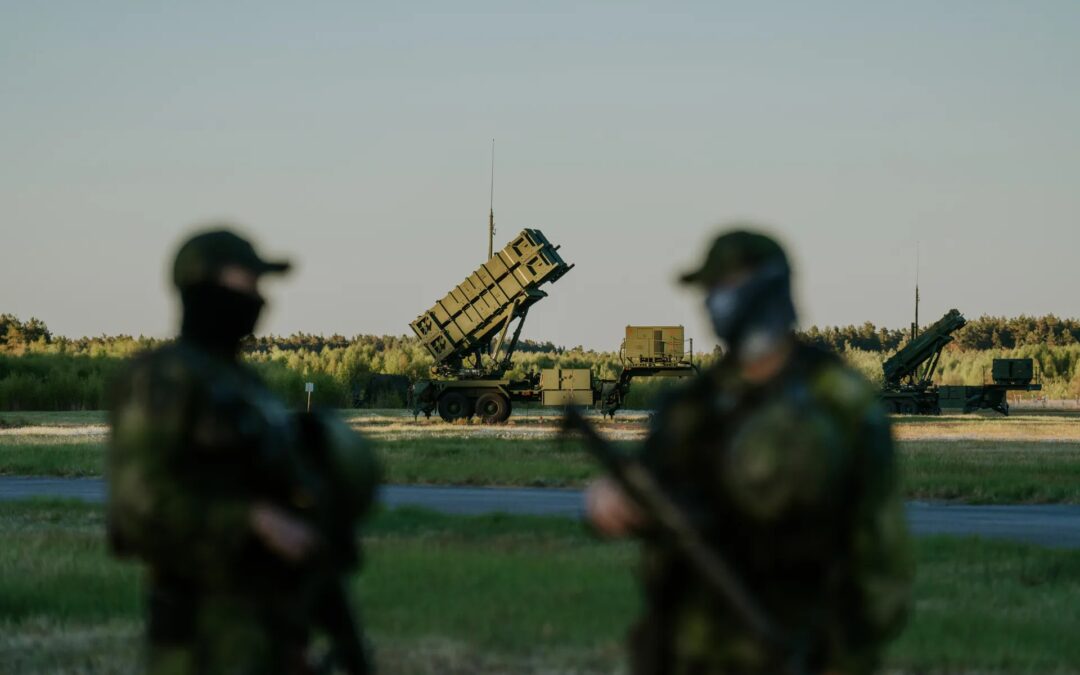
Last year, Germany announced plans to send soldiers to Poland to support efforts to strengthen the borders with Russia and Belarus. Previously, in 2023 and 2025, Germany deployed some of its Patriot air-defence batteries to Poland.
While campaigning for the 2025 federal elections that brought him to power, current German Chancellor Friedrich Merz proposed a “new treaty” with Poland, notes the Rzeczpospolita daily.
However, the document signed today with Germany is, in fact, not a treaty but an agreement between the two countries’ governments. The decision to choose that option was made because treaties often require ratification by Poland’s president, who is currently opposition-aligned Karol Nawrocki.
Nawrocki and the opposition are highly critical of Germany, and have regularly demanded that Berlin pay reparations to Poland for the damage it inflicted during World War Two.
“We all know the obsession of PiS and the president with German affairs, so of course he would veto [a treaty],” said foreign minister Radosław Sikorski, quoted by the Polish Press Agency (PAP). “All hell would break loose.”
Polish President @NawrockiKn has called on Germany to pay Poland war reparations during talks in Berlin with Chancellor @_FriedrichMerz.
In response, Germany has reiterated that it considers the issue to be legally closed and that no reparations are owed https://t.co/sX07qtCFRL
— Notes from Poland 🇵🇱 (@notesfrompoland) September 16, 2025
Poland’s current government, led by Prime Minister Donald Tusk, has not pursued the reparations claim of its PiS predecessor, arguing that there is no chance of success. But it has called on Germany to provide some form of “compensation” to Poland for its brutal wartime occupation.
Speaking alongside Pistorius today, Kosiniak-Kamysz said that, “while historical policy is very important for us, our duty is the policy of the future, of development and of security”.
Separately from the defence agreement, but as part of today’s anniversary celebration of the 1991 treaty, Germany returned to Poland a number of historical artefacts looted during World War Two.
Germany has returned historical artefacts that were looted during the occupation of Poland in WWII.
The items include a 14th-century manuscript containing a medieval Polish hymn and a ring that once belonged to 16th-century Polish King Sigismund I https://t.co/czrkVuElbs
— Notes from Poland 🇵🇱 (@notesfrompoland) June 17, 2026
Poland has in recent years signed a series of treaties and agreements with allied countries in response to the growing threat from Russia.
Last month, it signed a treaty with the UK strengthening security and defence ties. That followed recent strategic partnership agreements with South Korea and Japan, as well as a letter of intent to deepen defence ties with Canada. In 2024, Poland and Sweden also signed a new strategic partnership.
Since Russia’s full-scale invasion of Ukraine, Poland has also bolstered its defence spending to the highest relative level in NATO. It now has the alliance’s third-largest army – and its largest in Europe – while by 2030 Poland will have more tanks than Germany, the UK, Italy and France combined.
Poland and the UK have signed a major new defence and security treaty.
The agreement includes plans to jointly develop a new air-defence missile, hold large-scale military exercises, and cooperate on countering Russian hybrid attacks https://t.co/cXeYT2u1lw
— Notes from Poland 🇵🇱 (@notesfrompoland) May 27, 2026
Notes from Poland is run by a small editorial team and published by an independent, non-profit foundation that is funded through donations from our readers. We cannot do what we do without your support.
Main image credit: MON/X

Olivier Sorgho is senior editor at Notes from Poland, covering politics, business and society. He previously worked for Reuters.