Keep our news free from ads and paywalls by making a donation to support our work!

Notes from Poland is run by a small editorial team and is published by an independent, non-profit foundation that is funded through donations from our readers. We cannot do what we do without your support.
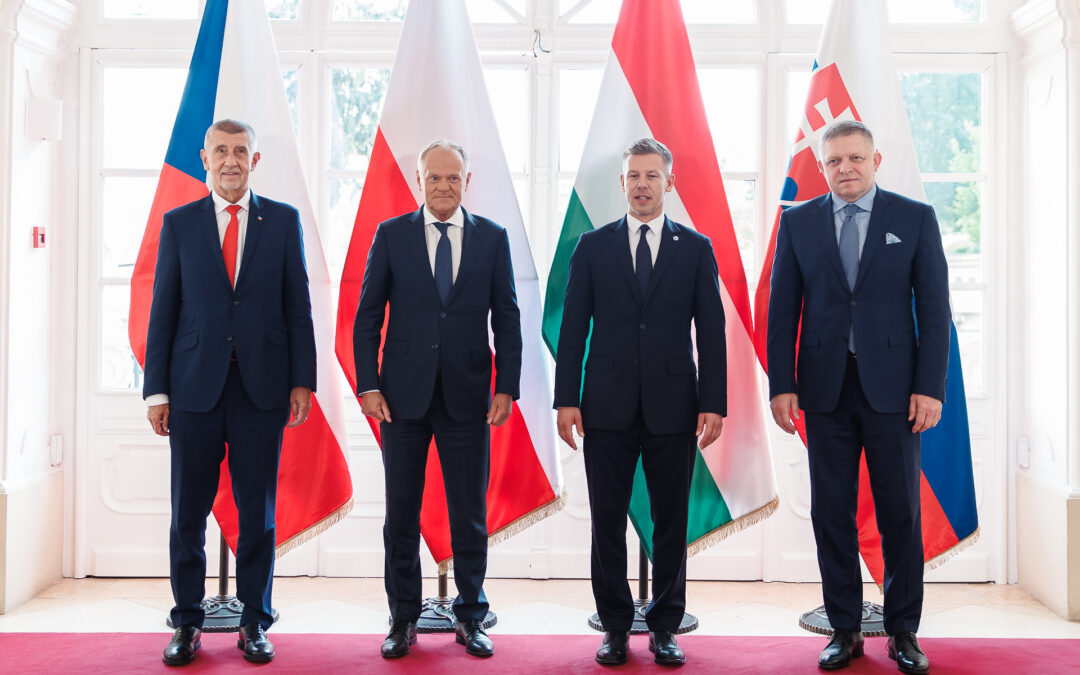
The prime ministers of the Visegrád Group (V4), which is made up of Poland, Hungary, Slovakia and the Czech Republic, have met for the first time in over two years as Péter Magyar, who recently replaced Viktor Orbán as Hungary’s leader, seeks to revive the body.
A revived “V4 will be one of the greatest powers”, declared Poland’s Donald Tusk alongside his counterparts, adding that it can “once again serve as a beacon for all those who, in confrontation with Germany, France and the Brussels bureaucracy, on their own do not stand a chance”.
💬 Premier @donaldtusk ⤵️
Grupa Wyszehradzka będzie jedną z największych potęg, jeżeli wrócimy do sposobu działania opartego na zaufaniu, wzajemnej lojalności i wyczuciu wspólnych interesów. To jest unikatowe w skali europejskiej. pic.twitter.com/3IhlPcbIUa
— Kancelaria Premiera (@PremierRP) June 23, 2026
The Visegrád Group – named after the Hungarian town in which it was formed 35 years ago – has waxed and waned in terms of coherence and influence depending on who holds power in each of the four countries.
From 2015, when Poland and Hungary were ruled by the national-conservative Law and Justice (PiS) and Fidesz parties respectively, the V4 often presented clear joint positions within the EU.
However, the relationship began to fray in 2022 amid Fidesz and PiS’s very different responses to Russia’s full-scale invasion of Ukraine. Once PiS lost power in 2023 to Tusk’s more liberal coalition, relations with Hungary, and by extension the V4, became even frostier.
But last month, Orbán was replaced as prime minister by Magyar, prompting Tusk to welcome Hungary’s “return to Europe”. That has in turn helped reinvigorate the V4, with Magyar on Tuesday hosting Tusk, Slovakia’s Robert Fico and Czech Prime Minister Andrej Babiš at the Royal Palace of Gödöllő.
The Hungarian government said that it has “relaunched the partnership of the four countries” by “reviving political dialogue and identifying areas of cooperation.
It added that the four leaders had agreed “to act in a coordinated manner in various forums of the European Union in order to effectively promote common interests”. That would include resuming regular consultations ahead of meetings of the European Council and the Council of the European Union.
V4 is back!
It was an honour to host the Prime Ministers of Poland, Czechia, and Slovakia in Gödöllő at Grassalkovich Castle.
The Visegrád Group is stronger than ever! pic.twitter.com/Ai6fWvpEN1
— Magyar Péter (Ne féljetek) (@magyarpeterMP) June 23, 2026
Current issues of particular importance include ongoing negotiations of the next EU budget, ensuring that changes to European climate and trade policies maintain competitiveness, and promoting north-south transport and energy infrastructure, said Magyar’s office.
“Our main task is to address energy prices, the revision of the emission trading system and also the negotiations on the multiannual financial framework [budget],” confirmed Babiš, who said that the V4 would “fight for the interests of our countries and the entire region”.
Tusk likewise declared that the quartet would now “once again play a significant role in shaping events in Europe” by “working together, beyond existing differences, on issues that are important to our countries and the entire region”.
“If we always understand that what unites us, regardless of conflicts, is stronger than what divides us, Europe will start listening to us,” he added. “When the Visegrád Group was like one fist, we were able not only to influence, but also to impose decisions in Europe.”
Donald Tusk hailed Hungary's "return to Europe" as he hosted Péter Magyar on his first foreign visit as the Hungarian PM.
Magyar said that his government can “learn from Poland” on restoring the rule of law, recovering EU funds and fighting corruption https://t.co/fls0Wp3vXz
— Notes from Poland 🇵🇱 (@notesfrompoland) May 20, 2026
As Tusk hinted at, there remain areas of tension within the V4. A particular sticking point may be Slovakia and Hungary’s continued reliance on Russian energy supplies. While Magyar is not pro-Russian in the manner of Orbán, he has made clear that Russia will remain Hungary’s main energy supplier.
However, the Hungarian prime minister said on Tuesday that “there is much more that connects our [V4] countries than divides them”. He noted that regional cooperation had previously frayed because of a breakdown in Polish-Hungarian relations, but that this obstacle had now been overcome.
One specific project announced by Magyar at the meeting is a proposal for a high-speed rail connection between their four capital cities, Budapest, Bratislava, Prague and Warsaw.
A Polish Pendolino high-speed train has begun running in the Czech Republic for the first time.
The Prague-Bohumín service will run until June as part of a certification process that Polish operator PKP Intercity hopes will lead to a Warsaw-Prague route https://t.co/hmUNd7ft0E
— Notes from Poland 🇵🇱 (@notesfrompoland) March 10, 2026
Notes from Poland is run by a small editorial team and published by an independent, non-profit foundation that is funded through donations from our readers. We cannot do what we do without your support.
Main image credit: KPRM/Flickr (under CC BY-NC-ND 4.0)

Daniel Tilles is editor-in-chief of Notes from Poland. He has written on Polish affairs for a wide range of publications, including Foreign Policy, POLITICO Europe, EUobserver and Dziennik Gazeta Prawna.