Keep our news free from ads and paywalls by making a donation to support our work!

Notes from Poland is run by a small editorial team and is published by an independent, non-profit foundation that is funded through donations from our readers. We cannot do what we do without your support.
By Aleks Szczerbiak
Poland’s ruling coalition is likely to survive until the scheduled 2027 parliamentary election, despite presidential veto constraints and internal frictions, because access to state resources incentivises cohesion. However, its reelection prospects depend on whether the election focuses on the government’s domestic record or national security narratives.
Little prospect of an early election
In December 2023, a coalition headed by liberal-centrist Civic Coalition (KO) leader Donald Tusk took office following eight years’ rule by the right-wing Law and Justice (PiS) party, currently the main opposition grouping.
The ruling coalition also includes the agrarian-centrist Polish People’s Party (PSL), liberal-centrist Poland 2050 (Polska 2050) party and breakaway Centre (Centrum) caucus, and the New Left (Nowa Lewica).
However, PiS-backed candidate Karol Nawrocki’s surprise victory in the May-June 2025 presidential election scuppered the Tusk administration’s plans to align all the branches of state power so that it could push through its policy agenda and elite replacement programme
The government lacks the three-fifths parliamentary majority required to overturn a presidential veto, so faces continued resistance from a hostile president who can effectively block much of its policy agenda for the remainder of its term of office, which is scheduled to run until the next parliamentary election in autumn 2027.
Włodzimierz Czarzasty has transformed the role of speaker of parliament into a forceful political weapon, writes @aleksszczerbiak
Controversial yet effective, he has become one of Donald Tusk's key allies and the ruling coalition’s uncompromising enforcer https://t.co/wZFCqCSFly
— Notes from Poland 🇵🇱 (@notesfrompoland) March 9, 2026
Nonetheless, although the Tusk government was weakened, it has demonstrated unity when challenged and maintained a stable working majority, comfortably winning key parliamentary votes and surviving opposition attempts to no-confidence its ministers.
Dissolving parliament is virtually impossible without the consent of the governing parties, and hanging on gives them time to consolidate and deliver better results.
Moreover, all the governing parties will want to maintain ongoing access to public appointments and state resources for as long as possible. This often serves as the “glue” holding together governments and political formations despite ideological differences and internal splits. As a consequence, all sides appear to be positioning themselves for a regular autumn 2027 legislative poll.
Poland 2050 is the weakest link
However, the arrangement remains fragile, with Poland 2050 widely seen as the weakest and most unstable link in the ruling coalition, and most likely source of future defections. Its 15 parliamentary deputies are of critical importance to maintaining the government’s parliamentary majority.
Support for the party has plummeted to only 1-3% in the polls, well below the 5% parliamentary representation threshold, which makes its leaders acutely aware that they risk political extinction if they cannot deliver results or secure a strong position now.
So far, Poland 2050 has remained loyal and supported the government on key votes because the party’s MPs feel that they have an interest in the coalition remaining in power.
However, regional development minister Katarzyna Pełczyńska-Nałęcz, who took over as party leader from Poland 2050 founder Szymon Hołownia in January, has a confrontational style and often clashes with Tusk, even on issues that go beyond her ministerial competencies.
Around half the MPs from Poland 2050, a junior member of Poland’s ruling coalition, have split from the party and formed a new parliamentary caucus.
They expressed dissatisfaction with the actions of the party's recently elected new leader, @Kpelczynska https://t.co/IqU4vE1EEe
— Notes from Poland 🇵🇱 (@notesfrompoland) February 18, 2026
Her political strategy is based on the notion that Poland 2050 needs to clearly differentiate itself from KO and actively carve out a more distinctive niche for itself within the ruling coalition.
She has, for example, come into conflict with KO-nominated finance minister Andrzej Domański over calls to increase income tax thresholds. This approach creates constant friction and exacerbates internal divisions within the governing camp.
Nonetheless, while members of the Poland 2050 parliamentary caucus may broadly support Pełczyńska-Nałęcz’s strategy of asserting the party’s independence and distinctiveness within the coalition, they are also pragmatic about their future survival.
If she tried to break more decisively with, or even exited, the governing camp, it is unlikely that most of them would follow her, and almost certainly not enough to deprive the government of its parliamentary majority.
Fearing loss of access to posts and state resources, many would probably continue to support the ruling coalition as independents or join other pro-government parliamentary factions.
A weak domestic record
For sure, KO is currently well ahead in the opinion polls; according to the Politico Europe aggregator it is averaging around 33% support compared to 26% for PiS.
However – although the situation remains fluid and could shift with electoral alliances, voter consolidation or the possible emergence of a “new” pro-government centrist formation – if an election were held today the current governing coalition would likely fall short of an overall parliamentary majority.
This is mainly because, while KO is the most competitive individual party, overall the right-wing opposition has greater combined strength and, crucially, the smaller ruling coalition parties are hovering near or below the 5% threshold and so are unable to reliably deliver the extra parliamentary seats needed.
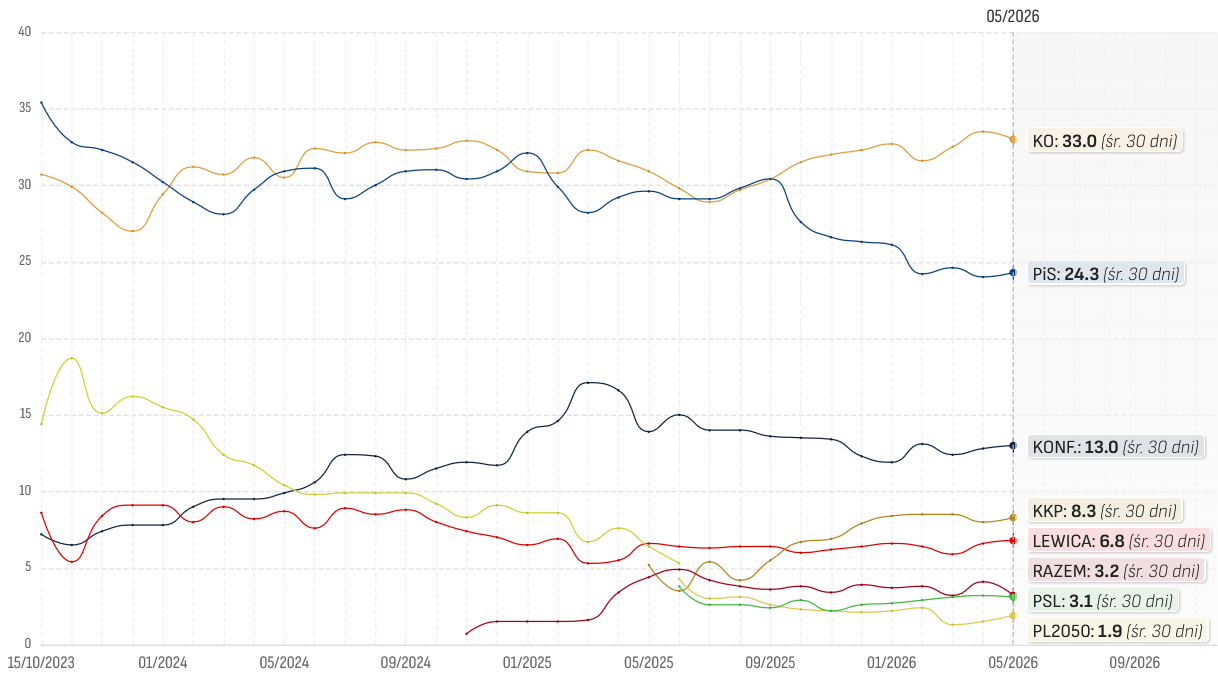
Monthly polling averages for Poland’s main political groups (via eWybory.eu)
The outcome of the next election will depend on what the most important issues are felt to be, particularly whether or not the focus is primarily on domestic politics or foreign and security policy. The ruling party knows that if the election turns into a referendum on the government’s domestic record, then it is very likely to struggle.
The Tusk administration took office promising major changes, but there is a widespread feeling, even among many of its supporters, that the government has not fully delivered on many of its key election pledges.
While it can point to some successes on the economic front – such as increases in the overall rate of growth, a fall in the headline rate of inflation, and the release of frozen EU investment funds – Poles often feel that these top-level indicators are not translating into tangible improvements in their living standards.
Moreover, the government still faces deep, persistent structural socioeconomic challenges, particularly the state of the health service, which often ranks as Poles’ top concern and where assessments of the government’s record are overwhelmingly negative, with regular media reports of hospitals delaying medical treatments or turning patients away.
High levels of public debt and a significant state budget deficit (due partly to massive defence and social spending) have also constrained the government’s ability to honour its election promises, notably KO’s flagship pledge to increase tax allowances substantially.
These challenges are, of course, compounded by the ongoing conflict with Nawrocki. Although it retains a loyal hardcore of supporters, polls show that the government faces persistently negative approval ratings with domestic problems amplifying an overwhelming sense that it is gridlocked, internally divided and lacking an overarching sense of purpose or mission.
Energising its disappointed base
In fact, in Poland’s highly polarised political landscape, frustrated government supporters are far more likely to abstain than switch over to the right-wing opposition in large numbers. So turnout matters greatly and demobilisation is a bigger electoral risk to the ruling coalition than voter swings.
Indeed, one of the key lessons that the ruling liberal-centrist camp drew (rightly or wrongly) from its 2025 presidential election defeat was that it lost because it had failed to mobilise its core supporters sufficiently.
Precisely in order to reenergise its disappointed base, the government has doubled down on its so-called “reckoning” (rozliczenie) agenda. A key element of this is being seen to actively pursue criminal investigations of PiS party figures for their alleged corruption and abuse of state resources when in office.
However, these have proceeded sluggishly and faced major setbacks, notably the government’s ongoing inability to bring former justice minister Zbigniew Ziobro and his deputy Marcin Romanowski (both of whom are currently residing abroad) to trial, which has deeply frustrated the coalition government’s electoral base.
PM @donaldtusk says it is "outrageous" that the US granted a visa to fugitive former justice minister Zbigniew Ziobro, who is wanted on 26 criminal charges.
Reuters earlier reported that a senior US official intervened personally to secure Ziobro's visa https://t.co/cQKMKXKMPV
— Notes from Poland 🇵🇱 (@notesfrompoland) May 19, 2026
Moreover, beyond the ruling coalition’s core supporters, the “reckoning” agenda risks being seen as (at best) simply negative displacement activity by a government focused more on score-settling with the previous PiS administration than delivering positive forward-looking policy outcomes, or (at worst) a politically motivated witch hunt.
Focusing on national security
That is why the government is very keen to “change the conversation” and make national security in an uncertain geopolitical situation, rather than domestic political issues, the cornerstone of its reelection narrative.
It justifies prioritising this issue on the basis of the international security situation that Poland finds itself in, particularly the war in neighbouring Ukraine and ongoing security risk that Russia represents.
The government argues that Moscow is already waging a new type of war in Europe with hybrid tactics, including arson, drone incursions, and cyberattacks, and presents itself as a strong defender of the nation against a clear external enemy.
Poland is the "primary focus" of Russia's sabotage campaign in Europe, finds a new report by the International Centre for Counter-Terrorism.
Among 151 incidents identified since 2022, 31 of them took place in Poland – more than in any other country https://t.co/QXfSI00FD6
— Notes from Poland 🇵🇱 (@notesfrompoland) March 3, 2026
Critics argue that using such stark “prewar” language helps the government avoid having to answer awkward questions about other, more problematic aspects of its policy agenda.
Nonetheless, national security is an issue that resonates deeply with Poles and focusing on it allows the governing parties to appeal to a broad range of voters, including those who may otherwise be dissatisfied with the pace of reforms.
Situations of international insecurity often help to produce what political scientists call a “rally effect”: the inevitable psychological tendency for worried citizens to unite around their political leaders and institutions as the embodiment of national unity when they feel that they face a dramatic external threat.
In essence, the government’s national security rhetoric is a calculated strategy to reframe political debate around the Russian threat.
Over the last two years, Poland has launched as many espionage investigations as in the previous three decades, new data show.
There has been an "unprecedented increase in threats", especially from Russia and Belarus, says the Internal Security Agency https://t.co/vl5027DnoU
— Notes from Poland 🇵🇱 (@notesfrompoland) May 7, 2026
An important element of this involves delegitimising the right-wing opposition as an objectively pro-Moscow security risk by arguing that its rhetoric and actions align with Russian propaganda and interests.
This includes framing the geopolitical choice facing Poland in Manichean terms between east and west, arguing that by undermining EU unity and criticising closer alignment with Berlin and the so-called European “mainstream” the right-wing opposition is playing into Russian hands and threatening the whole of the continent’s security architecture.
It also involves portraying Nawrocki’s more assertive presidency, particularly his frequent use of presidential vetoes and independent foreign policy initiatives, as divisive and undermining the unity of the Polish state.
The government cites Nawrocki’s veto of legislation enabling Poland to access its €43.7 billion (185 billion zloty) allocation from the EU’s Security Action for Europe (SAFE) defence procurement initiative as a paradigmatic example of this; the president argues that it saddles future generations with a huge, long-term debt and undermines Polish sovereignty.
A clash between the right-wing president and more liberal government over Poland's receipt of EU defence loans has sharpened polarisation and turbocharged the ruling coalition’s “Polexit” and security narratives, writes @AleksSzczerbiak https://t.co/Iu7rcJfj5e
— Notes from Poland 🇵🇱 (@notesfrompoland) April 2, 2026
At the same time, the governing camp is hoping that fragmentation on the Polish right will help it to retain power.
Since the presidential election – when Nawrocki united the fractured Polish conservative landscape in a broad, anti-government winning coalition – not only have the main right-wing groupings turned on each other in mutual recriminations, but PiS also faces the most serious internal crisis in its history.
Falling poll ratings and pressure from more radical rivals have exposed deep factional divisions between the party’s traditionalist-conservative and modernising-technocratic wings, raising the real possibility of a damaging split before the next election.
The governing camp has also tried to use the prospect of a future right-wing coalition having to rely on the support of the deeply controversial far-right politician Grzegorz Braun to govern as way of mobilising its own, otherwise demotivated, supporters and dissuading moderate voters from backing the more mainstream conservative parties.
Foreign policy is rarely an election winner
However, the government cannot simply rely on opposition fragmentation to win the next election and needs a more fundamental strategic gamechanger that can shift the current negative political dynamic.
Experience from other countries, most recently the Hungarian parliamentary poll, suggests that voters tend to prioritise bread-and-butter domestic day-to-day concerns – such as the economy, public services and living standards – in voting decisions, and it is difficult to win an election by focusing mainly on security and foreign affairs, unless there really is a credible imminent and acute security threat.
Indeed, foreign policy narratives are often a risky electoral strategy and can actually backfire on incumbents if they are seen as simply a distraction from weak government domestic performance.
Unless the government can re-anchor its appeal in credible domestic policy delivery on the issues voters feel most directly, foreign and security policy could even turn from a hoped-for strength into an electoral liability.
Notes from Poland is run by a small editorial team and published by an independent, non-profit foundation that is funded through donations from our readers. We cannot do what we do without your support.
Main image credit: KPRM/Flickr (under CC BY-NC-ND 4.0)