Keep our news free from ads and paywalls by making a donation to support our work!

Notes from Poland is run by a small editorial team and is published by an independent, non-profit foundation that is funded through donations from our readers. We cannot do what we do without your support.
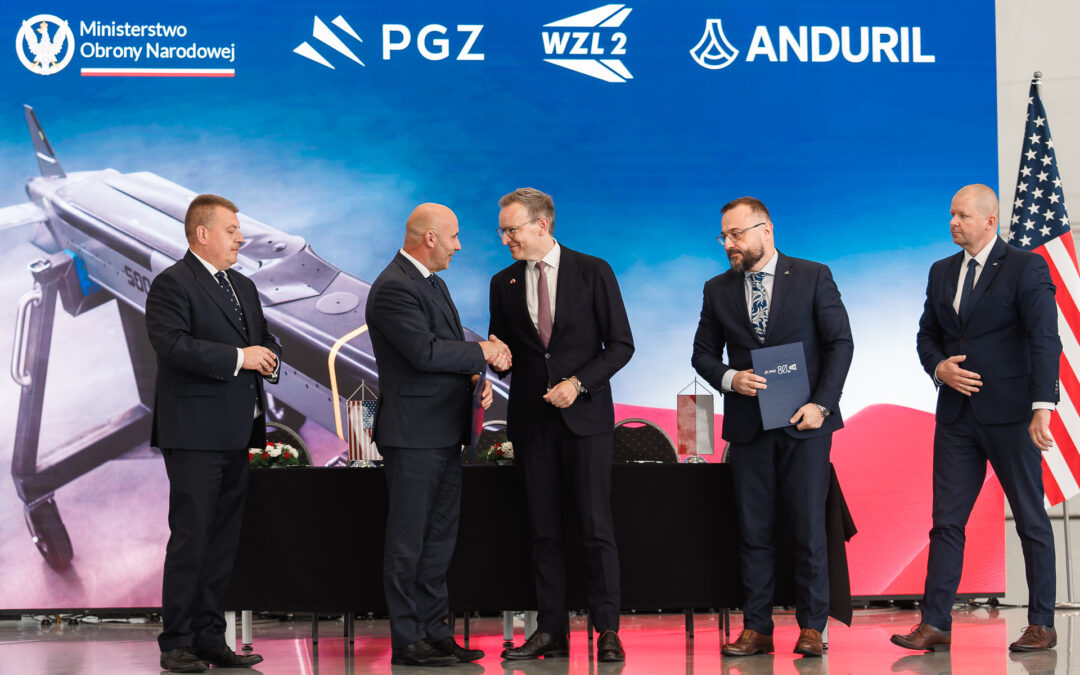
Poland will become the first country in Europe to produce cruise missiles developed by US defence firm Anduril Industries under an agreement signed on Monday with Polish state defence group PGZ.
The deal, which will see Poland produce thousands of Barracuda-500M cruise missiles, will “transform the continent’s defence industry”, claims the American supplier.
🚀 To był ważny dzień dla Polskiej Grupy Zbrojeniowej i polskiego przemysłu obronnego!
Dzisiejsze podpisanie porozumienia pomiędzy PGZ, @WZL2_SA i @anduriltech otwiera drogę do uruchomienia w Polsce montażu, a następnie produkcji autonomicznych pocisków manewrujących dalekiego… pic.twitter.com/rePitaV1FZ
— Polska Grupa Zbrojeniowa🇵🇱 (@PGZ_pl) July 6, 2026
Speaking at the signing ceremony, defence minister Władysław Kosiniak-Kamysz said the deal was “of strategic importance for our ability to influence the whole of Europe”, given that Poland is the first European country to reach such an agreement with Anduril.
He added that the arrangement gives PGZ exclusive rights covering production, technology transfer, know-how and expertise, and would ultimately lead to the production of a Polish version of the Barracuda-500M.
Prime Minister Donald Tusk, meanwhile, described the missiles as “one of the most important elements of defence of the modern battlefield” and said the agreement showed that the government is “effectively taking care of Poland’s security and the development of the Polish arms industry”.
The Barracuda-500M, which will be first assembled and later eventually produced in the Polish city of Bydgoszcz, has a range of up to 926 km (575 miles) when launched from fighter aircraft and about 700 km from ground-based launchers, according to defence news website Defence24.
The missile is used by both F-16 fighter jets, of which Poland has 47, and the latest F-35s, which began to be delivered to Poland in May.
PGZ’s CEO Adam Leszkiewicz said the partnership with Anduril would allow the companies to “quickly produce and deliver several thousand low-cost, yet technologically advanced, autonomous, long-range Barracuda cruise missiles”.
Anduril’s vice president for Europe, Brian Moran, added that the agreement with PGZ would “transform the continent’s defence industry” by “helping build a European industrial base capable of replenishing precision-guided weapons at a pace that meets modern operational needs”.
Po co Polsce Barracuda @anduriltech?
Czy wyprodukujemy tani pocisk do naszych myśliwców F-16 i F-35?
Odpowiedź na to pytanie znajdziecie w artykule @Maciej_Szopa, link w komentarzu👇 pic.twitter.com/8pWgd0AD0x
— Defence24 (@Defence24pl) July 7, 2026
Since Russia’s full-scale invasion of Ukraine in 2022, Poland has embarked on a major defence procurement spree. It now has the highest relative defence budget in NATO and is also the alliance’s largest arms importer.
But the Polish government has also been seeking to boost domestic arms production, including through the European Union’s SAFE defence loans programme and through partnerships with foreign firms.
In January, it was announced that Poland will manufacture the missiles for K239 Chunmoo rocket artillery systems that Norway is purchasing from South Korea.
The following month, US defence firm Northrop Grumman and Polish manufacturer Niewiadów-PGM announced plans to jointly produce more than 180,000 155-mm artillery shells annually in Poland. PGZ has also partnered with Britain’s BAE Systems on ammunition production.
Poland will manufacture the missiles for rocket artillery systems that Norway is buying from South Korea.
The Norwegian government says that Polish production "will strengthen security of supply for Norway and other European customers of the system" https://t.co/NIJj7owK45
— Notes from Poland 🇵🇱 (@notesfrompoland) January 29, 2026
In March, PGZ signed an agreement with Estonia’s Frankenburg Technologies to establish a facility in Poland producing up to 10,000 low-cost anti-drone missiles per year. The same month, a Polish-Ukrainian joint venture was announced to manufacture Ukraine’s Bohdana howitzer in Poland.
In April, defence firm Bumar-Łabędy, part of PGZ, signed an agreement with South Korea’s Hyundai Rotem to produce dozens of South Korean K2 tanks in Poland. The following month, PGZ signed an agreement with Sweden’s Saab to cooperate on naval technology.
Meanwhile, Polish defence firm Mesko, which is part of PGZ, announced record financial results in 2025 on the back of growing international demand for its Piorun air-defence systems.
Swedish defence giant Saab has signed a strategic collaboration agreement with Polish state defence group PGZ.
The firms will cooperate on naval production, servicing and technology, including establishing an underwater technology centre in Poland https://t.co/dykKjMIAzX
— Notes from Poland 🇵🇱 (@notesfrompoland) May 15, 2026
Notes from Poland is run by a small editorial team and published by an independent, non-profit foundation that is funded through donations from our readers. We cannot do what we do without your support.
Main image credit: Kancelaria Premiera/Flickr (under CC BY-NC-ND 4.0)

Alicja Ptak is deputy editor-in-chief of Notes from Poland and a multimedia journalist. She has written for Clean Energy Wire and The Times, and she hosts her own podcast, The Warsaw Wire, on Poland’s economy and energy sector. She previously worked for Reuters.