Keep our news free from ads and paywalls by making a donation to support our work!

Notes from Poland is run by a small editorial team and is published by an independent, non-profit foundation that is funded through donations from our readers. We cannot do what we do without your support.
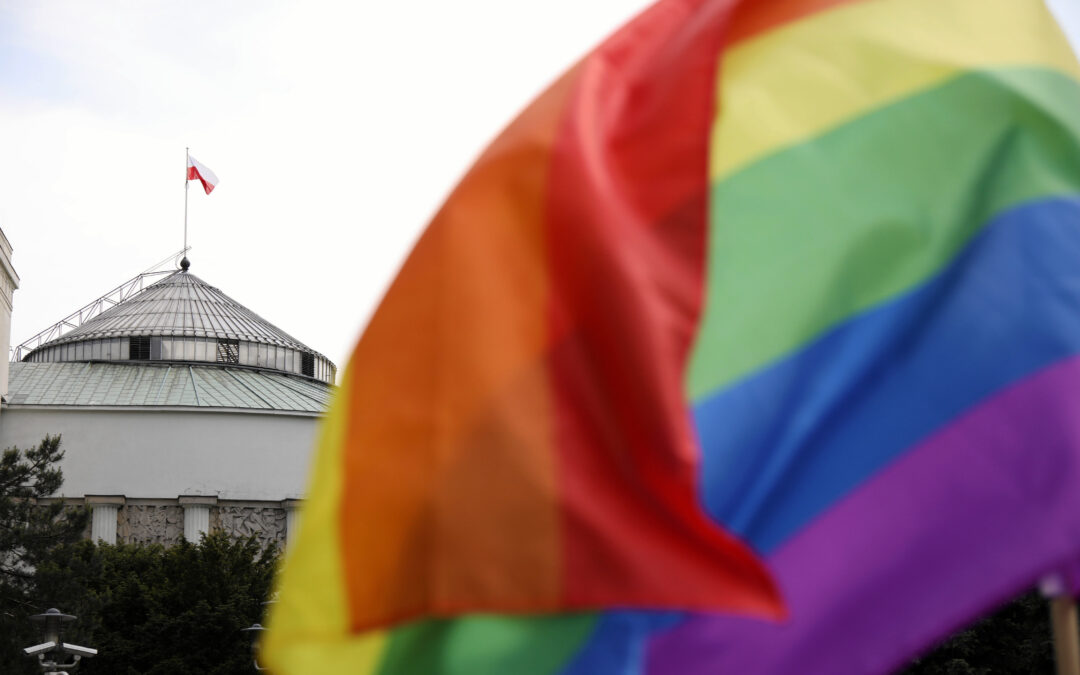
The government’s majority in parliament has approved a bill that would allow unmarried partners, including same-sex couples, to sign an agreement granting them certain rights. That would make a breakthrough in a country where no form of same-sex union is currently possible under domestic law.
However, President Karol Nawrocki, who is aligned with the right-wing opposition, made clear this week that he would exercise his right to veto the bill once it is sent to him by parliament. He argues that it would create an alternative form of marriage.
Dziś historyczny dzień – Sejm przegłosował ustawę o statusie osoby najbliższej w związku i umowie o wspólnym pożyciu wraz z przepisami wprowadzającymi! To pierwsza w historii ustawa dająca możliwość formalizacji związków jednopłciowych, która została przyjęta przez Sejm.
Za nami… pic.twitter.com/bvhylaDdHB
— Katarzyna Kotula (@KotulaKat) May 29, 2026
On Friday, the Sejm, the more powerful lower house of parliament, voted on a government bill that would allow couples, both same-sex and opposite-sex, to enter into a new type of contract that would be signed before a notary and then submitted to the registry office.
It would grant them some of the rights available to married couples, including joint property and tax settlement, access to their partner’s medical information, exemption from inheritance and gift taxes, and the right to decide about their partner’s burial if they die.
The bill was the result of a hard-fought compromise within Prime Minister Donald Tusk’s ruling coalition, which ranges from left to centre right. His own centrist Civic Coalition (KO) party and one of its junior partners, The Left (Lewica), support introducing same-sex civil partnerships.
However, more conservative elements in the government, in particular the centre-right Polish People’s Party (PSL), are opposed to that idea. As a result, the coalition announced last year that it had instead settled upon the current solution.
Poland’s ruling coalition has presented a bill that would allow unmarried partners, including same-sex couples, to sign an agreement granting them certain rights.
The proposal is a compromise intended to be acceptable to both liberals and conservatives https://t.co/n7VqUnP6uq
— Notes from Poland 🇵🇱 (@notesfrompoland) October 17, 2025
In today’s Sejm vote, almost all MPs present from the ruling coalition were in favour of the bill, though five PSL members (of 28 present) opposed it. The two main opposition parties – the national-conservative Law and Justice (PiS) and far-right Confederation (Konfederacja) – also voted against the legislation.
Despite the minor PSL rebellion, the bill was approved with 230 votes in favour and 200 against. It now passes to the upper-house Senate, where the government also has a majority and which can, in any case, only delay legislation or suggest amendments, not block it.
Once approved by parliament as a whole, the bill passes to Nawrocki, who is aligned with the right-wing opposition. He can sign it into law, send it to the constitutional court for assessment, or veto it (something he has done with an unprecedented number of government bills).
Following today’s vote, Katarzyna Kotula, the government’s plenipotentiary for equality, welcomed the Sejm’s decision to approve “the first law in [Poland’s] history that gives the possibility of formalising same-sex unions”.
Kotula, who is from The Left, admitted that “this is not the bill of my dreams” and that she personally favours introducing same-sex marriage. But “we have difficult times and a difficult coalition, [so] our responsibility is to make the most of them and fight for a better Poland”.
“Dear LGBT community, I know that this is too little for you,” she added. “But you have many allies in the Sejm and the government who will always fight for you. And this vote will forever remind us that the rights of the LGBT community are human rights”.
For the first time in six years, Poland is not ranked as the EU's worst country for LGBT+ people.
It is now second from last, having overtaken Romania in the latest annual Rainbow Map published by @ILGAEurope https://t.co/PtLdFtxL2L
— Notes from Poland 🇵🇱 (@notesfrompoland) May 16, 2025
However, although Kotula last year expressed hope that the bill had been written in such a way as to win Nawrocki’s approval, this week the president made clear that he would not sign it.
On Wednesday, the head of Nawrocki’s cabinet, Paweł Szefernaker, said that, in their view, the proposed law would effectively introduce same-sex civil partnerships and legally equate them with marriage.
“There is not and will not be consent from the president for the introduction or legalisation of civil partnerships,” said Szefernaker.
Podczas wspólnej konferencji prasowej szef Gabinetu Prezydenta RP @szefernaker oraz Doradca Prezydenta RP @barbarasocha przedstawili stanowisko Prezydenta w sprawie rządowej ustawy o statusie osoby najbliższej.
💬 Nie ma i nie będzie zgody pana prezydenta na wprowadzenie, na… pic.twitter.com/sUFqwN1M6F
— Kancelaria Prezydenta RP (@prezydentpl) May 27, 2026
Speaking on Friday morning just ahead of the Sejm vote, Nawrocki himself confirmed that he would not sign a bill that creates “an alternative [form of] marriage and undermines the Polish constitution”, which specifies that marriage between a man and a woman is under the protection of the state.
However, the president added that, “if we find solutions that will help those with close relative status to function formally and administratively, without bringing ideological pressure or attempts to undermine the unique status of marriage, I will sign such a bill”.
However, neither he nor his chancellery have specified what such a bill would entail and how it would differ from the one currently being proposed.
Right-wing opposition leader Jarosław Kaczyński has declared that Poland must be defended from the “spread of homosexuality”, which he called a “pathology”.
He also appeared to suggest that same-sex parenting should be criminalised and “severely punished” https://t.co/L6HY1fyE1k
— Notes from Poland 🇵🇱 (@notesfrompoland) May 24, 2026
The government’s bill is separate from another recent development, which has seen Poland begin to recognise same-sex marriages conducted in other EU member states, after being ordered to do so by the Court of Justice of the European Union (CJEU).
Earlier this month, Warsaw and Wrocław became the first cities to transcribe foreign same-sex marriages into the civil registry when requested by couples. Shortly afterwards, the government issued a regulation making it easier for registry offices to recognise such marriages.
However, there remains uncertainty as to what the legal consequences of entering foreign same-sex marriages into the registry will be, especially as Poland’s domestic law does not allow for any legally recognised form of same-sex union.
Poland has legally recognised a same-sex relationship for the first time, after the city of Warsaw complied with a court order to transcribe into its civil registry a marriage between two Polish men that took place in Germany https://t.co/LOUWHHLRqe
— Notes from Poland 🇵🇱 (@notesfrompoland) May 14, 2026
Notes from Poland is run by a small editorial team and published by an independent, non-profit foundation that is funded through donations from our readers. We cannot do what we do without your support.
Main image credit: Maciek Jazwiecki / Agencja Wyborcza.pl

Daniel Tilles is editor-in-chief of Notes from Poland. He has written on Polish affairs for a wide range of publications, including Foreign Policy, POLITICO Europe, EUobserver and Dziennik Gazeta Prawna.