Keep our news free from ads and paywalls by making a donation to support our work!

Notes from Poland is run by a small editorial team and is published by an independent, non-profit foundation that is funded through donations from our readers. We cannot do what we do without your support.
Poland has won the 2026 Rail Champion Award in recognition of its contribution to the development of rail transport in Europe.
The prize was given this week at the European Railway Awards, which are organised annually by rail operators from across the continent to celebrate political and technical achievements in developing rail transport.
They honoured Poland this year for its efforts in the first half of last year, when it held the EU’s rotating presidency, to “drive rail forward as a pillar of European competitiveness and resilience”.
Organisers cited the Polish presidency’s “exceptionally rich programme for rail”, which “gave much-needed attention to issues such as innovation and investment”.
The European Rail Champion Award goes to Poland!🏆
Yesterday, Deputy Minister @PiotrMalepszak accepted the award for the 🇵🇱Polish Presidency’s efforts in promoting rail transport.
In Poland, it is a renaissance for rail – 439 million passengers chose railway in 2025! 🚆 pic.twitter.com/rOEi2YcxW4
— Permanent Representation of Poland to the EU (@PLintheEU) February 3, 2026
The award was accepted on Poland’s behalf by deputy infrastructure minister Piotr Malepszak, who noted the strategic importance that transport plays in the face of growing geopolitical threats.
“Transport is not only about mobility – it’s about security,” he said, pointing to last year’s sabotage by Russian agents of a rail line in Poland that is used for supplying Ukraine. Since Russia’s full-scale invasion in 2022, Poland has become the main hub for military equipment and other aid being transported to Ukraine.
“Under the Polish presidency, we made security a pillar of a competitive and well-financed European transport system,” declared Malepszak. “Today, the Polish approach is setting the direction for Europe’s rail future.”
Poland last year listed “strengthening the capacity of rail transport” as one of its priorities in its programme for the EU presidency and organised a series of events to promote investment in rail.
“Given the role of the railways in crisis situations, the presidency will emphasise the promotion of investment and action to strengthen the resilience of the railway sector and preserve its strategic role,” the document said.
Polish officials also stressed the importance of developing dual-use civil and military infrastructure and protecting transport operators exposed to attacks.
The government has announced a military operation that will see up to 10,000 troops deployed to secure critical infrastructure following last weekend's rail sabotage.
They also plan to launch an app allowing people to report potential cases of sabotage https://t.co/F6dpZBuSIU
— Notes from Poland 🇵🇱 (@notesfrompoland) November 20, 2025
Poland’s state rail operator PKP also welcomed this week’s award. Tomasz Lachowicz, head of the company’s representative office in Brussels, said the country was experiencing “a true renaissance of Polish railways”.
He noted that last year almost 439 million rail journeys were made in Poland, which is the highest figure in 30 years. “For comparison, in 2005, a year after Poland joined the EU, only 258 million people used rail,” he said, quoted by the Polish Press Agency (PAP).
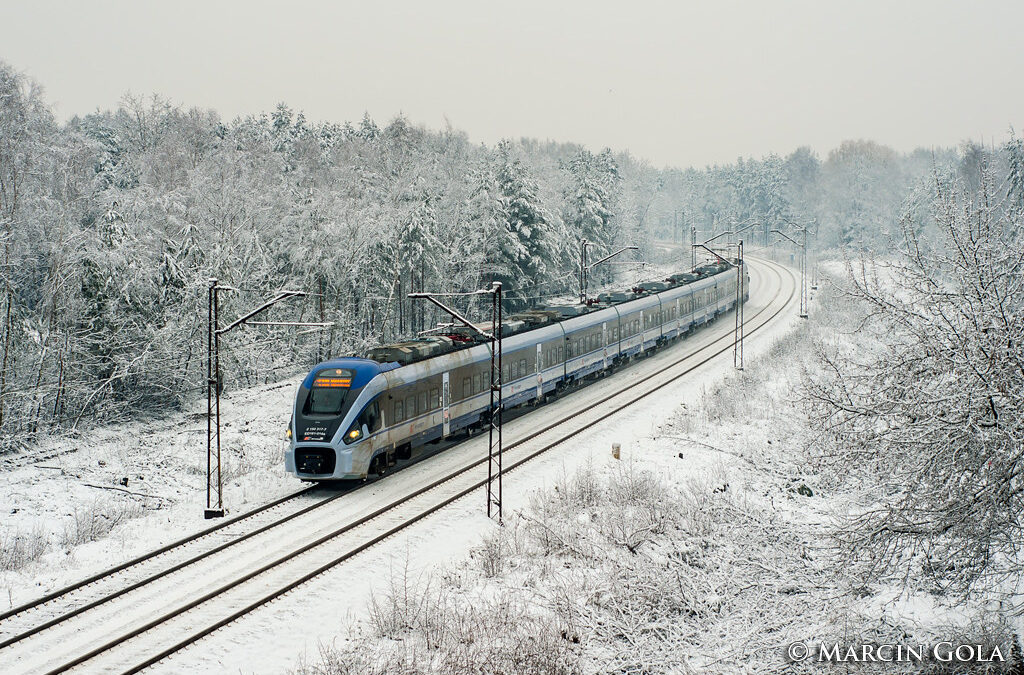
Passenger numbers have indeed hit record levels in recent years. To help meet demand, in November PKP signed the largest rolling stock contract in Polish history. The following month, it launched a tender to buy trains capable of speeds of up to 320 km/h (199 mph), which would be the fastest ever to run on Polish tracks.
In November, EU funding was also confirmed for a planned standard-gauge railway connecting Ukraine and Poland. The countries use different-sized gauges for their tracks, which slows freight and passenger transport between them.
A planned standard-gauge railway connecting Ukraine and Poland has received EU funding.
Ukraine has a different track gauge to most of Europe, which currently means time-consuming train changes at the border.
The new line will avoid that problem https://t.co/K3Cs4lif83
— Notes from Poland 🇵🇱 (@notesfrompoland) November 13, 2025
Notes from Poland is run by a small editorial team and published by an independent, non-profit foundation that is funded through donations from our readers. We cannot do what we do without your support.
Main image credit: D29-1/Flickr (under CC BY-NC-ND 2.0)

Alicja Ptak is deputy editor-in-chief of Notes from Poland and a multimedia journalist. She has written for Clean Energy Wire and The Times, and she hosts her own podcast, The Warsaw Wire, on Poland’s economy and energy sector. She previously worked for Reuters.