Keep our news free from ads and paywalls by making a donation to support our work!

Notes from Poland is run by a small editorial team and is published by an independent, non-profit foundation that is funded through donations from our readers. We cannot do what we do without your support.
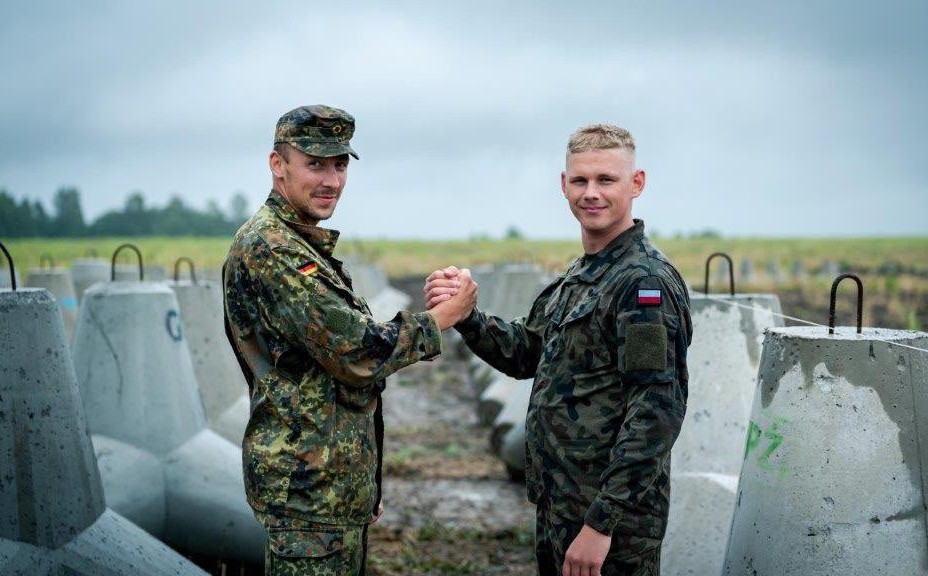
Germany has deployed soldiers to Poland to help reinforce defences on NATO’s eastern flank in response to the threat of Russia.
While Poland already hosts various allied forces, the presence of German troops is particularly symbolic given the two countries’ difficult history. “United, we will prevail,” wrote the General Staff of the Polish Armed Forces (SGWP), announcing the deployment.
“This is what allied cooperation looks like in practice, which translates into greater military readiness and strengthens NATO’s defensive potential.”
Polscy i niemieccy żołnierze razem wzmacniają granicę z Rosją. Takie rzeczy możliwe tylko za Tuska ☺️ pic.twitter.com/oNBME2gBsv
— Donald Tusk (@donaldtusk) July 22, 2026
Last December, the Polish and German defence ministries revealed that a “mid-double-digit number” of German troops would be deployed from mid-2026 until the end of 2027 to support implementation of Poland’s East Shield operation, which seeks to bolster defences along the borders with Belarus and Russia.
They said that the German personnel would mainly engage in engineering work, such as digging trenches, laying barbed wire and constructing anti-tank barriers.
Today, Poland’s SGWP confirmed that “several dozen” German troops, including “highly specialised engineering forces” along with their equipment, had since June been temporarily deployed to “support the Polish armed forces in expanding defence infrastructure on NATO’s northeastern flank”.
It emphasised that the East Shield project is “purely defensive in nature” and comes in “response to threats stemming from, among others, Russian aggression against Ukraine”.
While the armed forces did not reveal the location of the deployment, Polish Prime Minister Donald Tusk indicated in a social media post that it was on the Russian border. Poland has a 210-km frontier with the Russian exclave of Kaliningrad.
German public broadcaster Deutsche Welle reports that the activities of the German sappers are focused in particular on improving defences around the so-called Suwałki Gap, a strategically important stretch of land around the Polish-Lithuanian border between Belarus and Kaliningrad.
“Together, we are ensuring Europe’s security,” said Lieutenant General Alexander Sollfrank, the Bundeswehr’s operational commander, announcing the deployment today.
“Through our engagement in Poland, we are strengthening NATO’s defence capabilities and underscoring the alliance’s unwavering commitment to ensuring peace through unity and credible deterrence.”
Poland and Germany have signed a bilateral security agreement that will see the two neighbours and NATO allies increase cooperation in areas such as military mobility, logistics infrastructure, maritime security in the Baltic Sea, and cybersecurity https://t.co/6BPX2WxvxH
— Notes from Poland 🇵🇱 (@notesfrompoland) June 17, 2026
SGWP, which shared footage of Polish and German forces installing anti-tank barriers, said the work aims to “hinder and delay an aggressor’s actions in the event of a threat”, thereby “increasing the time for a response from the Polish armed forces and the entire [NATO] alliance”.
It also seeks to “create conditions for the efficient reception, deployment and use of NATO forces on Polish territory”.
SGWP welcomed “the involvement of the German contingent as a practical expression of allied solidarity and the result of consistently developing military cooperation between Poland and Germany”.
It also noted that the cooperation would help the two sides improve their ability to operate jointly, including “developing the competencies necessary for conducting a joint defence operation”.
However, it emphasised that the current deployment is focused on training and engineering, with no combat component, and that the German troops are unarmed. SGWP also emphasised that the East Shield operation remains entirely a Polish national programme.
The leaders of eight countries on the EU's eastern flank have met in the first summit of its kind to discuss closer security cooperation.
Finland and Poland announced that they would jointly lead an initiative, Eastern Flank Watch, to bolster defences https://t.co/fxRHpkM6w9
— Notes from Poland 🇵🇱 (@notesfrompoland) December 16, 2025
The deployment of German troops to Poland comes shortly after the two countries signed a defence cooperation agreement in which they pledged to increase cooperation in areas such as military mobility, logistics infrastructure, maritime security in the Baltic Sea, and cybersecurity.
The agreement is a sign that the two countries now stand “shoulder to shoulder, as equals”, declared German defence minister Boris Pistorius.
Poland is also currently seeking a new permanent US military base on its territory, after President Donald Trump recently pledged to boost American troop numbers. Last week, Tusk also announced that Poland will host military exercises involving France and the UK this autumn.
Poland will host military exercises later this year with France and the UK to prepare for providing future security guarantees to Ukraine, says PM @donaldtusk.
He also declared Poland's willingness to permanently host more troops from its European allies https://t.co/couian4FrP
— Notes from Poland 🇵🇱 (@notesfrompoland) July 14, 2026
Notes from Poland is run by a small editorial team and published by an independent, non-profit foundation that is funded through donations from our readers. We cannot do what we do without your support.
Main image credit: Władysław Kosiniak-Kamysz/X

Daniel Tilles is editor-in-chief of Notes from Poland. He has written on Polish affairs for a wide range of publications, including Foreign Policy, POLITICO Europe, EUobserver and Dziennik Gazeta Prawna.