Keep our news free from paywalls by making a donation to support our work!

Notes from Poland is run by a small editorial team and is published by an independent, non-profit foundation that is funded through donations from our readers. We cannot do what we do without your support.
Warsaw’s first astronomical observatory open to the public and run by a local municipal institution launched on Sunday.
Its organisers say the facility, with two telescopes allowing safe observation of the Sun and photography of the cosmos, is aimed at astronomy enthusiasts as well as children and young people, who will be able to watch the night sky and participate in recording data without needing their own equipment.
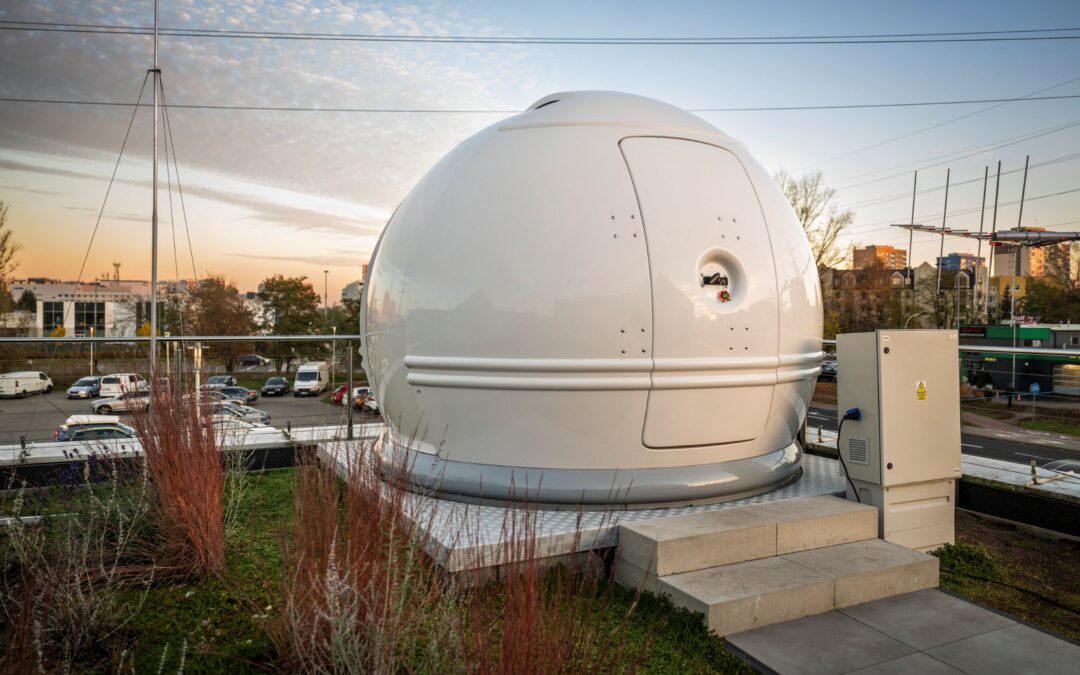
The new observatory, which is located on the roof of the Gocław Culture Terminal in the Praga-South of Poland’s capital, was created in response to growing public interest in astronomy, science and new technologies, says city hall.
“Under the three-metre-high dome, specialised equipment awaits, allowing for observation of the sky, including safe viewing of the Sun,” said mayor Rafał Trzaskowski, who visited the facility last week ahead of its official opening.
“Anyone who is interested can come here and learn about space through observation, photographing the sky and hands-on activities,” he added.
The observatory will be free to use but only accessible during organised events, owing to limited space and the expensive equipment it contains, reports newspaper Super Express.
“The dome houses very expensive equipment. For most of the year, it will function as a broadcasting station, and images from the telescopes will be projected onto screens in the main hall of the terminal,” Jacek Białek, head of Gocław Culture Terminal, told the newspaper.
“We will invite people inside the dome as part of programs, the dates of which will be published on the cultural centre’s website,” he added.
Participants in workshops and events will also be able to help collect and analyse data, with Białek noting that the centre will be working closely with scientists from the University of Warsaw
The new facility cost around 500,000 zloty (€111,000), most of which was covered from the district budget, with contributions from private donations as well as grants from the state-owned military optoelectronic equipment company PCO and the national lottery foundation.
The core of the new facility is a 14″ DO-GSO (Ritchey-Chrétien) telescope with a mirror diameter of approximately 35 cm and a focal length of approximately 2,850 mm, placed on an EQ8-RH equatorial mount with automatic sky tracking.
This setup, along with a QHY268M Pro monochrome camera, a filter wheel and an electronic focuser, will be used for astrophotography and targeted photometric measurements, producing images suited to Warsaw’s atmospheric conditions.
The observatory also boasts a specialist Sky-Watcher Heliostar 100 H-Alpha telescope, which is used for safe and detailed observation and astrophotography of the Sun, allowing viewers to see structures in the solar atmosphere invisible through an ordinary telescope.
The telescope allows solar prominences – large, bright features extending out from the Sun’s surface – to be observed and compared with images produced on other days. The telescope is protected by a three-metre dome that automatically opens and rotates.
Warsaw has been chosen as the location for a new European Space Agency security centre, as Poland takes another step in its ambitions to become a bigger player in the space sector
The facility will be the @esa's first outside its 11 founding member states https://t.co/WnHIbrW3ze
— Notes from Poland 🇵🇱 (@notesfrompoland) July 13, 2026
The observatory also features a computer coordinating its measurements, a camera showing almost the entire sky, and a weather monitoring system. Observations will depend on atmospheric conditions and visibility.
“Examples of how this telescope might be used include photographing the cosmos and conducting simple research, such as measuring changes in the brightness of stars and producing graphs illustrating these changes,” explained Ewa Konarzewska from Gocław Culture Terminal.
Poland has placed great emphasis on developing its space industry in recent years, with the aim of becoming a major European player in the sector.
Last year, the country launched its first national military satellite. A Polish firm, Creotech Instruments, signed Poland’s largest-ever contract with the European Space Agency, a €52 million deal to build and launch a constellation of Earth observation satellites.
Meanwhile, 2025 also saw astronaut Sławosz Uznański-Wiśniewski become the second-ever Pole to travel into space, as part of an ESA mission to the International Space Station.
Earlier this year, Warsaw was chosen as the location for a new ESA centre focused on civil security and resilience, with the agency’s head declaring that “Poland has rapidly become one of the driving forces in Europe’s space sector”.
Notes from Poland is run by a small editorial team and published by an independent, non-profit foundation that is funded through donations from our readers. We cannot do what we do without your support.
Main image credit: UM Warszawa/X

Ben Koschalka is a translator, lecturer, and senior editor at Notes from Poland. Originally from Britain, he has lived in Kraków since 2005.