Keep our news free from ads and paywalls by making a donation to support our work!

Notes from Poland is run by a small editorial team and is published by an independent, non-profit foundation that is funded through donations from our readers. We cannot do what we do without your support.
Polish prosecutors have indicted an 18-year-old Ukrainian accused of working on behalf of Russia to stir tensions between Poland and Ukraine by painting dozens of slogans in public places glorifying the Ukrainian Insurgent Army (UPA), which massacred Poles during World War Two.
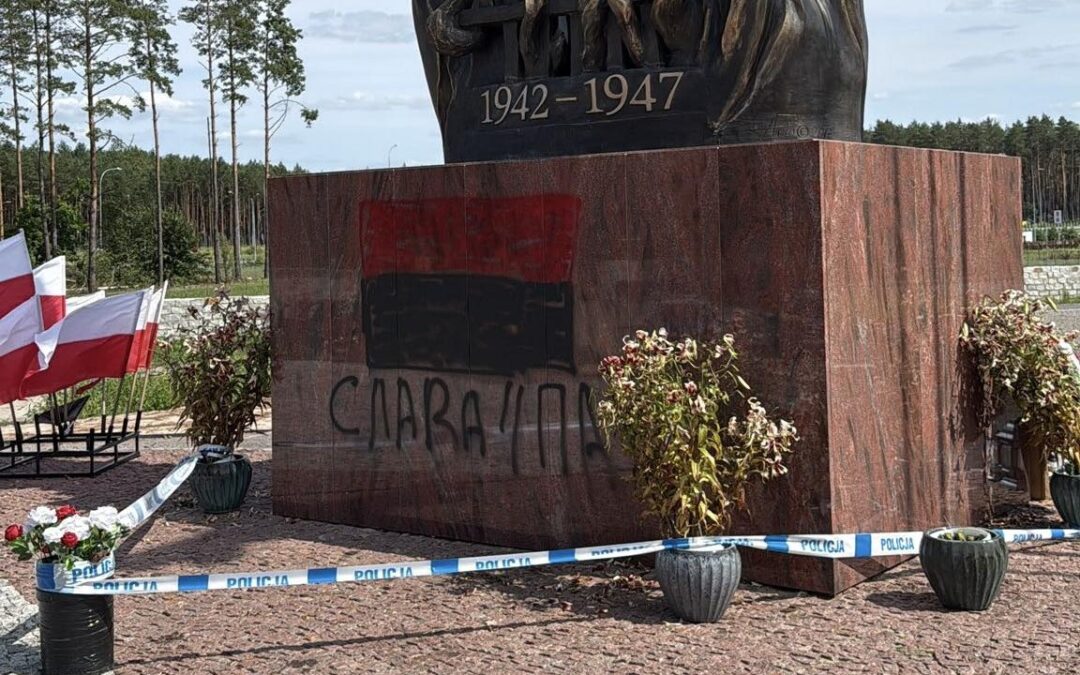
Among the sites where he placed graffiti were a monument to Polish victims of those massacres (pictured above), as well as a memorial dedicated to the heroes of the Warsaw Ghetto Uprising. If found guilty, the suspect could face up to life in prison.
The history of the UPA has been at the heart of an ongoing diplomatic dispute between Warsaw and Kyiv. However, the actions in this particular case took place in 2024 and 2025, before the current crisis emerged.
Prokurator z dolnośląskiego wydziału PZ PK skierował do Sądu Okręgowego we Wrocławiu akt oskarżenia przeciwko Illii K., któremu zarzucono popełnienie 47 przestępstw związanych z działalnością dywersyjną i sabotażową na rzecz obcego wywiadu.
45 zarzutów dotyczy umieszczania na…
— Prokuratura (@PK_GOV_PL) July 16, 2026
The suspect in the case was detained in August 2025, shortly after graffiti glorifying the UPA had appeared on a monument in Poland honouring victims of the so-called Volhynia massacres, in which the UPA led the slaughter of around 100,000 Poles.
On Thursday, prosecutors announced that they have issued an indictment against the suspect, whom they named only as Illia K. under Polish privacy law. He is accused of 47 crimes in total.
Of those, 45 are for “acts of subversion and sabotage for the benefit of foreign intelligence, consisting primarily of writing slogans in Ukrainian on the facades of buildings and in memorial sites with the text ‘Glory to the UPA’ and red-and-black flags attributed to the UPA “, prosecutors said.
Those actions “were aimed at inciting hatred on national grounds, deepening antagonisms between Poles and Ukrainians, causing social unrest and creating a sense of helplessness of state authorities”.
There have long been tensions between Poland and Ukraine over the massacres, which Poland recognises as a genocide. Ukraine rejects that label, and also continues to honour the UPA for its role in fighting for independence from Moscow-backed Soviet rule.
The issue has recently flared up again after President Volodymyr Zelensky in late May named a Ukrainian military unit after the “heroes of the UPA”. That sparked widespread anger in Poland and prompted Polish President Karol Nawrocki to strip Zelensky of his country’s highest honour.
Russia has also long sought to exploit such tensions, and Poland’s Internal Security Agency (ABW) notes that Illia K.’s actions were carried out “at the request of the Russian security services”, which were seeking to “incite conflicts between the Polish and Ukrainian nations”.
Russia has published purported archival documents relating to massacres of Poles by Ukrainians in WWII.
Kyiv had warned that Russia was planning to release the files in order to stir tensions, while Polish media note that the material contains nothing new https://t.co/CI0cfAlDle
— Notes from Poland 🇵🇱 (@notesfrompoland) July 6, 2026
In addition, Illia K. also faces one charge of participation in an organised criminal group and another of preparing for an act of subversion or sabotage that would have involved flying a drone over Poland’s Armed Forces Day parade in Warsaw last year, which was attended by President Nawrocki.
Prosecutors note that the accused “acted for financial, not ideological, reasons”. He was paid for his actions in cryptocurrencies. That is typical of the so-called “disposable agents” Russia increasingly uses, who are amateurs – often young Ukrainians or Belarusians – hired and paid through messaging service Telegram.
The suspect has been held in pretrial detention since he was arrested by the ABW last year. If found guilty, he could face up to life in prison.
Prosecutors say that, although Illia K. initially admitted to the charges against him, he later decided to change his stance and has pleaded not guilty while exercising his right to remain silent.
The head of Poland's security services has appealed to Ukrainians, the country's largest immigrant group, not to be tempted to earn money by acting as Russian agents.
Russia regularly recruits Ukrainians in Poland to carry out espionage and sabotage https://t.co/aa5UUWWBrx
— Notes from Poland 🇵🇱 (@notesfrompoland) October 28, 2025
Poland has in recent years detained, charged and in some cases convicted dozens of agents accused of carrying out espionage, sabotage and other so-called “hybrid actions” on behalf of Russia and its ally Belarus.
In March, the International Centre for Counter-Terrorism (ICCT) reported that Poland is now the “primary focus of Russian activity” when it comes to sabotage.
In June, foreign minister Radosław Sikorski warned that Moscow is “waging a full-scale cognitive war against us” and that there is a “Russian fifth column” operating in Poland.
Russia is “waging a full-scale cognitive war against us”, Polish foreign minister @sikorskiradek has warned.
He also said that there is a “Russian fifth column” operating in Poland https://t.co/wsmZSvYnzN
— Notes from Poland 🇵🇱 (@notesfrompoland) June 9, 2026
Notes from Poland is run by a small editorial team and published by an independent, non-profit foundation that is funded through donations from our readers. We cannot do what we do without your support.
Main image credit: Konrad Berkowicz/Facebook
Olivier Sorgho is senior editor at Notes from Poland, covering politics, business and society. He previously worked for Reuters.