Keep our news free from ads and paywalls by making a donation to support our work!

Notes from Poland is run by a small editorial team and is published by an independent, non-profit foundation that is funded through donations from our readers. We cannot do what we do without your support.
Poland has for the first time used DNA testing to identify the remains of Poles massacred by Ukrainian nationalists during World War Two.
The process has allowed eight individuals whose remains were exhumed in Ukraine last year to be named. Their families were presented with identification certificates by the Polish culture ministry on Monday.
“After more than 80 years, families are receiving the answer they have awaited for generations,” said culture minister Marta Cienkowska. “This is a victory of truth over anonymity and of dignity over oblivion.”
Dwa dni temu wspominaliśmy dziesiątki tysięcy ofiar zbrodni wołyńskiej dokonanej przez ukraińskich nacjonalistów.
Dziś osiem z nich odzyskuje imiona i nazwiska.
śp. Bronisława Karpińska,
śp. Maria Karpińska,
śp. Maria Szafrańska,
śp. Władysława Szafrańska,
śp. Mikołaj… pic.twitter.com/olpEhj7dYo— Marta Cienkowska (@MartaCienkowska) July 13, 2026
Bronisława and Maria Karpińska, Maria and Władysława Szafrańska, Mikołaj Szafrański, Adolf and Bronisław Dancewicz, and Henryk Fedorowicz are the eight individuals who have been identified as victims of a massacre in the village of Puźniki (Puzhnyky in Ukrainian) in 1945.
Their remains were among those of at least 43 people that were located and exhumed in the now-depopulated village last year. That moment in itself represented a breakthrough: it was the first exhumation Ukraine permitted to take place after a previous eight-year moratorium.
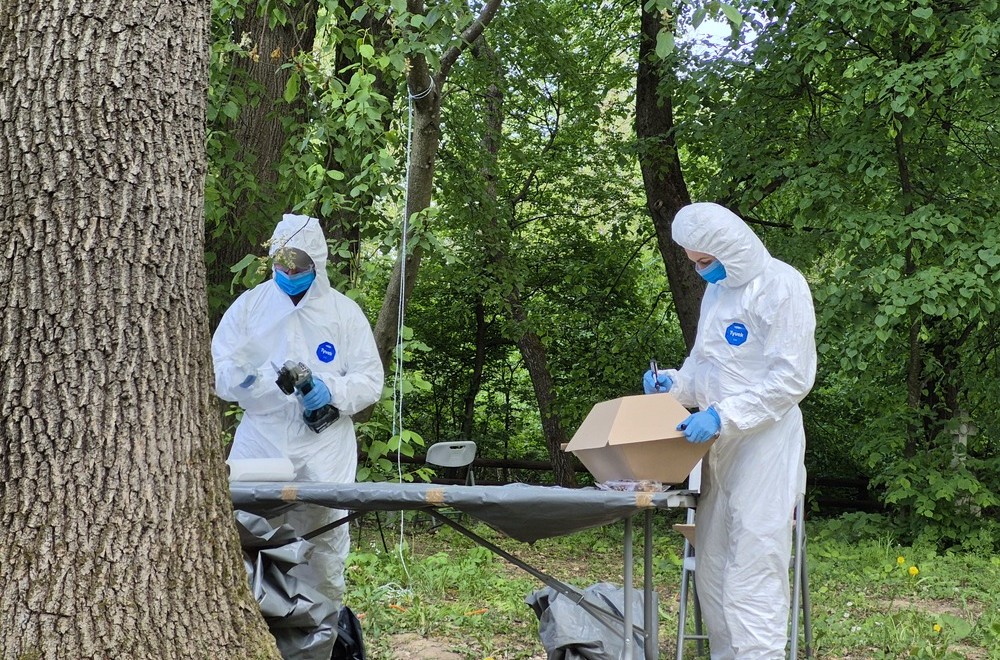
Cienkowska and her Ukrainian counterpart, Tetyana Berezhna, last September attended a ceremony to rebury the remains. Since then, researchers at the Pomeranian Medical University have been carrying out genetic studies of material from the victims in an effort to identify them.
Thanks to their work, “a name can finally be engraved on a grave, and this person will no longer be an anonymous victim of history”, said Cienkowski. However, she noted that “we still have much work ahead of us, more names are waiting to be found, and more families are waiting for answers”.
Polish victims of massacres committed by Ukrainian nationalists in WWII have been reburied in Ukraine at a ceremony attended by officials from both countries.
Their remains were exhumed this year following a diplomatic breakthrough between Kyiv and Warsaw https://t.co/FQwhjXOZDb
— Notes from Poland 🇵🇱 (@notesfrompoland) September 6, 2025
During the Volhynia massacres, around 100,000 Polish civilians, mostly women and children, were killed. Often, whole villages were wiped out in the attacks. Poland’s Institute of National Remembrance (IPN) believes that most of the victims remain buried in unmarked mass graves in Ukraine.
The issue has long been a point of tension between Poland, which recognises the massacres as a genocide, and Ukraine, which rejects that label. The decision by Kyiv to allow exhumations to resume last year was regarded as a major step towards reconciliation.
However, that process was undermined in May, when Ukrainian President Volodymyr Zelensky decided to name a military unit after the “heroes of the Ukrainian Insurgent Army (UPA)”, the group responsible for leading the Volhynia massacres.
That in turn prompted an angry response from Warsaw, where President Karol Nawrocki stripped Zelensky of Poland’s highest honour. Efforts to reach a solution to the crisis have so far not yielded fruit.
However, despite those difficulties, exhumations are continuing. Last week, Ukraine’s Institute of National Remembrance (UINP) announced that work would begin yesterday in the former Polish villages of Ostrówki and Wola Ostrowiecka (Ostrivky and Volya Ostrovetska in Ukrainian).
Late last year, Ukraine authorised searches there for remains and, in April this year, mass graves were discovered. Poland’s IPN then requested permission for exhumation, which has now been granted by the Ukrainian side.
In a statement last Saturday, when Poland was marking its day of commemoration for victims of the massacres, Zelensky pointed to the exhumation work in Ostrówki and Wola Ostrowiecka as evidence that “Ukraine is doing its part to fairly establish the facts about those who were killed in those years”.
“What we need is the full truth and a Christian commemoration of the victims,” he added. “But we must also remember that today, in our own time, Ukraine and Poland face one common threat…[and] that is Russia.”
Every year on this day, Poland and Ukraine honor the memory of people – civilians – who were killed in Volyn during the Second World War. Today, representatives of the Ukrainian state took part in joint prayer services alongside representatives of the Polish state – both here in…
— Volodymyr Zelenskyy / Володимир Зеленський (@ZelenskyyUa) July 11, 2026
However, Zelensky’s statement did not include any information on who the victims or the perpetrators of the massacres were.
Poland is demanding that Ukraine do more to acknowledge the murderous actions of the UPA, which is still revered in Ukraine for its role in fighting for independence from Moscow-backed Soviet rule.
During Saturday’s commemorations of the massacres in Poland, Polish Prime Minister Donald Tusk announced that a new “Wall of Remembrance” would be established in Warsaw to which the names of victims of the massacres would be added as they are identified.
Poland has held its annual commemoration of the massacre of Poles by Ukrainian nationalists in WW2
This year's event took on particular significance amid a dispute with Ukraine over its decision to name a military unit after a group that led the massacres https://t.co/lrEDF3qZqS
— Notes from Poland 🇵🇱 (@notesfrompoland) July 11, 2026
Notes from Poland is run by a small editorial team and published by an independent, non-profit foundation that is funded through donations from our readers. We cannot do what we do without your support.
Main image credit: MKiDN (under CC BY-SA 4.0)

Daniel Tilles is editor-in-chief of Notes from Poland. He has written on Polish affairs for a wide range of publications, including Foreign Policy, POLITICO Europe, EUobserver and Dziennik Gazeta Prawna.