Keep our news free from ads and paywalls by making a donation to support our work!

Notes from Poland is run by a small editorial team and is published by an independent, non-profit foundation that is funded through donations from our readers. We cannot do what we do without your support.
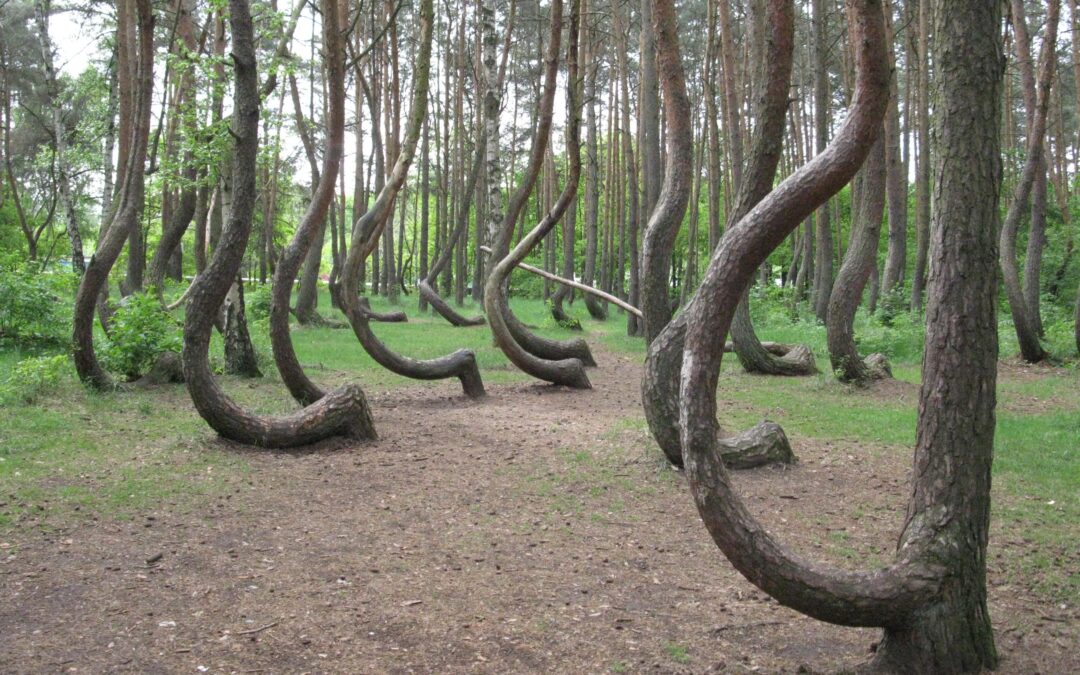
Scientists are seeking to solve the mystery of Poland’s “Crooked Forest” – a set of 90-year-old trees with bizarrely curved trunks – by developing “tree-bending technology” to recreate their unusual growth.
The Crooked Forest, located near the town of Gryfino in northwestern Poland, has long intrigued researchers, locals and tourists. Yet the reason why the pine trees have such dramatic C-shaped curves at the bottom of their trunks remains unknown.
Efforts to better understand the phenomenon have recently accelerated as some of the trees have been dying out, leading to fears that now is the last chance to unravel the mystery. The researchers and local authorities hope that the new project can create a “Crooked Forest 2.0” for future generations to enjoy.
The Crooked Forest is estimated to have been established around 1934 on a plot of land spanning around 1,600 square metres (17,222 square feet), reports the Polish Press Agency’s (PAP) science news service, Nauka w Polsce.
It once featured around 400 of the oddly curved trees, though now only around 100 remain. The forest has become a point of curiosity, drawing large numbers of tourists and sparking various theories about how the trees obtained their unusual shape.
Gryfino Forest District says the grove was “probably created as a result of deliberate human activity, cultivating crooked trees for useful purposes”. Hypotheses about those purposes include using the curved trunks as material for furniture, boats, sleigh runners or wagon stanchions for transporting hay.
“Curved wood is significantly more resistant to stress than boards made by cutting straight trunks,” notes broadcaster RMF. “However, the lack of surviving documents from the period means these explanations remain only speculation.”
In 2021, amid concern over the fact that the trees were dying out, the Gryfino Forest District established a plot nearby where it planted pines genetically related to those in the Crooked Forest, as well as some of other origin.
Last week, Gryfino Forest District signed a cooperation agreement with the West Pomeranian University of Technology (ZUT) to test various bending methods on the recently planted trees in an attempt to recreate the effect seen on the original ones.
As part of these efforts, scientists will “develop tree-bending technology that will allow them to create a copy of the current crooked tree complex,” wrote Gryfino’s municipal authorities in an announcement of the plans.
Nowy Krzywy Las pod Gryfinem pomogą leśnikom ukształtować naukowcy z WKŚiR ZUT 🌲https://t.co/DxoD3GQxnE pic.twitter.com/YoZeXnknr0
— Zachodniopomorski Uniwersytet Technologiczny (@ZUTSzczecin) July 10, 2026
“We’ll begin by learning about the anatomy of these trees,” Marcin Kubus, a researcher at ZUT, told Nauka w Polsce. “We’ll examine the structure of wood fibres and other elements, which will allow us to see at what stage of their lives these trees were bent.”
“Then, through various nursery activities – pruning, bending, etc. – we will try to restore their picturesque shape as optimally as possible,” he added, emphasising that this must be done while the trees are still relatively young.
Daniel Pogorzelec of the Gryfino Forest District added that several different methods would be tested to see which creates an effect most similar to the original. However, he warned that it would be “a long process” that could even take decades to have the desired effect.
However, Jan Grzyś, head of the forest district, expressed hope that, if their efforts succeed, they will “create a Crooked Forest 2.0” that can be enjoyed by future generations.
Notes from Poland is run by a small editorial team and published by an independent, non-profit foundation that is funded through donations from our readers. We cannot do what we do without your support.
Main image credit: Rzuwig/Wikimedia Commons (under CC BY-SA 3.0)

Olivier Sorgho is senior editor at Notes from Poland, covering politics, business and society. He previously worked for Reuters.