Keep our news free from ads and paywalls by making a donation to support our work!

Notes from Poland is run by a small editorial team and is published by an independent, non-profit foundation that is funded through donations from our readers. We cannot do what we do without your support.
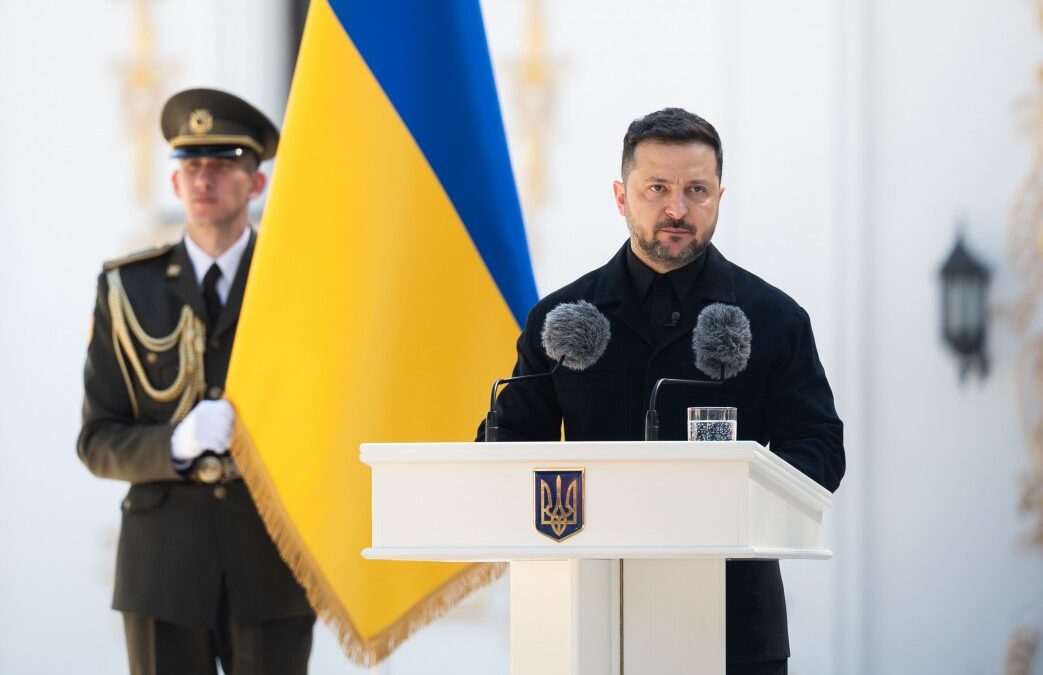
President Volodymyr Zelensky has declared that “no one will dictate” to Ukraine which heroes the country honours as he announced plans to establish a new national pantheon celebrating outstanding Ukrainians.
While Zelensky did not mention Poland directly, his remarks were interpreted as a reference to the ongoing dispute with Warsaw over the Ukrainian president’s decision to name a military unit after the “heroes” of a World War Two group that fought for Ukrainian independence but also massacred Poles.
His comments have been criticised by figures from across Poland’s political spectrum, with some suggesting Ukraine’s stance will hinder its negotiations to join the European Union.
2026 is a special year for our state. Ukraine is marking anniversaries: the adoption of the Constitution, the establishment of the Armed Forces of Ukraine, the restoration of our state symbols and the hryvnia. And the culmination of all this is August 24, 2026 – Independence Day… pic.twitter.com/HiTxIY7Bo8
— Volodymyr Zelenskyy / Володимир Зеленський (@ZelenskyyUa) June 28, 2026
Poland and Ukraine have been locked in a diplomatic dispute since the end of May, when President Volodymyr Zelensky named a military unit after the “heroes of the Ukrainian Insurgent Army (UPA)”.
In Ukraine, the UPA is remembered primarily for its role in fighting for Ukrainian independence from Moscow-imposed Soviet rule during and after World War Two. In Poland, however, it is associated with the Volhynia massacres, in which the UPA led the slaughter of around 100,000 ethnic Polish civilians.
On 19 June, after efforts to reach a diplomatic solution to the situation had failed, Poland’s president, Karol Nawrocki, followed through on his earlier pledge to strip Zelensky of the Order of the White Eagle, Poland’s highest honour.
That in turn prompted an angry response in Ukraine, including Zelensky cancelling plans to attend last week’s Ukraine Recovery Conference, which was being hosted by Poland.
On Sunday, in a speech marking Ukraine’s Constitution Day, Zelensky declared that “no one, ever, will dictate how we should live, how we should speak, whom we should love, whom we should be grateful to, or which heroes we should honour”.
He announced that he had presented to parliament a proposed law to create a Ukrainian National Pantheon that would ensure that “the names of all the heroes who, across different centuries and eras, fought for Ukraine and inspired Ukraine will be brought together and forever inscribed in our history”.
The Ukrainian president’s office added that the pantheon would honour those who fought for independence, built and defended the Ukrainian state, and contributed to culture, science, sport, civil society, religion and the Ukrainian language. It did not indicate which individuals or groups might be included.
No one will ever again dictate to Ukrainians which heroes to honor, which holidays to celebrate, or which history to study. Our ancestors fought for centuries for this right to freedom of choice and national independence, and it is for this very right that our warriors are…
— Kyrylo Budanov (@Kyrylo_Budanov) June 28, 2026
In Poland, however, Zelensky’s announcement was widely interpreted as a further escalation of his stance on the “heroes of the UPA”.
Former Prime Minister Mateusz Morawiecki, now deputy leader of the national-conservative Law and Justice (PiS) party, called it “another slap in the face to Poland”. He blamed the “servile policy” of Prime Minister Donald Tusk’s government, which has criticised opposition-aligned Nawrocki’s tough stance.
Morawiecki called for Poland to block the conclusion of negotiations on Ukraine’s EU accession until there is “full agreement on historical truth, exhumations [of Polish massacre victims in Ukraine], and an end to the cult of the UPA…and other criminals”.
Ewa Zajączkowska-Hernik, an MEP from the far-right Confederation (Konfederacja), another opposition group, said that Zelensky’s latest announcement shows that he “not only has no intention of backing down…[but] is actually going further and showing us the middle finger”.
Słowa prezydenta Zełenskiego to kolejny policzek wymierzony Polsce, będący efektem służalczej polityki rządu Tuska, który zamiast ramię w ramię z Prezydentem @NawrockiKn bronić polskiej pamięci, pozwala Kijowowi przekraczać kolejne granice.
Ukraina nie będzie nam mówić, że…
— Mateusz Morawiecki (@MorawieckiM) June 28, 2026
Meanwhile, Robert Kropiwnicki, an MP from Tusk’s centrist Civic Coalition (KO) party, warned that, “if Zelensky thinks that by escalating the conflict with Poland, Ukraine will join the EU, he may be in for a major disappointment”.
Anna-Maria Żukowska, the head of the parliamentary caucus of The Left (Lewica), a junior partner in Tusk’s ruling coalition, wrote that Zelensky’s actions show that Ukraine has decided “it doesn’t need us [Poland] any more”.
In order to join the EU, Ukraine needs the consent of all current member states. However, in recent years, both Nawrocki and a deputy prime minister in Tusk’s government, Władysław Kosiniak-Kamysz, have warned that Poland will not allow that to happen until Kyiv “resolves” historical issues.
Long-simmering tensions between Poland and Ukraine over WWII massacres have finally boiled over, prompting a diplomatic crisis.@danieltilles1 looks at how we got here and what it may mean for the two countries and Europe more broadly https://t.co/a8tiYJJHRr
— Notes from Poland 🇵🇱 (@notesfrompoland) June 22, 2026
Speaking on Monday to news service Wirtualna Polska, Karol Rabenda, an aide to Nawrocki, said that, while Ukraine has the right to honour whomever it wants, “they must also consider the consequences that this entails”.
Rabenda said that the UPA and the Organisation of Ukrainian Nationalists (OUN), another historical group, “adhered to Nazi ideology”.
“Does [Zelensky] want to apply for EU membership with swastikas? Does he want to build Ukraine’s historical memory with Hitler’s collaborators? This is his choice, and he will bear responsibility for it,” said Rabenda.
"Muszą się liczyć z konsekwencjami". Prezydencki minister @KarolRabenda o ruchu Zełenskiego
🎙️@tzolciak pic.twitter.com/KOFPLKvSCe
— Wirtualna Polska (@wirtualnapolska) June 29, 2026
Notes from Poland is run by a small editorial team and published by an independent, non-profit foundation that is funded through donations from our readers. We cannot do what we do without your support.
Main image credit: President of Ukraine (under CC BY-NC-ND 4.0)

Daniel Tilles is editor-in-chief of Notes from Poland. He has written on Polish affairs for a wide range of publications, including Foreign Policy, POLITICO Europe, EUobserver and Dziennik Gazeta Prawna.