
Keep our news free from ads and paywalls by making a donation to support our work!

Notes from Poland is run by a small editorial team and is published by an independent, non-profit foundation that is funded through donations from our readers. We cannot do what we do without your support.
Poland has risen to its highest-ever level in a measure of household prosperity in European Union member states, overtaking four other countries since last year.
The new figures, released by Eurostat, the EU’s statistical agency, also show that, for the first time, Poland is top among the eastern member states that have joined the EU since 2004.
The measure, called actual individual consumption (AIC), calculates the value of all goods and services consumed by households, both those purchased directly as well as those provided by the government (such as health and education) and nonprofit organisations.
Eurostat says that this measure is preferable to gross domestic product (GDP) per capita, which is an indicator of the economic strength of a country but not necessarily of individual consumers.
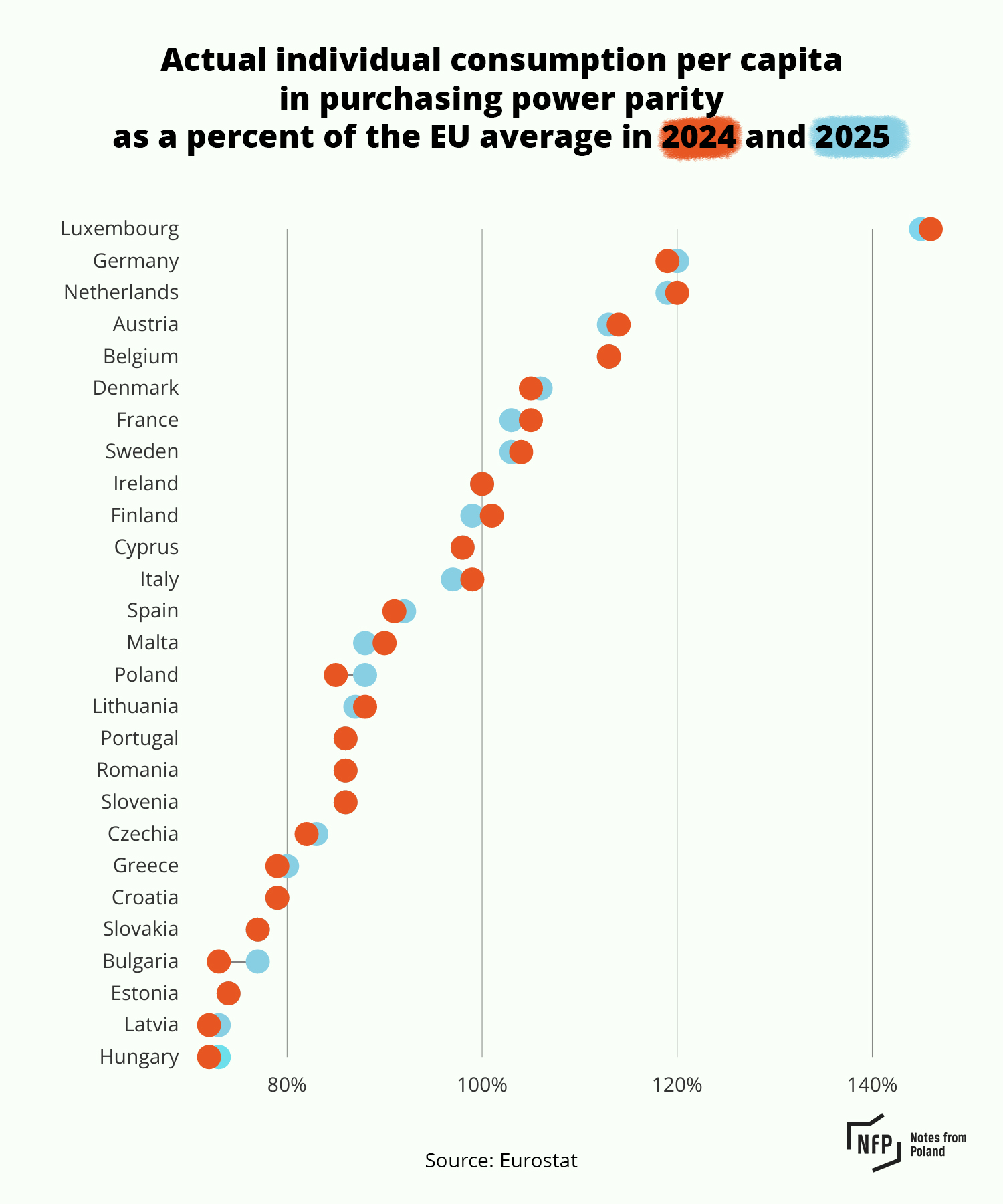
In its latest data on AIC per capita adjusted for price level differences between countries – known as purchasing power parity (PPP) – Eurostat found that Poland reached 88% of the EU average in 2025.
Poland’s figure, which is up from 85% in 2024, means that in 2025 it overtook Portugal, Romania and Slovenia (all now on 86%) as well as Lithuania (87%). Poland is now level with Malta (88%) in joint 14th place among the 28 EU member states, just behind Spain (92%).
When Eurostat first began collecting such data in 1995, Poland’s AIC stood at just 45% of the EU average, showing how rapidly the country’s economy and standard of living have risen over the last three decades.
This year’s data also mark the first time that Poland has led among the group of 10 eastern member states that have joined the EU since 2004, which also include Bulgaria, Croatia, the Czech Republic, Estonia, Hungary, Latvia, Lithuania, Romania, Slovakia and Slovenia.
At the top of this year’s ranking, Luxembourg recorded actual individual consumption at 145% of the EU average, followed by Germany (120%) and the Netherlands (119%). The lowest levels were in Hungary and Latvia (both 73%) and Estonia (74%).
Poland’s economy has moved closer than ever to the EU average, new @EU_Eurostat data show.
Its GDP per capita, adjusted for cost of living, reached 81% of the EU average in 2025. That is Poland's highest ever figure, and up from 44% three decades ago https://t.co/DCTyps6uDT
— Notes from Poland 🇵🇱 (@notesfrompoland) March 26, 2026
The new data also show that Poland recorded the second-largest year-on-year increase in AIC, rising by three percentage points since 2024, behind only Bulgaria’s four-point jump. Poland also narrowed the gap with Spain to four percentage points, from six in 2024.
Previously, in 2022, Eurostat reported that Poland had overtaken Spain on its measure of AIC. However, the agency revised its methodology last year and applied the changes retrospectively, producing updated estimates showing that Poland did not, in fact, surpass Spain.
A longer-term comparison shows continued convergence between eastern and western EU economies. Over the past decade, the strongest gains in actual individual consumption were recorded in Romania (27 percentage points), Bulgaria (22 points) and Croatia (16 points), the bloc’s most recent entrants.
Among countries that joined the EU in 2004, Poland has posted the largest increase since 2015, rising by 11 percentage points relative to the EU average, ahead of Latvia and Slovenia (both 10 points).
Poland has emerged as Europe’s undisputed growth champion over the past 35 years.
In the first part of a new series of articles and podcasts, @AlicjaPtak4 explores the reasons behind Poland's rapid economic development, and the dangers that may lie ahead https://t.co/bW3bnV7Ozn
— Notes from Poland 🇵🇱 (@notesfrompoland) July 7, 2025
Since the fall of communism in 1989 and the transition to a market economy, Poland has been one of the world’s fastest-growing countries.
By 2024, its GDP per capita had reached $25,060, up from $2,700 in 1994, according to IMF data. In absolute terms, Poland’s economy is forecast to overtake Switzerland’s to become the world’s 20th largest by 2028.
The share of people in Poland who say they are financially comfortable has risen this year to a record 39%, up from 3% in the early 1990s, according to a long-running survey by state research agency CBOS.
According to real estate consultancy Knight Frank, the number of ultra-wealthy individuals in Poland has also more than doubled over the past five years, a faster rate of growth than anywhere else in the world. Meanwhile, the level of severe deprivation has fallen to 2%, its lowest ever level.
The number of ultra-wealthy individuals in Poland has more than doubled since 2021, a faster rate of growth than anywhere else in the world, according to a new study https://t.co/MNKgmjzn2U
— Notes from Poland 🇵🇱 (@notesfrompoland) May 11, 2026
Notes from Poland is run by a small editorial team and published by an independent, non-profit foundation that is funded through donations from our readers. We cannot do what we do without your support.
Main image credit: Jakub Zerdzicki/Pexels

Alicja Ptak is deputy editor-in-chief of Notes from Poland and a multimedia journalist. She has written for Clean Energy Wire and The Times, and she hosts her own podcast, The Warsaw Wire, on Poland’s economy and energy sector. She previously worked for Reuters.