Keep our news free from ads and paywalls by making a donation to support our work!

Notes from Poland is run by a small editorial team and is published by an independent, non-profit foundation that is funded through donations from our readers. We cannot do what we do without your support.
President Karol Nawrocki has warned that Poland should not repeat “the mistake of Western countries” by trying to use immigration as the solution to its demographic problems.
He instead called for efforts to “promote the idea that family is the most important thing”, saying that this must include politicians, business leaders and society as a whole.
Prezydent RP @NawrockiKn o demografii podczas Poland Future Summit. pic.twitter.com/YrKmYnUj1r
— Kancelaria Prezydenta RP (@prezydentpl) June 22, 2026
Poland has long been grappling with a shrinking, ageing population. Last year saw the number of births fall to a new post-war low of 238,000, while deaths totalled 406,000. That marked the 13th consecutive year in which more people died than were born in Poland.
The country’s fertility rate – meaning the average number of children that are born to a woman over her lifetime – fell to a new record low of 1.068 in 2025.
That is one of the lowest figures anywhere in the world and well below the so-called “replacement rate” – the figure needed to ensure that the population does not decline – which is generally defined as 2.1.
Poland’s fertility rate, already one of the lowest in the world, fell to a new record low of 1.07 in 2025, deepening concerns over the country's shrinking and ageing population https://t.co/OMGC1MpA5l
— Notes from Poland 🇵🇱 (@notesfrompoland) May 28, 2026
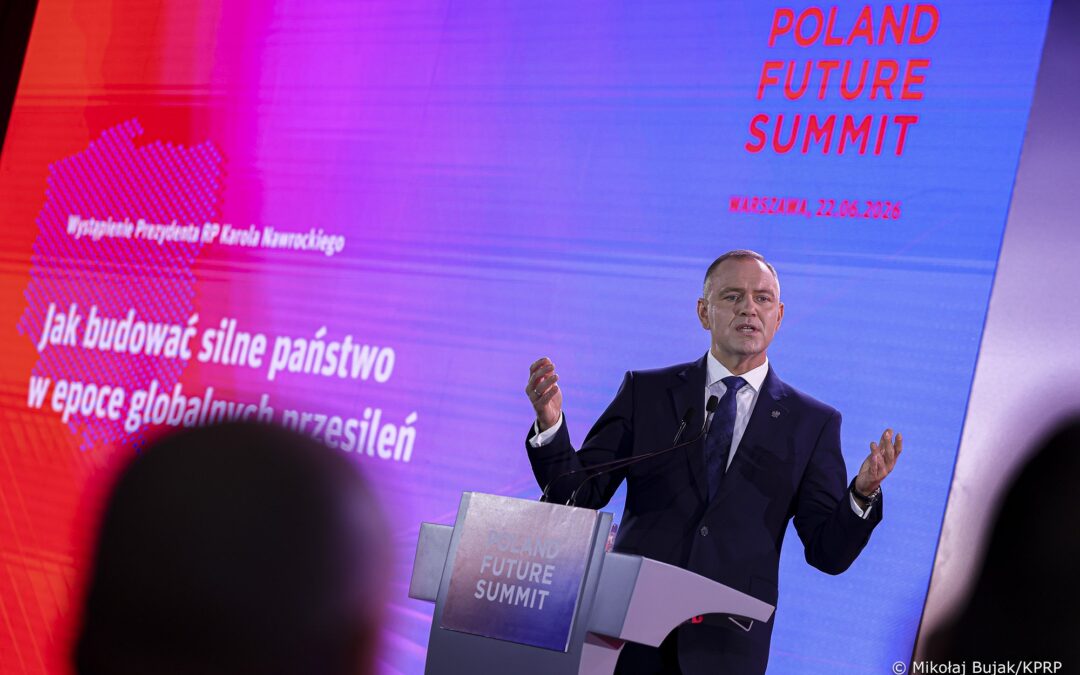
On Monday, Nawrocki, a conservative elected to office last year, addressed these challenges during a keynote speech at the Poland Future Summit in Warsaw, which was co-organised by his chancellery and the Centre for Development Strategies (CSR).
“It will be impossible to build a strong, secure state, and a state that develops, without overcoming the demographic crisis,” warned the president.
However, Poland must also avoid “the mistakes of Western countries, which replaced the demographic crisis with mistakes in migration policy”, he added.
“Migration…has not solved the problem; it has only brought ghettoisation, assimilation problems, social unrest, and everything else western Europe is grappling with today,” said Nawrocki. “This is not, and will not be, the Polish path. We will not replace the demographic crisis by succumbing to migration pressure.”
Instead, argued Nawrocki, “the solution lies in…a clear focus on the Polish family”. We must “promote the idea that family is the most important thing; this is our Polish response to the demographic crisis”.
The president said that some of the responsibility for this lies with politicians. He noted that he had last year proposed a bill to cut income tax for parents of two or more children. Nawrocki criticised the more liberal ruling coalition, with which he regularly clashes, for not proceeding with it.
However, he also noted that such measures are in any case not enough on their own. “A certain mode of thinking must change” among “society as a whole”, he said. And business must also play a role in making creating environments that “put families first”.
“This includes introducing greater flexibility in working hours and employment relationships, and recognising women who return to work after childbirth, rather than punishing them,” said the president.
One of Poland's largest hotel and real estate firms is offering rewards to clients who conceive babies at its properties in an effort to tackle the country's demographic crisis https://t.co/uwNNngBP2o
— Notes from Poland 🇵🇱 (@notesfrompoland) September 19, 2025
Successive Polish governments have introduced various measures intended to boost the birth rate, though so far without clear success.
The flagship policy of the former national-conservative Law and Justice (PiS) government was a child benefit programme that gives monthly payments to parents for each child they have. While there was a brief bump in births after it was introduced in 2016, numbers subsequently continued their downward trend.
The current government, a coalition ranging from left to centre right led by Prime Minister Donald Tusk, has introduced new payments to support parents who return to work. It also restored funding for IVF treatment, which was previously cut by PiS.
Over 15,000 children have been born in Poland as a result of state funding for IVF treatment since it was restored by the government two years ago.
Previously, IVF funding had been cut off by the former national-conservative PiS administration https://t.co/VnNIdaSskf
— Notes from Poland 🇵🇱 (@notesfrompoland) June 1, 2026
Meanwhile, despite the anti-immigration rhetoric of both PiS and the Tusk government, Poland has seen levels of immigration over the last decade that are unprecedented in the country’s history and among the highest anywhere in Europe.
In each year between 2017 and 2022, Poland issued more first residence permits to migrants from outside the EU than did any other member state. There are now two million legal foreign residents in Poland, representing 5% of the population, including 1.14 million foreign workers, making up 7% of the workforce.
In 2023, Poland’s state Social Insurance Institution (ZUS) reported that the country would need to attract a further two million immigrant workers over the next decade to maintain its current ratio of working-age population to retirees. However, it admitted that that target was “unrealistic”.
The number of foreign workers in Poland rose 7.2% last year to reach 1.14 million.
Immigrants now make up almost 7% of all workers. While Ukrainians remain by far the largest group, the fastest-growing nationalities last year were Colombians and Indians https://t.co/E0LNJXyyTx
— Notes from Poland 🇵🇱 (@notesfrompoland) June 9, 2026
Notes from Poland is run by a small editorial team and published by an independent, non-profit foundation that is funded through donations from our readers. We cannot do what we do without your support.
Main image credit: Mikołaj Bujak/KPRP

Daniel Tilles is editor-in-chief of Notes from Poland. He has written on Polish affairs for a wide range of publications, including Foreign Policy, POLITICO Europe, EUobserver and Dziennik Gazeta Prawna.