Keep our news free from ads and paywalls by making a donation to support our work!

Notes from Poland is run by a small editorial team and is published by an independent, non-profit foundation that is funded through donations from our readers. We cannot do what we do without your support.
By Maria Kędzior
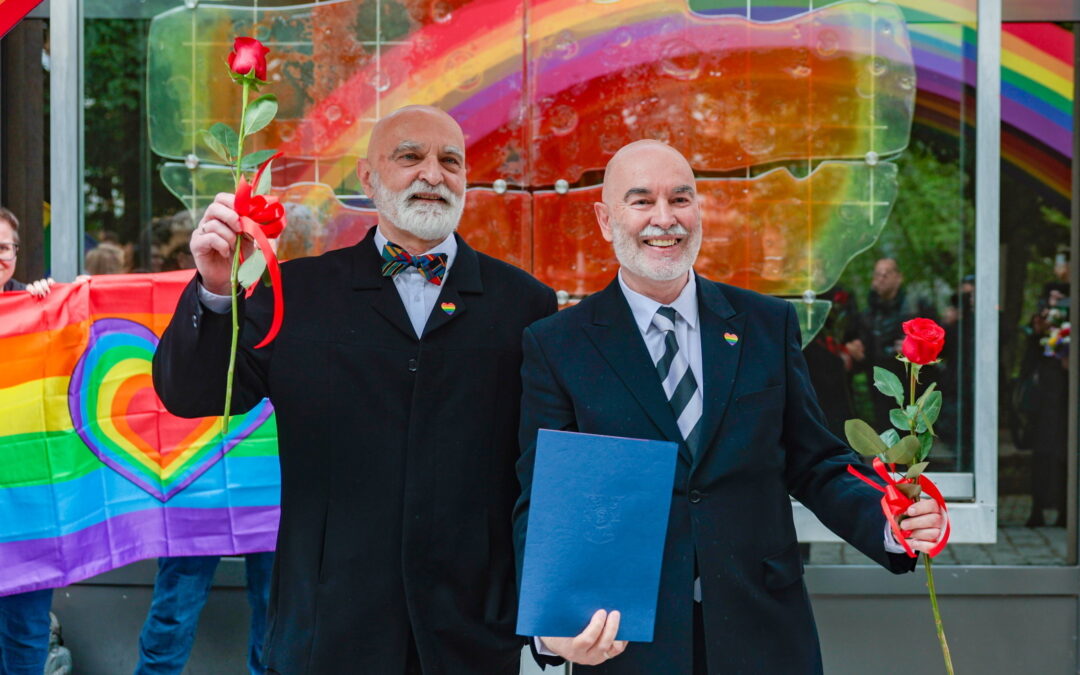
On 14 May 2026, Warsaw became the first place in Poland to recognise a same-sex union, by transcribing a marriage conducted by two Polish men in Germany into its civil registry. It was a bureaucratic act, but its legal implications are anything but routine.
Prime Minister Donald Tusk’s government has since issued a regulation allowing registry offices nationwide to also recognise same-sex marriages conducted in other European Union member states, thereby implementing rulings by the Court of Justice of the EU (CJEU) and the Polish Supreme Administrative Court (NSA).
The government has issued a regulation allowing foreign same-sex marriages to be entered in the civil registry
The decision comes in response to an EU court order and marks a major change in a country that does not allow same-sex unions under domestic law https://t.co/2an5mGtnHl
— Notes from Poland 🇵🇱 (@notesfrompoland) May 22, 2026
Yet, given that Polish domestic law does not allow for any form of same-sex union – while the constitution states that marriage “as a union of a man and a woman” shall be protected by the state – there remains great uncertainty as to what transcription into the civil registry will actually mean for same-sex couples.
Will they receive the same rights as other married couples, such as joint property and tax settlement, exemption from inheritance and gift taxes, and access to their partner’s medical information?
The question is all the more pressing because, with conservative President Karol Nawrocki likely to veto any legislative efforts by the more liberal government to broaden LGBT+ rights, the courts have become the primary battlefield on which the issue will be played out.
We therefore asked five experts on the law, human rights and LGBT+ advocacy what they believe the legal consequences of transcribing same-sex marriages into the Polish civil registry will be.
“The consequences are not yet known”
Anna Mikołajczyk, the office of Poland’s commissioner for human rights
At present, the legal consequences of accepting marriage certificates issued abroad into Polish civil registers are not yet known, apart from those arising from European Union law in the context of the EU’s freedom of movement and residence.
Transcription itself consists of the transfer of foreign civil status records to Polish registers. The Act of 28 November 2014 on Civil Status Records does not attach any further consequences to the act of transcription. However, the transcription of these records should not be treated as a purely symbolic matter.
Poland is obliged to implement the judgements of the European Court of Human Rights concerning the recognition and protection of same-sex relationships within the Polish legal system (e.g. the judgement of 19 September 2024 in the case of Formela and Others v. Poland), which amounts to regulating the rights and obligations associated with this. Such regulation should be enshrined in an act of law.
The EU court has ruled that Poland must recognise the marriage of a Polish same-sex couple who married in Germany, even though Polish law does not allow such marriages.
The ruling requires Poland to change its system for recognising such marriages https://t.co/upbcxVEdd8
— Notes from Poland 🇵🇱 (@notesfrompoland) November 25, 2025
“The constitution does not define marriage as a union between a man and a woman”
Jarosław Jagura, Helsinki Foundation for Human Rights
Public authorities and various institutions should not treat foreign marriages whose documents have been transcribed into Polish civil registers differently on the basis of whether they are same-sex or opposite-sex marriages.
Nor is this precluded by article 18 of the Polish constitution, which, contrary to some opinions, does not contain a legal definition of marriage as a union between a man and a woman. The constitution states that such a union (the marriage of a man and a woman) is protected by the state, which does not, of course, preclude the possibility that there may also be other legally recognised unions that will benefit from such state protection.
In its judgement of November 2025, the CJEU did not use the wording familiar from earlier rulings, namely that the recognition of marriages is solely “for the purposes of exercising the freedom of movement of persons” – that is, movement and residence within the EU – which would suggest a narrow interpretation of this situation.
Spouses should be able to continue their family life in another EU member state with similar guarantees of protection and similar rights, and not merely with the guarantee of ceremonial recognition of their relationship through the issue of a Polish marriage certificate, which would have no practical significance.
Therefore, the minimum standard should be the recognition of these marriages in all areas covered by EU regulations, such as tax, social security and inheritance matters. In practice, however, it will likely be necessary to go through numerous court proceedings once again, aimed at confirming the recognition of the rights of same-sex couples in all these areas.
Poland has legally recognised a same-sex relationship for the first time, after the city of Warsaw complied with a court order to transcribe into its civil registry a marriage between two Polish men that took place in Germany https://t.co/LOUWHHLRqe
— Notes from Poland 🇵🇱 (@notesfrompoland) May 14, 2026
“The beginning of a long journey”
Jakub Jaraczewski, Democracy Reporting International
The legal consequences of Polish authorities accepting same-sex marriage certificates issued abroad will be complicated due to the absence of domestic legislation on same-sex unions in Poland. Whether the rights and freedoms conferred on heterosexual marriages concluded in Poland will be applied to same-sex unions concluded abroad will, in practice, come down to decisions by individual public authorities – and private actors.
Some, such as the Polish social security authority, ZUS, and the healthcare authority, NFZ, have already indicated that they will treat such couples the same as Polish heterosexual marriages. In the area of taxation, no clear answers have emerged so far, and same-sex couples will likely have to request individual interpretations from tax authorities as to whether they can file taxes jointly and claim benefits as heterosexual marriages do.
Beyond dealing with public institutions, same-sex couples will face uncertainty in interaction with various private actors – be it banks, service providers or residential communities.
The recent judgement of the CJEU and the reaction by Polish authorities are only the beginning of a long journey towards shaping the legal status of same-sex marriages concluded abroad, which will not be fully resolved until Poland manages to introduce legislation resolving these issues.
The government’s majority in parliament has approved a bill that would grant same-sex partners some of the rights available to married couples.
However, President Nawrocki, who is aligned with the right-wing opposition, has made clear he will veto the law https://t.co/hx8viUN6QH
— Notes from Poland 🇵🇱 (@notesfrompoland) May 29, 2026
“An important step towards marriage equality”
Maja Heban, LGBT+ advocacy group Miłość Nie Wyklucza
Couples who obtain a Polish marriage certificate through transcription now have strong grounds to apply for the various rights to which married couples are entitled. How this will work in practice depends on ministers and the institutions under their authority, and ultimately on lower-ranking officials.
ZUS and the NFZ have already announced that they will recognise same-sex marriages in the context of social security and health insurance. Other issues remain unresolved, and there has been no communication from the government on this matter.
This will be a problem for future governments, as any refusal to recognise a specific right – including the highly taboo issue of adoption – will provide grounds for legal battles. Today, we owe the right to transcription to rulings by the CJEU, the Supreme Administrative Court and provincial courts, and, in a few years, we will have such rulings on specific legal safeguards.
In this context, accepting foreign marriage certificates is an important step towards marriage equality. Politicians must prepare for this, because there will be no consent for discussing civil partnerships and contractual alternatives now that Poland is already recognising marriages.
The far-right Confederation group has proposed a law banning adoption by same-sex couples, including the adoption of a spouse’s child, saying it will “protect the youngest from depravity”.
It comes after Poland began recognising foreign same-sex marriages https://t.co/ztdzkqmiT6
— Notes from Poland 🇵🇱 (@notesfrompoland) May 21, 2026
“The practical consequence is not ‘equal rights’ but legal confusion and chaos”
Rafał Dorosiński, Ordo Iuris, a conservative legal think tank and litigation centre
To answer this directly: no, these same-sex couples will not obtain the rights afforded to married couples.
First, individual judgements of the Supreme Administrative Court are binding only in the specific cases in which they were issued. They do not establish a legal norm and do not alter the legal situation for anyone other than the parties to the proceedings in question.
Second, marriage is a matter governed by the constitution and the civil code. It is defined in article 18 of the constitution and article 1(1) of the family and guardianship code as a union between a man and a woman. The regulation of the digital affairs minister amending the marriage certificate template cannot modify either the law or the constitution, and is itself not a source of law.
Third, it is worth noting what is actually happening here. The government is resorting to the lowest-ranking instrument in the hierarchy of sources of law – a regulation – to circumvent the constitution and legislation. If a regulation could change the definition of marriage in violation of the constitution, then a regulation could change everything – and the Sejm, the Senate and the president would no longer be needed. This would mean trampling on the foundations of the rule of law.
Fourth, the practical consequence of such actions is not “equal rights” but legal confusion and chaos: civil status records that are unlawful from the moment of their creation, uncertainty as to their validity, and the potential for misleading state authorities and third parties, as well as a pretext for further attempts to violate the law.
Fifth, the announcements that are emerging – for example, regarding the recognition of such unions by ZUS – are unlawful. One might just as well declare the recognition of polygamous unions. Acting in violation of the laws and the constitution constitutes a breach of the law, which may entail disciplinary or even criminal liability for the person committing it.
Poland’s top administrative court has ordered the registry office to recognise a same-sex marriage conducted by two Polish men in Germany, a groundbreaking ruling in a country that currently does not allow any form of officially recognised same-sex unions https://t.co/7hlnMFs6YW
— Notes from Poland 🇵🇱 (@notesfrompoland) March 20, 2026
Notes from Poland is run by a small editorial team and published by an independent, non-profit foundation that is funded through donations from our readers. We cannot do what we do without your support.
Main image credit: Krzysztof Zatycki / Agencja Wyborcza.pl

Maria Kędzior is an assistant editor at Notes from Poland and student of history and political economy at King’s College London. A Polish national living in Britain, she has previously written for The Tab and The Dialogue.