
Keep our news free from ads and paywalls by making a donation to support our work!

Notes from Poland is run by a small editorial team and is published by an independent, non-profit foundation that is funded through donations from our readers. We cannot do what we do without your support.
Poland’s fertility rate, already one of the lowest anywhere in the world, fell to a further record low in 2025, deepening concerns over the country’s shrinking and ageing population, despite years of government efforts to boost the number of births.
In a new publication of demographic data for 2025, Statistics Poland (GUS), a state agency, revealed that the fertility rate – meaning the average number of children that are born to a woman over her lifetime – declined to 1.068 last year, from 1.099 in 2024.
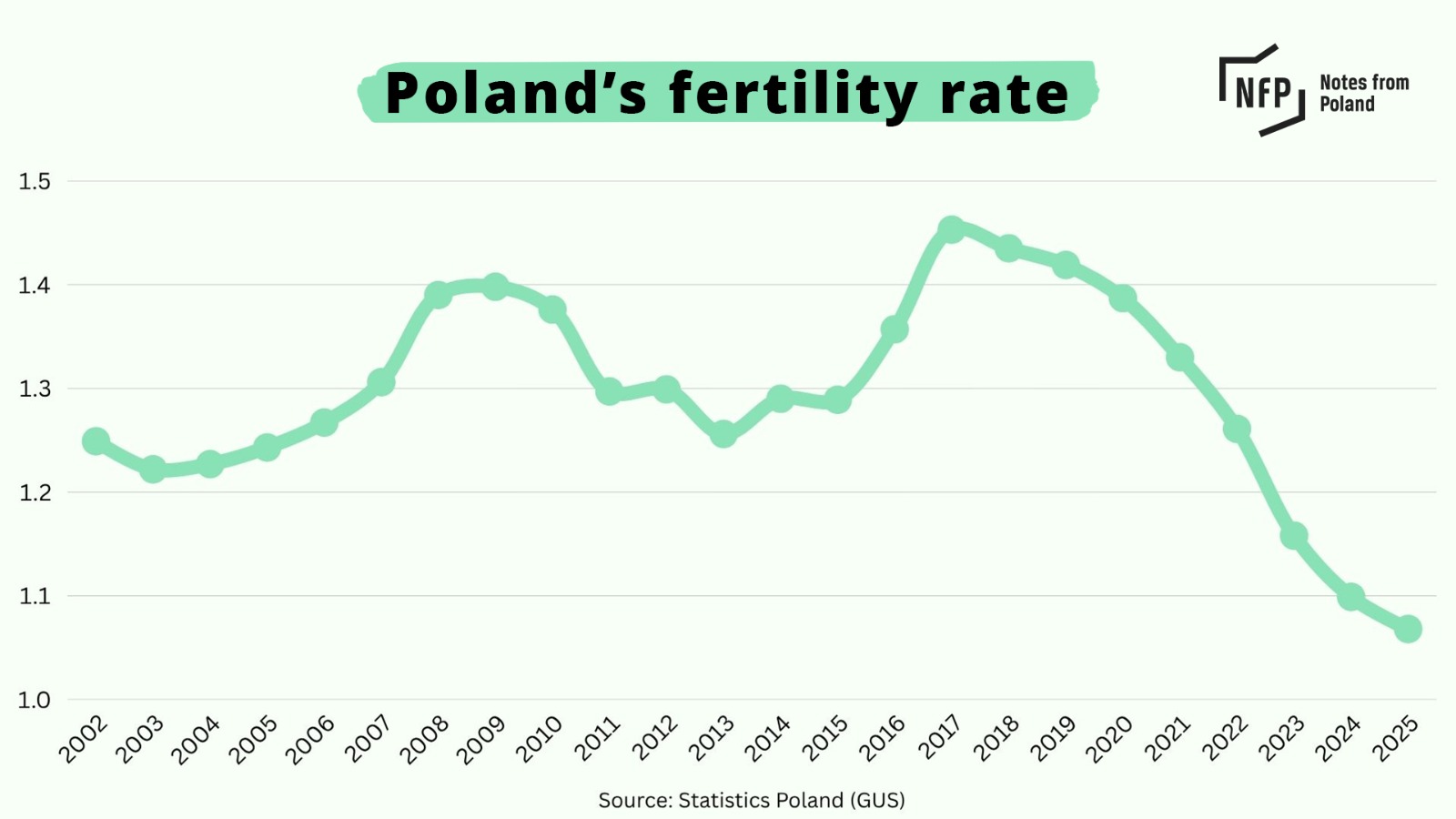
The figure is just over half the level recorded in 1990 (1.991) and well below the so-called “replacement rate” – the figure needed to ensure that the population does not decline – which is generally defined as 2.1.
While different agencies use slightly different methodologies to calculate fertility rates, according to the Population Reference Bureau, a US-based NGO, only eight countries in the world had a lower figure than Poland’s figure of 1.1 in 2024.
They include Singapore, Thailand, Ukraine (all 1.0) and, in last place, South Korea (0.7). Poland’s rate is lower than Japan’s (1.2), a country that has long struggled with demographic issues, as well as those of western European states such as Germany, the UK (both 1.4) and France (1.6).
Last year saw the number of births in Poland fall to a new post-war low of 238,000, while deaths totalled 406,000, according to preliminary GUS data. That marked the 13th consecutive year in which more people died than were born in Poland.
Experimental projections published by GUS in November showed that Poland’s population, currently around 37.3 million, could shrink to 29.4 million by 2060, 1.5 million lower than an official forecast issued in 2023.
In April, the European Union’s statistics office Eurostat also revised down its long-term population projections for Poland. It now expects the population to decline by 32% by 2100, to 25.6 million people, compared with a forecast of 29.5 million published three years earlier.
Poland’s population could shrink even more than previously forecast, according to a new simulation by the state statistics agency that assumes current record-low birth rates will continue.
The population would fall to 29.4m by 2060, down from 37.4m now https://t.co/ewhEYpj8gP
— Notes from Poland 🇵🇱 (@notesfrompoland) November 7, 2025
Poland’s worsening demographic situation has been at the centre of public debate for years, with various governments trying to address the issue. However, a range of state incentives – from raising child benefit to renewed funding for IVF – have failed to halt the demographic slide.
Analysts say that economic insecurity, limited access to affordable housing, and a restrictive abortion law have all contributed to the reluctance of young Poles to have children.
Immigration has partly softened the impact of population decline, with Poland recording some of the highest migration inflows in the European Union. But the state Social Insurance Institution (ZUS) cautions that it is “unrealistic” to assume migration will be high enough to counter demographic decline.
Poland’s population is set to fall 32% by 2100, according to a new Eurostat forecast.
It predicts that the population, currently around 37.5 million, will drop to 25.6 million by 2100. That is almost four million less than forecast three years ago https://t.co/1e2q3r1l2J
— Notes from Poland 🇵🇱 (@notesfrompoland) April 24, 2026
Notes from Poland is run by a small editorial team and published by an independent, non-profit foundation that is funded through donations from our readers. We cannot do what we do without your support.
Main image credit: Jakub Zerdzicki / Pexels

Alicja Ptak is deputy editor-in-chief of Notes from Poland and a multimedia journalist. She has written for Clean Energy Wire and The Times, and she hosts her own podcast, The Warsaw Wire, on Poland’s economy and energy sector. She previously worked for Reuters.