Keep our news free from ads and paywalls by making a donation to support our work!

Notes from Poland is run by a small editorial team and is published by an independent, non-profit foundation that is funded through donations from our readers. We cannot do what we do without your support.
A planned metro system in Kraków, Poland’s second-largest city, has moved a step closer after the authorities launched a 188 million zloty (€43 million) tender for “pre-design” of the project.
City authorities say the plans – which will include a feasibility study, environmental report, geological research, and assessment of the project’s impact on existing buildings – are a major milestone in the development of what would be only Poland’s second underground railway network.
#Krakow #metro #projektowanie #przetargi
🚇Kraków ogłasza przetarg na opracowanie dokumentacji przedprojektowej dla budowy metra. W ramach uruchomionego postępowania powstaną m. in. dokumenty, analizy i decyzje, które pozwolą przygotować dokumentację niezbędną do finalnego… pic.twitter.com/0jcYL4HGRq— Kraków (@krakow_pl) July 13, 2026
The idea of building a metro in Kraków has been discussed for decades and, in 2014, 55% of residents who took part in a referendum voted in favour of the project. However, only in 2024 did the city’s then-mayor, Aleksander Miszalski, announce plans to build a system.
In September last year, the city unveiled the metro’s planned route, with two lines travelling through the city’s historic centre from its southwestern and southeastern suburbs to its eastern outskirts.
In May this year, Miszalski, who had made developing the metro part of his election campaign in 2023, was removed as mayor in a recall referendum. But the project has nevertheless continued, with the municipal authorities last week announcing a tender for pre-design of the metro.
The work will include confirmation of the planned structure of the system as well as the location of stations, tunnels and other infrastructure. The city has allocated 188 million zloty for the pre-design in its budget for 2026 to 2031.
Studies of feasibility and impact are particularly important given that the planned route of the metro envisages it skirting around Kraków’s Old Town, which is a UNESCO World Heritage site that contains many historical structures.
The tender follows months of preparatory work, initial market consultations, analyses and discussions with experts, said Maria Wojtacha, director of Kraków’s public works department.
“Although this process doesn’t yet mean that construction has begun, it is one of the most important steps that the city can take individually,” Wojtacha added. “Our goal is to prepare Kraków for the next stage – the ‘design and build’ phase.”
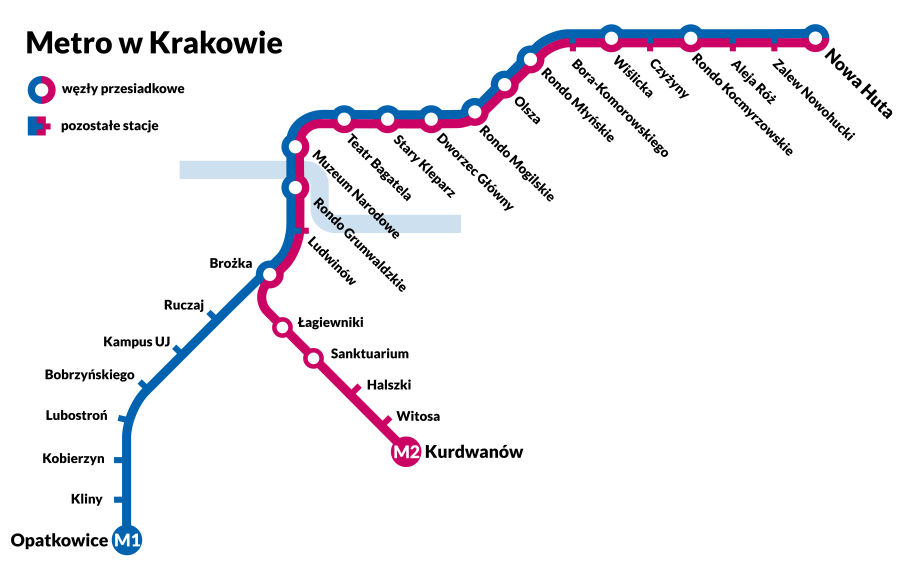
The planned route of the two metro lines, unveiled in September 2025.
The experiences of other recent major infrastructure projects in Poland, such as a major new airport and transport hub and Warsaw’s second metro line, show that environmental and tender procedures need not slow investments down, said Marek Grochowicz of the city’s strategy and European funds department.
However, it is clear that the earlier timeline for Kraków’s metro outlined is slipping. Last September, the city said that it hoped construction would begin in 2030 and that the system would be finished by 2035.
However, the current acting mayor, Stanisław Kracik, announced last month that construction is unlikely to start until between 2040 and 2045. Even the current tender for “pre-design” work envisages a timeline of up to 50 months for that work alone.
Warsaw has announced 56m zloty for “pre-design” work on a fourth metro line.
The mayor says improving public transport is an "absolute priority". But his rival in next month's elections says the mayor is digging up forgotten plans as part of the campaign https://t.co/lg3zkNeW2E
— Notes from Poland 🇵🇱 (@notesfrompoland) March 15, 2024
Rafał Solecki, head of Kraków’s department of strategy and European funds, also made clear last week that “construction of the metro exceeds the financial capabilities of the local authorities”, and that therefore financial support from the national government and the EU will be necessary.
“The metro should be treated as a national strategic investment, similar to large railway, road, aviation and metropolitan projects implemented in other parts of the country with state participation,” he added.
The city also announced that it has received a proposal for a consortium of seven local universities and research institutions to provide scientific and expert support for the metro project throughout its preparation and implementation.
“Building a metro in a historic city is an extremely complex undertaking, requiring special attention to the protection of cultural heritage,” said Andrzej Szarata, rector of Cracow University of Technology. “Therefore, the support of the scientific community…is of paramount importance.”
Kraków has been named Europe's best city break destination by members of @WhichUK.
The city's food and drink was rated as better than in Paris and Rome, while it also scored top marks for accommodation, ease of getting around and value for money https://t.co/U1P1QkQCm4
— Notes from Poland 🇵🇱 (@notesfrompoland) September 19, 2025
Notes from Poland is run by a small editorial team and published by an independent, non-profit foundation that is funded through donations from our readers. We cannot do what we do without your support.
Ben Koschalka is a translator, lecturer, and senior editor at Notes from Poland. Originally from Britain, he has lived in Kraków since 2005.