Keep our news free from ads and paywalls by making a donation to support our work!

Notes from Poland is run by a small editorial team and is published by an independent, non-profit foundation that is funded through donations from our readers. We cannot do what we do without your support.
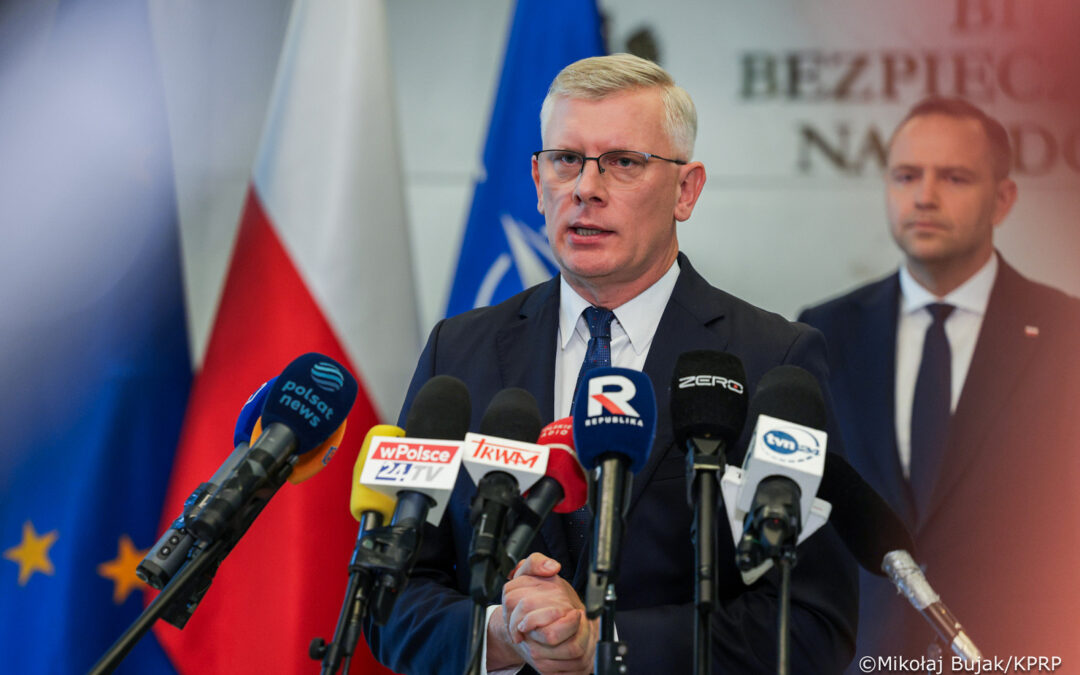
The national security adviser to opposition-aligned President Karol Nawrocki has resigned. Sławomir Cenckiewicz says the decision is due to the government’s “brutal interference” in his work, in particular denying him security clearance, which had “paralysed” his office.
In his announcement, Cenckiewicz revealed that he would remain politically active and seek to help the right-wing and far-right opposition defeat the government at next year’s parliamentary elections.
Oświadczenie!!!
Wobec bezprawnych działań rządu Donalda Tuska, który nie szanuje prawomocnych wyroków sądów i bezpodstawnie odbiera mi prawo dostępu do informacji niejawnych, na ręce prezydenta Karola Nawrockiego w dniu 22 kwietnia 2026 r. złożyłem rezygnację ze stanowiska…
— Sławomir Cenckiewicz (@Cenckiewicz) April 23, 2026
Cenckiewicz has served as head of the presidential National Security Bureau (BBN) since Nawrocki was elected last year with the support of the national-conservative Law and Justice (PiS), Poland’s main opposition party.
However, throughout that time, he has been in the unusual position of working as the president’s national security adviser while himself not having security clearance, meaning he cannot access much confidential material.
That situation stems from a decision made by the Military Counterintelligence Service (SKW) in 2024 – and subsequently confirmed by the chancellery of Prime Minister Donald Tusk – to revoke Cenckiewicz’s access to classified information.
No official reason for the decision was given, but media reports indicate that it was made because the SKW found that Cenckiewicz had failed to disclose, when completing a security vetting questionnaire, medical treatment he was undergoing at the time.
Cenckiewicz challenged the decision in court, and last week won a final victory in the case, with the Supreme Administrative Court (NSA) upholding a lower-court ruling overturning the decision by the SKW and the prime minister’s chancellery to revoke his security clearance.
However, the government and security services have noted that the decision does not mean that Cenckiewicz’s clearance is automatically restored. Rather, the process of assessing whether he should receive it simply begins again.
They have strongly suggested that Cenckiewicz will not be granted clearance, in particular because he is currently facing criminal proceedings for allegedly disclosing state secrets while previously working as head of the Military Historical Office (WBH).
The president's national security adviser has won a legal battle with the prime minister's office and security services, which have been blocking his access to classified information.
It shows they are acting "in flagrant violation of the law", he says https://t.co/Hfv4JAw5wm
— Notes from Poland 🇵🇱 (@notesfrompoland) April 15, 2026
In a lengthy statement on Thursday afternoon, Cenckiewicz announced that he was stepping down as head of the BBN and would be replaced by his deputy, General Andrzej Kowalski.
Cenckiewicz said that he had made the decision out of a sense of “responsibility for the country”, given that the “brutal interference and pressure from Donald Tusk’s government…has effectively paralysed the normal functioning of the BBN and prevented me from fulfilling the role entrusted to me by the president”.
Last week’s NSA ruling, which “exposed the unlawfulness of the government”, had simply “further intensified the harassment, persecution and investigations” he was facing, added Cenckiewicz.
“I have no illusions that the goal of the evil people ruling Poland is to delegitimise the president, limit his powers, and ultimately, destroy and ‘revoke’ Karol Nawrocki’s presidency.”
Poland’s justice minister has ordered prosecutors to launch a criminal investigation into advisors to opposition-aligned President Karol Nawrocki for their role in Nawrocki’s decision not to swear in constitutional court judges appointed by parliament https://t.co/chWqHGSuUS
— Notes from Poland 🇵🇱 (@notesfrompoland) April 14, 2026
The outgoing BBN chief said that he would continue to support Nawrocki’s work and would also “do everything in my power to ensure the success of Przemysław Czarnek”, who was last month unveiled by PiS as its prime ministerial candidate for next year’s elections.
He also expressed hope that, under Nawrocki’s “patronage”, the right-wing opposition could work together “to build a future coalition and, as a result, a government of PiS and Confederation”.
Confederation (Konfederacja) is a far-right group that forms the second-largest opposition caucus in parliament and which has been performing strongly in the polls. If PiS is to form a government after next year’s elections, it is likely to need Confederation’s support.
“Poland needs the unity of patriots! Poland needs a national government! Poland needs a New State!” declared Cenckiewicz at the end of his message.
In a subsequent press conference, presidential spokesman Rafał Leśkiewicz revealed that, while Cenckiewicz was stepping down as head of the BBN, he would continue to serve in Nawrocki’s office as an adviser and chair of the Security and Defence Council.
The national-conservative opposition PiS party's newly named candidate for prime minister has made overtures to the far-right Confederation.
But he also ruled out Grzegorz Braun, an even more radical far-right figure, serving in a PiS-led government https://t.co/i3zOZJWdUN
— Notes from Poland 🇵🇱 (@notesfrompoland) March 9, 2026
Since Nawrocki assumed the presidency last August, he has regularly clashed with Tusk’s government, including issuing an unprecedented number of vetoes of legislation passed by parliament.
In January, after holding their first meeting in months, Tusk and Nawrocki pledged to cooperate on issues of national security, which they sought to insulate from other political disputes.
However, they have failed to keep that promise, with regular disputes over defence and security policy. Last month, Nawrocki angered the government by vetoing a bill that would have facilitated the receipt by Poland of almost €44 billion (186 billion zloty) in loans for defence spending from the EU.
A clash between the right-wing president and more liberal government over Poland's receipt of EU defence loans has sharpened polarisation and turbocharged the ruling coalition’s “Polexit” and security narratives, writes @AleksSzczerbiak https://t.co/Iu7rcJfj5e
— Notes from Poland 🇵🇱 (@notesfrompoland) April 2, 2026
Notes from Poland is run by a small editorial team and published by an independent, non-profit foundation that is funded through donations from our readers. We cannot do what we do without your support.
Main image credit: Mikołaj Bujak/KPRP

Daniel Tilles is editor-in-chief of Notes from Poland. He has written on Polish affairs for a wide range of publications, including Foreign Policy, POLITICO Europe, EUobserver and Dziennik Gazeta Prawna.