Keep our news free from ads and paywalls by making a donation to support our work!

Notes from Poland is run by a small editorial team and is published by an independent, non-profit foundation that is funded through donations from our readers. We cannot do what we do without your support.
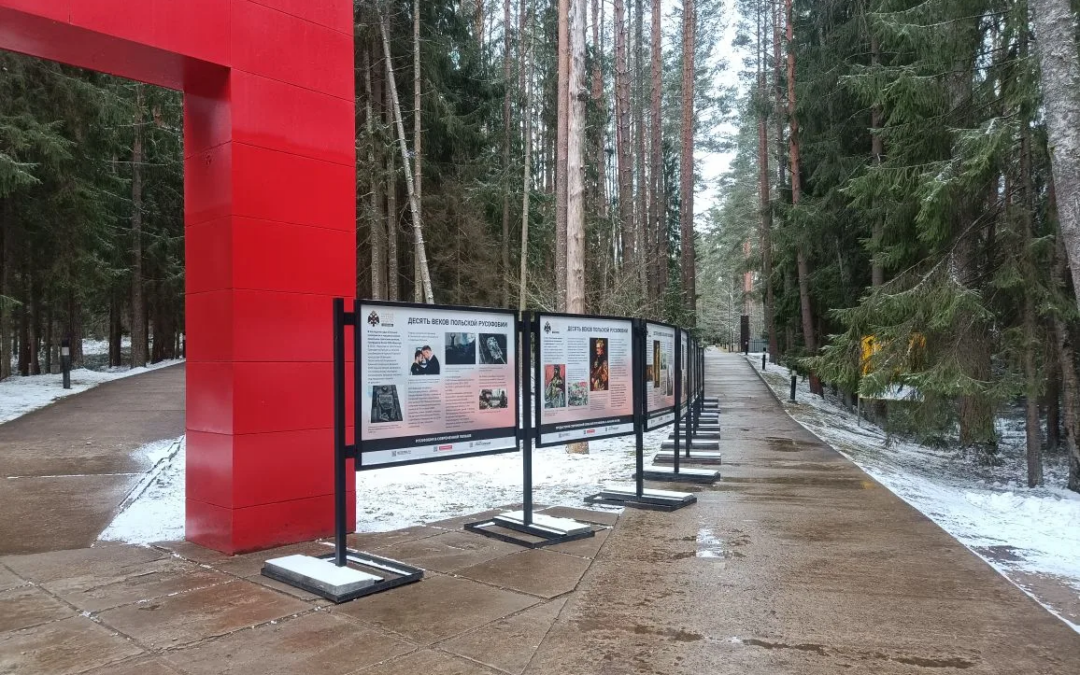
Russia has installed an exhibition titled “Ten Centuries of Polish Russophobia” outside the entrance to a cemetery containing the remains of thousands of Poles murdered by the Soviets in the Katyn massacre of 1940.
The outdoor exhibit, which includes a section downplaying Soviet responsibility for the massacre, was opened just before Poland marked its annual day of remembrance for victims of the killings.
The exhibition is organised by the Russian Military Historical Society (RMHS), which was established in 2012 by Vladimir Putin to “counter attempts to distort Russian history”. The body is overseen by the defence and culture ministries and is chaired by Vladimir Medinsky, an aide to Putin.
Made up of a series of panels, the exhibition was first displayed in central Moscow last year and, according to the RMHS, aims to show how “Russophobia has become the foundation of Polish political consciousness today” and how “the origins of modern neo-Nazism in Poland are deeply rooted in history”.
In fact, neo-Nazism is a completely marginal phenomenon in Poland, and the country has strict laws against the promotion of Nazi or other fascist ideologies.
While most Poles do hold negative views of Russia, those are rooted in Russian and Soviet aggression against and dominance over Poland, and have been further exacerbated by Moscow’s ongoing aggression against Poland’s eastern neighbour, Ukraine.
A new exhibition on “Ten Centuries of Polish Russophobia” has opened in Moscow, organised by a state historical society.
The display presents the Kremlin's revisionist view of history, including downplaying Soviet responsibility for the Katyn massacre https://t.co/YmQizwWnrm
— Notes from Poland 🇵🇱 (@notesfrompoland) October 14, 2025
The exhibition presents a revisionist version of history in keeping with the Kremlin’s narrative. For example, according to the RMHS, it presents evidence that “a German trace is evident” in the Katyn massacres despite Polish claims that “only the Russians are to blame” for the killings.
In fact, the massacres, in which around 22,000 Polish military officers, members of the intelligentsia, and other officials and prisoners of war were killed, were carried out by the Soviet secret police on Joseph Stalin’s orders.
When evidence of the massacre first came to light in 1943, the Soviets falsely blamed it on Nazi Germany, a position Moscow maintained until the 1990s, when it finally admitted responsibility for the crime. However, in recent years, Russia has begun to move back towards its former position.
The exhibition was opened outside the Polish war cemetery in Katyn, where the remains of over 4,000 victims are buried, on 10 April, just before Poland held its annual day of remembrance for the victims on 13 April. It will remain there until mid-May.
Mikhail Myagkov, the RMHS’s academic director, said that the display is intended to show how Poland had in the past “seized Russian territory and exterminated Russians, Belarusians, and Little Russians [a derogatory term used to refer to Ukrainians]”.
The exhibition also shows how “the Soviets lost over 600,000 men during the liberation of Poland”, he added. Poland, however, does not see Soviet actions in 1944-45 as a liberation, given that they resulted in further decades of brutal communist rule imposed by Moscow.
Moreover, Russia’s historical narrative fails to acknowledge that, at the start of the war in September 1939, the Soviet Union invaded Poland from the east as part of an agreement with Nazi Germany, which had two weeks earlier attacked from the west, to divide Polish lands between them.
Last year, Polish military symbols were removed from another cemetery in Russia housing the remains of Katyn victims, prompting condemnation from Poland’s foreign ministry. So far, however, there has been no official response from Poland regarding the opening of the exhibition outside the Katyn cemetery.
Poland has condemned the removal of Polish military symbols from a cemetery in Russia of Poles murdered by the Soviets in WWII.
"We will defend these crosses because we do not accept Russian historical lies," says foreign minister @sikorskiradek https://t.co/syYLpdWG3N
— Notes from Poland 🇵🇱 (@notesfrompoland) May 21, 2025
Polish-Russian relations have been particularly tense in recent years. Poland has been a strong supporter of Ukraine since Russia’s full-scale invasion in 2022, and has consistently led calls for tougher sanctions against Moscow.
Meanwhile, agents working on behalf of Russia have carried out a series of so-called hybrid actions in Poland, including sabotage, arson, cyberattacks and disinformation.
That has prompted Poland to successively close all of Russia’s consulates in the country, with Moscow doing the same with Polish consulates on its territory in a tit-for-tat response.
Electricity and heating have been cut off at the former Russian consulate in Gdańsk, which Poland ordered to close in December but Russia has refused to hand back.
It left a single employee to occupy the building and has refused entry to Polish officials https://t.co/2wZqPcHRxe
— Notes from Poland 🇵🇱 (@notesfrompoland) April 3, 2026
Notes from Poland is run by a small editorial team and published by an independent, non-profit foundation that is funded through donations from our readers. We cannot do what we do without your support.
Main image credit: Russian Military Historical Society

Daniel Tilles is editor-in-chief of Notes from Poland. He has written on Polish affairs for a wide range of publications, including Foreign Policy, POLITICO Europe, EUobserver and Dziennik Gazeta Prawna.