Keep our news free from ads and paywalls by making a donation to support our work!

Notes from Poland is run by a small editorial team and is published by an independent, non-profit foundation that is funded through donations from our readers. We cannot do what we do without your support.
Media reports claim that US President Donald Trump, during a previously unreported meeting earlier this year with Poland’s defence minister, Władysław Kosiniak-Kamysz, suggested that he leave Prime Minister Donald Tusk’s ruling coalition and form a new government with the right-wing opposition.
Kosiniak-Kamysz has confirmed that the meeting took place, but has not commented on what was discussed. Meanwhile, Tusk himself has said that, while he wants to “maintain discretion”, the information he received from Kosiniak-Kamysz indicates that Trump was interested in discussing the “internal situation in Poland”.
Foreign minister Radosław Sikorski has even more bluntly suggested that the meeting may have served as “an attempt to involve a foreign state in our internal politics”.
Below, we outline how the controversy unfolded, what we know so far, and how senior political figures have commented on the issue.
The context
Poland’s government is a broad coalition that ranges from left to centre right. Although Tusk’s centrist Civic Platform (KO) dominates, it would not have the parliamentary majority necessary to rule if it lost any of its junior coalition partners.
One of those partners is the Polish People’s Party (PSL), which is the most conservative element of the coalition. It has clashed with its partners over issues such as abortion and LGBT+ rights. PSL is led by Kosiniak-Kamysz, who serves as both deputy prime minister and defence minister.
Some elements of the right-wing opposition have suggested that PSL could break with Tusk to form an alternative government, perhaps even with Kosiniak-Kamysz as prime minister. Last year, PSL controversially polled its members on whether they would want to do so. However, PSL and its leader have repeatedly insisted that they remain loyal to Tusk’s coalition.
The Polish People's Party's parliamentary survival is on a knife edge, and could determine whether @donaldtusk's coalition remains in power after next year's elections.@AleksSzczerbiak looks at the challenges facing PSL and how it may respond to them https://t.co/MmswSLNWJE
— Notes from Poland 🇵🇱 (@notesfrompoland) June 30, 2026
Meanwhile, the government is in constant conflict with President Karol Nawrocki, who is aligned with the opposition. Nawrocki is also a close ally of Trump, who endorsed him during last year’s presidential election.
By contrast, Tusk and his government have clashed with the Trump administration, though they also seek to maintain close relations with the US as Poland’s most important security partner.
The meeting
The news that Kosiniak-Kamysz had met with Trump in March this year came to light in a rather roundabout way.
On 21 September, Poland’s defence ministry announced that a planned meeting at the Pentagon between Kosiniak-Kamysz and his US counterpart, Pete Hegseth, planned for 23 September, had been cancelled “at the urgent request of the American side”.
The official reason for the change of plans was Chinese President Xi Jinping’s visit to the US at the same time. However, some commentators in Poland claimed that Hegseth had actually cancelled the meeting at the behest of figures close to Nawrocki.
In an effort to debunk those claims, Adam Bielan, a senior PiS figure from the opposition Law and Justice (PiS) party, claimed that he and Nikodem Rachoń, a presidential advisor, had helped to arrange a meeting earlier this year between Kosiniak-Kamysz and a US figure “much more important than Hegseth”.
Rachoń later confirmed this, but said that the meeting had been secret and he was unable to reveal the identity of the US official. He urged Kosiniak-Kamysz to do so.
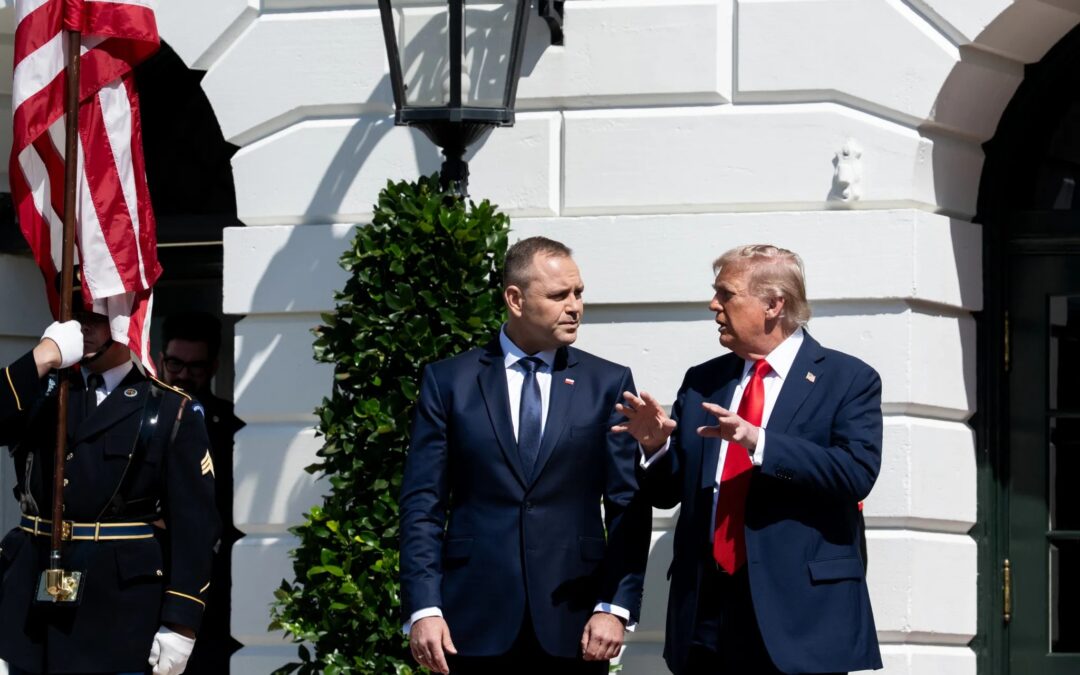
The defence minister obliged, confirming that the meeting had been with Trump himself and had taken place at the White House on 2 March, alongside a ceremony at which a US army officer, Michael Ollis, was posthumously awarded the Medal of Honour for giving his own life to save that of a Polish officer, Karol Cierpica, in Afghanistan.
“I had the opportunity to talk to President Trump for a moment, for which I am very grateful,” said Kosiniak-Kamysz, who noted the role of Nawrocki’s office in arranging the conversation.
What did Trump say to Kosiniak-Kamysz?
Neither Rachoń nor Kosiniak-Kamysz indicated what had been discussed at the meeting. However, last Friday, Dominika Wielowieyska, a leading Polish journalist, claimed that her conversations with various sources, who she did not name, had indicated that Trump used the meeting to encourage Kosiniak-Kamysz to split with Trump and form a new government with the right-wing opposition.
“Trump suggested to Kosiniak-Kamysz that it would be best if he formed a coalition with the right, and that then they would have 100% support from the United States and the presidential administration, and the door would essentially be open to achieving great success for many Poles,” said Wielowieyska, who writes for Gazeta Wyborcza, a leading liberal daily that is hostile towards Nawrocki and sympathetic towards Tusk.
She added that Kosiniak-Kamysz had immediately shared information about the meeting with the government but that Rachoń had failed to submit a note about it to the foreign ministry, despite that being normal practice and despite a request for a note from foreign minister Radosław Sikorski.
Today, Republika, a right-wing broadcaster with close ties to Nawrocki and the opposition, likewise reported, based on unnamed sources, that, “during the conversation with Kosiniak-Kamysz, there were indications that the Americans were interested in a change of prime minister in Poland”.
What has Poland’s government said?
On Friday, Sikorski took to social media to respond to a claim by Bielan that the Trump-Kosiniak-Kamysz meeting was intended to “unblock” negotiations regarding Poland’s desire to host a new permanent US military base.
“In the case of such an important conversation, the organiser [Rachoń] had an obligation to prepare a note,” wrote Sikorski, adding that such a document never reached the foreign ministry. “Could that be because the meeting also served as an attempt to involve a foreign state in our internal politics?”
Z tak ważnej rozmowy organizator miał obowiązek sporządzić notatkę. Do @MSZ_RP ona nie dotarła.
Czyżby dlatego, że spotkanie służyło też próbie zaangażowania obcego państwa w naszą wewnętrzną politykę? https://t.co/0wL0QZBxPv— Radosław Sikorski 🇵🇱🇪🇺 (@sikorskiradek) October 2, 2026
On Monday, Tusk himself told broadcaster TVN that Kosiniak-Kamysz had informed him about his meeting with Trump immediately after it took place. He added that the subject of the meeting “is too interesting to talk about publicly”, but that military “bases were not the topic of the conversation”.
“The conversation was of a confidential nature, and therefore I feel obliged to maintain discretion. It was more about the internal situation in Poland, that’s how I would put it most delicately,” said Tusk.
Kosiniak-Kamysz himself also confirmed on Monday that the question of a permanent US base in Poland had not been discussed at the meeting. He noted that, in March, that issue was not even seriously on the table, because it was only two months later that Trump announced he intended to send additional troops to Poland
The defence minister did not give any further details about the content of the meeting, which he described as “informal”.
Rozmowa miała dyskrecjonalny charakter i dlatego czuję się zobowiązany do dyskrecji – powiedział w poniedziałek premier Donald Tusk reporterce @tvn24 @WojcikowskaMaja, pytany o spotkanie ministra obrony Władysława Kosiniaka-Kamysza z prezydentem USA Donaldem Trumpem.
Szczegóły:… pic.twitter.com/aHK80cxaf4
— tvn24 (@tvn24) October 5, 2026
Notes from Poland is run by a small editorial team and published by an independent, non-profit foundation that is funded through donations from our readers. We cannot do what we do without your support.
Main image credit: White House (under CC BY 3.0 US)

Daniel Tilles is editor-in-chief of Notes from Poland. He has written on Polish affairs for a wide range of publications, including Foreign Policy, POLITICO Europe, EUobserver and Dziennik Gazeta Prawna.