Keep our news free from ads and paywalls by making a donation to support our work!

Notes from Poland is run by a small editorial team and is published by an independent, non-profit foundation that is funded through donations from our readers. We cannot do what we do without your support.
By Aleks Szczerbiak
Poland’s right-wing president has been largely successful at transforming his office into an assertive centre of resistance to the liberal centrist-led government, frustrating its agenda through extensive use of constitutional powers. He has emerged as the leading unifying figure on the fragmented Polish right but faces new challenges moving towards the next election.
Scuppering the government’s reform agenda
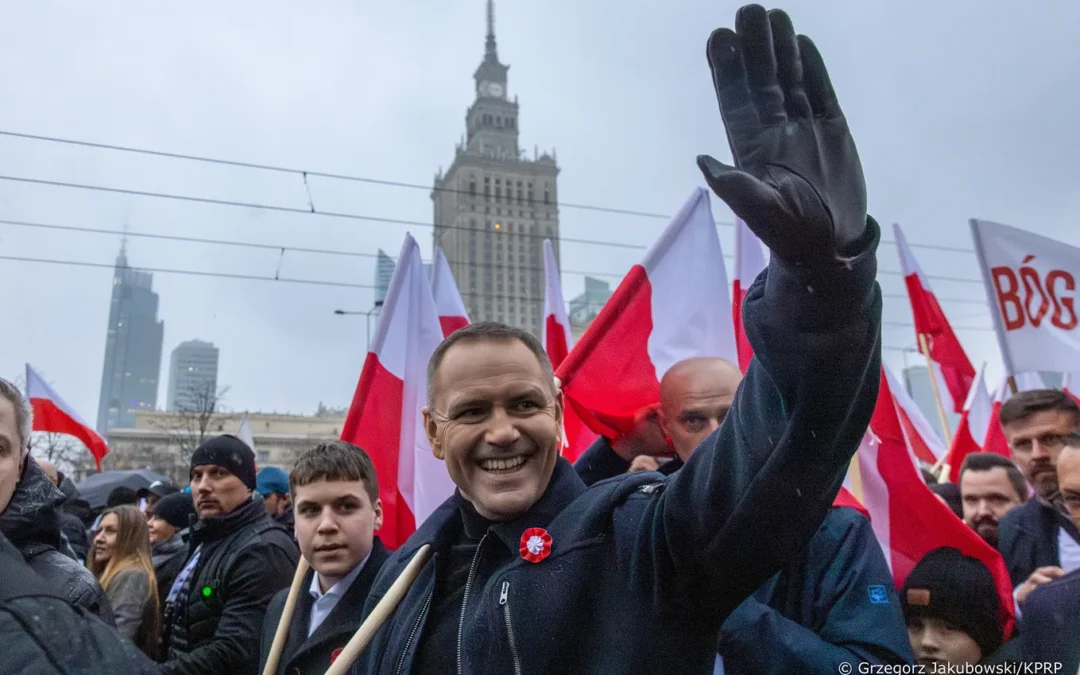
Last month, Polish President Karol Nawrocki marked the first anniversary of his inauguration following a surprise victory in the May-June 2025 presidential election over Warsaw mayor Rafał Trzaskowski, the candidate of the liberal-centrist Civic Coalition (KO), Poland’s main governing party since autumn 2023, led by Prime Minister Donald Tusk.
A relatively unknown conservative historian and head of the Institute of National Remembrance (IPN), a state historical research institute, Nawrocki ran formally as an independent but was backed by the right-wing Law and Justice (PiS), Poland’s ruling party between 2015 and 2023 and currently the main opposition grouping.
The election result represented a significant upset, ushering in a period of tense “cohabitation” between the Tusk government and a hostile president. The Polish presidency is not a day-to-day governing role, and in many respects largely ceremonial, but retains important constitutional powers.
Karol Nawrocki has now issued more vetoes than any other president in Polish history
Three vetoes on Thursday took his total to 37 in just ten months since taking office, surpassing the 35 issued by Aleksander Kwaśniewski during his ten years as president https://t.co/xf27K8Fyn6
— Notes from Poland 🇵🇱 (@notesfrompoland) June 12, 2026
These include a legislative veto, which the government lacks the required three-fifths parliamentary majority to overturn, and the ability to suspend a piece of legislation coming into law by referring it to the Constitutional Tribunal (TK). Given that a majority of tribunal members were appointed under previous PiS-dominated parliaments, this also functioned as a de facto veto.
As a result, Nawrocki was able to severely complicate the Tusk government’s plans to push through its legislative and elite replacement programme, notably efforts to roll back PiS’s judicial reforms.
This, combined with the political authority that stemmed from Nawrocki’s strong electoral mandate, meant that the government faced continued resistance for the remainder of its term of office until the next parliamentary election, scheduled for autumn 2027.
An assertive presidency
From the outset, Nawrocki has been a much more assertive president than his predecessor Andrzej Duda, leveraging his mandate to carve out a role as an active centre of resistance to the government.
Although both presidents were PiS-aligned, during cohabitation with the Tusk administration, Duda used his powers more selectively and occasionally sought common ground. Nawrocki, by contrast, interpreted his strong electoral mandate as authorising a more confrontational approach.
He has surrounded himself with a strong political support base who have helped him to develop and carry forward a blaze of independent initiatives in both the domestic and foreign policy spheres.
As well proposing a series of his own draft laws, Nawrocki has used the legislative veto far more frequently than Duda (who issued only 19 across two full five-year terms) or any previous post-1989 president in a comparable period.
By mid-2026, he had already surpassed previous records, blocking over 40 government-sponsored laws on issues such as judicial reform, socioeconomic policy and defence financing.
In foreign policy, where the president’s formal competencies are more limited, Nawrocki pursued independent initiatives that often diverged from, or complicated, the government’s line.
He has, for example, prioritised close personal and strategic ties with the USA, positioning Washington as Warsaw’s primary security guarantor. He cultivated a high-profile relationship with the Trump administration that yielded commitments to ongoing US troop deployments in Poland, sometimes bypassing or challenging the Tusk government.
On Ukraine, while supporting continued military and diplomatic aid, Nawrocki has adopted a more transactional and assertive approach, opposing rapid Ukrainian EU and NATO accession until bilateral issues are addressed, and taking symbolic steps such as removing a Polish state honour from Ukrainian President Volodymyr Zelensky over unresolved historical grievances.
Polish President Nawrocki has announced that he will strip @ZelenskyyUa of Poland’s highest honour in response to him naming a military unit after a group that massacred Poles during WWII
Ukraine's foreign minister condemned Nawrocki's "reckless" decision https://t.co/CEqj4aaHYg
— Notes from Poland 🇵🇱 (@notesfrompoland) June 19, 2026
These have drawn criticisms that he is playing into Russian hands by weakening regional unity, but were clearly in line with changing Polish public attitudes towards its eastern neighbour.
Uniting the fragmented right?
Nawrocki has also emerged as the most important unifying figure on the increasingly fragmented Polish right.
PiS, long the hegemonic force on the conservative side, has seen radical-right challengers, the free-market Confederation (Konfederacja) and ultra-nationalist Confederation of the Polish Crown (KKP), gaining ground. In July, PiS also suffered its biggest ever internal split, with a significant group of parliamentarians aligned with former prime minister Mateusz Morawiecki breaking away.
All of this weakened PiS leader Jarosław Kaczyński’s once unquestioned authority as the central broker on the Polish right; he is now one leader among several.
Jarosław Kaczyński, the leader of Poland's largest opposition party, PiS, has called on President @NawrockiKn to help unify the country’s various right-wing opposition forces ahead of next year’s parliamentary elections https://t.co/Q3BFSOSfTG
— Notes from Poland 🇵🇱 (@notesfrompoland) August 10, 2026
Alone among leading right-wing politicians, Nawrocki possesses genuine crossover appeal across the fractured conservative landscape. His 2025 presidential victory showed that he could consolidate a broad right-wing coalition and attract support well beyond traditional PiS loyalists, capturing the vast majority of voters from both Confederations.
Although he was the PiS candidate, Nawrocki operates as an independent authority outside of direct party control and has cultivated an image as an authoritative independent figure, which gives him greater moral and symbolic stature than any partisan leader.
Nawrocki’s assertive use of his constitutional powers has further reinforced his position as a natural focal point around which the broader right can unite. Many conservatives now look to him as a potential patron or broker ahead of the 2027 election.
Nawrocki can use the presidency to set a broad conservative agenda and mediate negotiations among the various right-wing groupings to secure pre- and post-election agreements. However, he has no unifying mandate and his ability to bring together the right depends ultimately on whether the various actors are willing to be led.
Moreover, not only is the president expected to remain formally non-partisan and not engage too openly in day-to-day politics, Nawrocki lacks the party organisational levers needed to enforce messy backroom deals.
Focus of government attacks
The Tusk government knows that Nawrocki’s is now the most potent counterweight to its authority and potential unifier of the fragmented right, which is precisely why he has become the main focus of its attacks on the opposition.
An essential element of this has been trying to portray Nawrocki’s more active presidency as destructive and undermining the unity of the Polish state. This forms a principal component of its broader “security” narrative, a calculated strategy to reframe political debate around the ongoing Russian threat.
At a time of heightened geopolitical risk with hybrid threats against Poland, the government has portrayed presidential obstruction as undermining the country’s military readiness and ability to co-ordinate with its allies.
Karol Nawrocki has sought to redefine Poland's presidency and become the figurehead of the right-wing opposition.
So far, it is working, but questions remain over what his end goal is and whether these tactics will get him there, writes @danieltilles1 https://t.co/TNDRGGv2QT
— Notes from Poland 🇵🇱 (@notesfrompoland) December 22, 2025
The Tusk administration cites Nawrocki’s veto of legislation enabling Poland to access its €43.7 billion allocation from the EU’s Security Action for Europe (SAFE) defence procurement initiative as an apparently perfect example of this, although the president argues that the loans saddle future generations with a huge, long-term debt and undermine Polish sovereignty.
In fact, Nawrocki is fairly relaxed about the government’s attempts to portray his more active presidency as obstructive. Rather, he feels he needs to be assertive because that is precisely what those who voted for him expect: action and change, not passivity or compromise.
Nawrocki’s 2025 presidential victory was based on a sharp critique of the Tusk administration and framed, and widely interpreted, as a vote of no confidence in the government’s performance.
The president believes that this gives him a strong mandate to confront the ruling coalition across a wide range of issues and that the greater political risk lies in undermining the political momentum that his win created and appearing weak or inactive, rather than in the government’s counternarrative that he is a “blocking” president.
A clash between the right-wing president and more liberal government over Poland's receipt of EU defence loans has sharpened polarisation and turbocharged the ruling coalition’s “Polexit” and security narratives, writes @AleksSzczerbiak https://t.co/Iu7rcJfj5e
— Notes from Poland 🇵🇱 (@notesfrompoland) April 2, 2026
More broadly, Nawrocki is not too concerned about what the Warsaw opinion-forming elites say about him. His approach stands in stark contrast to earlier presidents, even right-wing ones such as Duda, who, conservative critics argue, paid excessive attention to elite and liberal media criticism and received no meaningful political reward or pay-off for doing so.
Instead of seeking to present himself as a “president of all Poles” in the traditional, consensus-seeking sense, Nawrocki has deliberately prioritised appealing directly to his core electoral base: Polish voters living beyond the large urban agglomerations in smaller towns, rural areas, and the provinces.
By maintaining an assertive, unapologetic style that resonates with this electorate’s sense of cultural and political marginalisation, Nawrocki has sought to consolidate that support rather than diluting it in pursuit of metropolitan elite approval.
Poland’s most popular politician
There have obviously been plenty of missteps along the way. One clear risk has been the sheer volume and sometimes seemingly indiscriminate nature of the legislative vetoes.
While this has successfully blocked key elements of the government’s agenda and reinforced Nawrocki’s image as an assertive counterweight, it has also handed the Tusk administration a ready-made narrative that the president is simply an obstructive “veto machine”.
A number of Nawrocki’s more high-profile vetoes, such as the cryptocurrency regulation law, have proved highly contentious.
PM @donaldtusk called a classified meeting of parliament in a bid to persuade opposition MPs to overturn the president's veto of crypto-asset regulation, which Tusk said threatens national security.
However, in a subsequent vote, the veto was upheld https://t.co/Vj0Zh9wxpH
— Notes from Poland 🇵🇱 (@notesfrompoland) December 5, 2025
Moreover, some of the other constitutional instruments that he has sought to utilise have not been particularly successful or even proved counterproductive.
These include attempts to introduce his own legislation or referendum initiatives that have been stymied in parliament, as well as his original idea of holding the government to account via the so-called “Cabinet Council”, a formal meeting of the Council of Ministers chaired by the president.
Nonetheless, in general, Nawrocki’s strategy appears to have delivered political dividends for him. He can, for example, point to a number of foreign policy successes, particularly in cultivating close personal and strategic ties with the USA under the Trump administration and positioning himself as a significant actor on security issues.
President @NawrockiKn has recorded the highest ever level of trust (54.8%, up 8.4pp since May) of any politician in the history of regular polling by @IBRiS_PL for @onetpl
Foreign minister @sikorskiradek (42.6%) was second and PM @donaldtusk (38.1%) third https://t.co/POuUFR3Khk
— Notes from Poland 🇵🇱 (@notesfrompoland) June 26, 2026
At the same time, Nawrocki has asserted a greater degree of independence from PiS than Duda was ever able to achieve. This has been helped by the simple fact that PiS is now in opposition rather than in government, which reduces the formal and informal constraints that tied his predecessor more closely to the party.
As a result, Nawrocki has emerged as Poland’s most popular politician, with consistently high approval ratings that set him apart from both the government and right-wing opposition party leaders.
Challenges ahead
There are clear challenges ahead for Nawrocki in the run-up to next year’s election and beyond. The first is how to respond to the argument that electing a right-wing government would concentrate excessive power in one side of the political spectrum.
This is an awkward point for Nawrocki because he himself used a version of this argument during the 2025 presidential campaign, presenting his candidacy as a necessary check on the Tusk government.
Opponents of the right will inevitably turn this logic against the broader conservative camp in the run-up to the 2027 election, claiming that the combination of a sympathetic president and a right-wing parliamentary majority risks the very imbalance Nawrocki once warned against.
A second, related strategic challenge arises if a right-wing government does take office, and Nawrocki finds himself cohabiting with an ideologically and programmatically aligned administration rather than a hostile one.
In that situation, he would still need to carve out a distinct and independent role for himself. The risk is falling into the trap that afflicted Duda during the years of PiS government: being widely perceived as little more than the government’s “notary” or a passive rubber stamp for its agenda.
Maintaining personal authority, visibility, and a sense of autonomy, while avoiding conflict with an ideologically allied government, would demand a different style of presidency from the approach that has defined his first year.
The very assertiveness and independence that have served him well in cohabitation with the Tusk government will prove harder to sustain if the political balance shifts after 2027.
Notes from Poland is run by a small editorial team and published by an independent, non-profit foundation that is funded through donations from our readers. We cannot do what we do without your support.

Main image credit: Grzegorz Jakubowski/KPRP