Keep our news free from ads and paywalls by making a donation to support our work!

Notes from Poland is run by a small editorial team and is published by an independent, non-profit foundation that is funded through donations from our readers. We cannot do what we do without your support.
A dispute has emerged between Poland’s government and the office of opposition-aligned President Karol Nawrocki over whether Poland would be willing to host allied nuclear weapons.
Deputy defence minister Paweł Zalewski announced on Thursday that Poland wants to participate in the US-led NATO nuclear sharing programme, but without actually hosting warheads. That prompted criticism from Nawrocki’s senior foreign policy aide, Marcin Przydacz, who says Poland should host such weapons.
Jedno zdanie wiceszefa MON wystarczyło, by wywołać polityczną burzę wokół kwestii broni jądrowej w Polsce. Paweł Zalewski stwierdził w Kwaterze Głównej NATO w Brukseli, że Polska nie chce głowic nuklearnych na swoim terytorium. Kilka godzin później zareagował szef MON Władysław… pic.twitter.com/EqjTPKqidg
— OficjalneZero (@OficjalneZero) August 28, 2026
Zalewski met on Thursday with Elbridge Colby, US under secretary of defence for policy, at NATO’s headquarters in Brussels. Afterwards, he was asked by reporters if an expanded future US military presence in Poland might include nuclear weapons.
“No. I would like to say this very clearly and openly: Poland does not want nuclear warheads on its territory,” replied Zalewski, quoted by broadcaster TVN.
The minister added that Poland still wants to be part of NATO’s nuclear deterrence programme. However, he said that this could be achieved without hosting the weapons themselves.
Those remarks triggered criticism from the national-conservative Law and Justice (PiS), Poland’s main opposition party. Former PiS defence minister Mariusz Błaszczak said that refusing to host warheads “in practice means renouncing participation in nuclear sharing”.
“Poland should strive for full participation in nuclear sharing,” added Błaszczak. “This is not a matter of Poland possessing its own nuclear weapons, but of strengthening NATO’s nuclear deterrence on the eastern flank.”
Criticism also came from other sources, including retired Brigadier General Stanisław Koziej, who served as head of the National Security Bureau (BBN) of former President Bronisław Komorowski, who is an ally of the current government.
Koziej called Zalewski’s announcement “an incomprehensible strategic mistake in the field of deterrence”. He said that, to deter Russia, Vladimir Putin must know that there is the possibility Poland could host nuclear weapons.
Chęci nie odstraszają. Odstraszają realne zdolności – własne i sojusznicze. A przede wszystkim takie, o jakich użyciu sami decydujemy. To elementarz, który warto przypomnieć https://t.co/Nc3xXnA7bU
— Paweł Zalewski (@ZalewskiPawel) August 27, 2026
Late on Thursday, Zalewski commented on the controversy. He rejected Błaszczak’s claim that refusing to host warheads would effectively exclude Poland from nuclear sharing.
“We want to participate in NATO’s nuclear deterrence programme without wanting the stationing of nuclear weapons in Poland,” he wrote. “Thanks to our efforts, NATO has opened up precisely such a possibility.”
In response to Koziej, Zalewski argued that “intentions do not deter, real capabilities do…above all, those whose use we ourselves decide upon”.
Meanwhile, defence minister Władysław Kosiniak-Kamysz also weighed in, declaring that “Poland remains strongly interested in participating in the NATO nuclear sharing programme” and is also “conducting talks regarding the proposal for participation in a European nuclear protective umbrella”.
Kosiniak-Kamysz did not, however, comment on the issue of Poland potentially hosting warheads.
Rozwiewając wszelkie wątpliwości: Polska jest niezmiennie zainteresowana udziałem w programie NATO Nuclear Sharing.
Prowadzimy także rozmowy na temat propozycji uczestnictwa w europejskim nuklearnym parasolu ochronnym.
Stanowisko naszego rządu jest w tych kwestiach…
— Władysław Kosiniak-Kamysz (@KosiniakKamysz) August 27, 2026
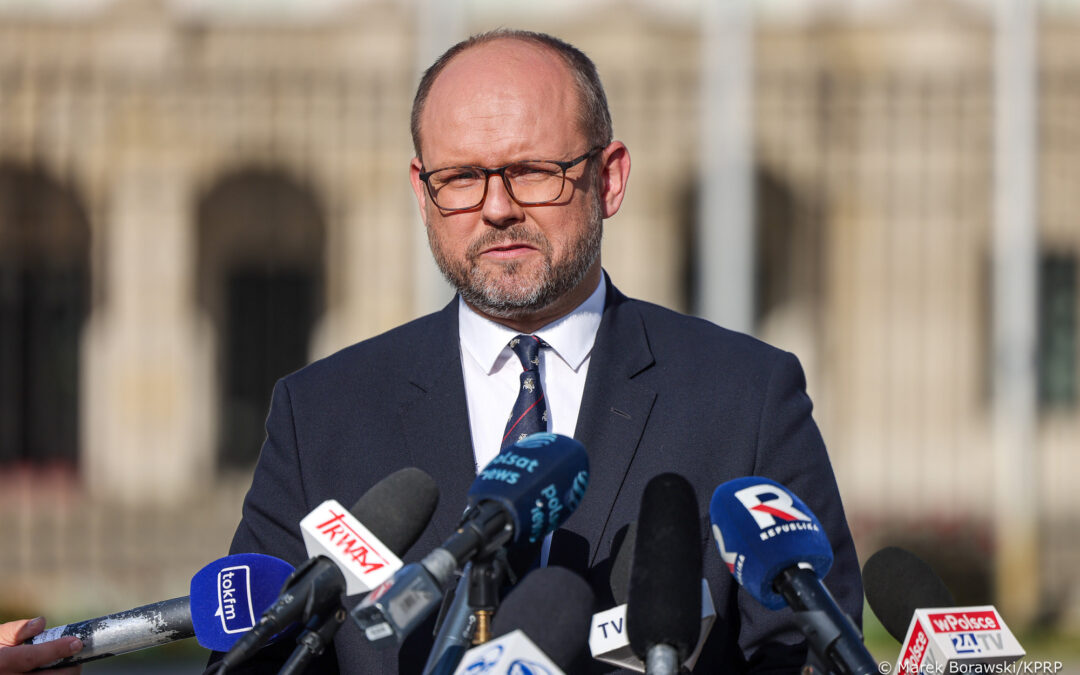
On Friday morning, Przydacz, who is the head of President Nawrocki’s International Policy Bureau (BPM), joined the criticism of Zalewski, calling his comments “bizarre, absurd and completely inconsistent with what Poland has been saying so far and what the policy of the Polish state is”.
“Both the presidential palace and the executive branch of the government have so far supported Poland joining the nuclear sharing programme as part of its deterrence policy,” he continued.
Przydacz added that “it is not true” the country wants to participate without actually hosting warheads. “Poland also wants to have warheads on its territory,” he said.
– Polska chce obecności głowic na swoim terytorium – powiedział @marcin_przydacz o programie NATO Nuclear Sharing.@marcinfijolek @Graffiti_PN https://t.co/WtyEU2Jef6
— PolsatNews.pl (@PolsatNewsPL) August 28, 2026
Nawrocki, who is a close ally of President Donald Trump, has made clear his support for Poland seeking a nuclear sharing arrangement with the United States. But it remains unclear exactly what the government’s plans are.
Earlier this year, Poland entered discussions with France over the extension of the French “nuclear umbrella” over Europe. Later, however, Prime Minister Donald Tusk indicated that Poland would not want to actually host French nuclear-armed aircraft.
Both last year and this year, Tusk has also hinted that Poland could seek to develop its own independent nuclear deterrent. However, Colby made clear that the US would “strenuously oppose” European countries such as Poland, Germany or the Scandinavian states seeking to develop their own nuclear weapons.
Nawrocki, who is aligned with the right-wing opposition, has regularly clashed with the government, including vetoing a record number of laws. However, the two sides have sought to present a more united front on issues of national security.
The United States would “strenuously oppose” Poland, Germany or the Scandinavian countries seeking to develop their own nuclear weapons, says a senior Pentagon official.
His comments come amid discussions in Poland and Europe over nuclear deterrence https://t.co/e9J8tNxcc9
— Notes from Poland 🇵🇱 (@notesfrompoland) March 5, 2026
Notes from Poland is run by a small editorial team and published by an independent, non-profit foundation that is funded through donations from our readers. We cannot do what we do without your support.
Main image credit: Marek Borawski/KPRP

Daniel Tilles is editor-in-chief of Notes from Poland. He has written on Polish affairs for a wide range of publications, including Foreign Policy, POLITICO Europe, EUobserver and Dziennik Gazeta Prawna.