Keep our news free from ads and paywalls by making a donation to support our work!

Notes from Poland is run by a small editorial team and is published by an independent, non-profit foundation that is funded through donations from our readers. We cannot do what we do without your support.
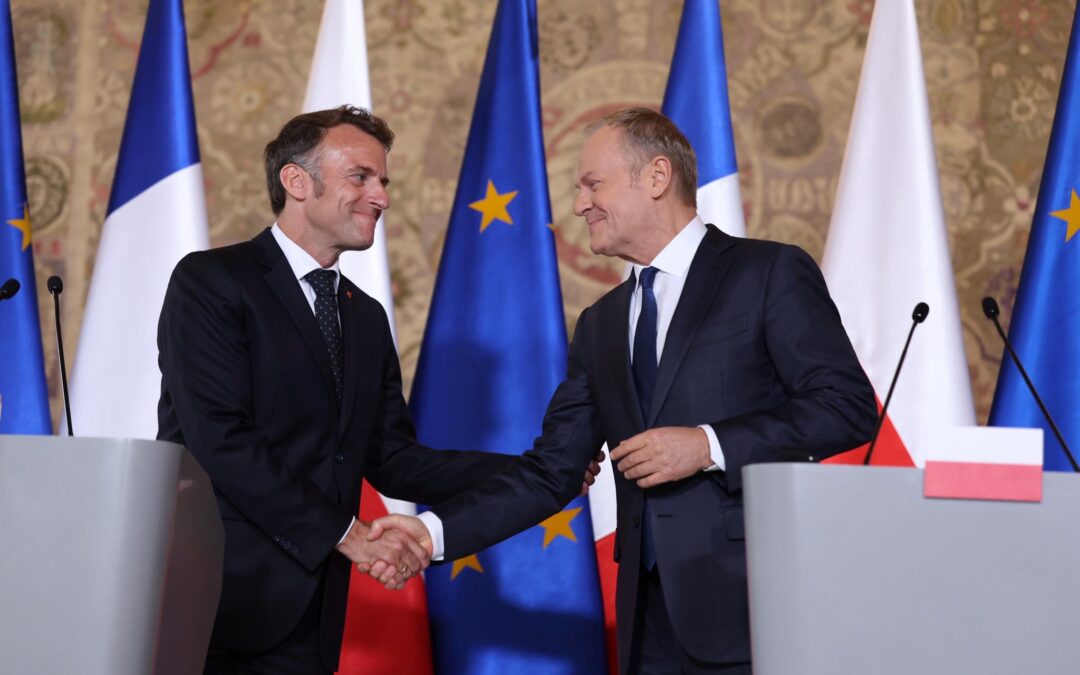
French President Emmanuel Macron has declared that relations between his country and Poland are at a “historic level” following a meeting with Polish Prime Minister Donald Tusk in Gdańsk.
However, the visit stirred domestic political controversy in Poland, with a spokesman for opposition-aligned President Karol Nawrocki saying that Tusk had deliberately prevented Nawrocki from meeting Macron.
On agit, on ne parle pas! 🇵🇱🇫🇷 pic.twitter.com/lrCq6GPfkU
— Donald Tusk (@donaldtusk) April 20, 2026
Today’s events marked the first Franco-Polish intergovernmental consultations held under the terms of an Enhanced Cooperation and Friendship Treaty signed by the two countries last year, in which they pledged to strengthen security, political, cultural and trade ties.
It brought Poland up to a level of relations that France had previously only enjoyed with Germany.
The visit was held on 20 April, which the treaty designated as an annual Polish-French Friendship Day. This date was chosen as that on which, in 1995, the remains of Polish-French scientist Maria Skłodowska-Curie were reburied alongside other French national heroes in the Panthéon in Paris.
Poland and France have signed a treaty upgrading relations, including mutual security guarantees.
"Today we talk to the French as an equal partner," declared @donaldtusk.
The treaty “opens a new era” for Poland, France and Europe, said @EmmanuelMacron https://t.co/9pHOQVx4lI
— Notes from Poland 🇵🇱 (@notesfrompoland) May 9, 2025
While state visits typically take place in the capital, Warsaw, Macron was welcomed by Tusk in the prime minister’s hometown of Gdańsk, a city on Poland’s northern Baltic coast. That prompted criticism from Nawrocki’s office, which suggested Tusk was trying to prevent him from meeting Macron.
“The foreign ministry did not issue an invitation to President Karol Nawrocki. Prime Minister Donald Tusk planned the visit to avoid a meeting of the presidents. That’s why he insisted that the visit take place in Gdańsk, not Warsaw,” presidential spokesman Rafał Leśkiewicz told Polsat News.
Nawrocki is aligned with the right-wing opposition and regularly clashes with Tusk’s government. He is also a close ally of US President Donald Trump and a strong critic of the European Union.
However, Polish defence minister Władysław Kosiniak-Kamysz told broadcaster TVN that today’s format for the meeting with France had been chosen because it involved intergovernmental consultations. Under Poland’s constitutional system, the president is not involved in day-to-day government affairs.
Speaking alongside one another following their talks, Macron and Tusk said that they had discussed Franco-Polish cooperation on security, technology (including AI and the space sector), culture, support for Ukraine, and measures to protect children on social media.
“Our partnership is becoming increasingly rich,” declared Macron. “Our partnership has reached a historic level.”
Tusk emphasised that the two countries “share precisely the same concerns regarding today’s geostrategic instability”.
That includes “a determination to maintain transatlantic relations at the highest possible level, while at the same time having no illusions about the fact that the world has changed and that Europe needs maximum unity in these difficult times”.
The US ambassador has hailed Poland as “Europe’s new great power”, an “ideal ally”, and a “model Europe must follow”.
He also praised Polish PM @donaldtusk as a "tough cookie" and "darn good negotiator", likening him to another Donald, President Trump https://t.co/uj2QxPyaeW
— Notes from Poland 🇵🇱 (@notesfrompoland) March 24, 2026
However, their announcements were short on details of new policies or joint ventures. Pressed for further details, Macron said only that they have “an action plan for the coming months” that would include “concrete, tangible actions for partnership in the field of deterrence”, including joint military exercises.
Later, Kosiniak-Kamysz and his French counterpart, Catherine Vautrin, signed a letter of intent for cooperation in the field of satellite telecommunications.
Tusk and Macron were also asked about the issue of nuclear cooperation, with France one of the countries interested in helping develop Poland’s second nuclear power plant and Paris also recently inviting Warsaw to join European talks on cooperating on nuclear deterrence.
With regard to deterrence, Tusk joked that “frankly, I would not want [French] Rafales [fighter jets] carrying nuclear bombs flying over Poland”, before adding that “I know you do not have such plans”. He then went on to say that any discussions over nuclear security cooperation would remain “discreet”.
Poland has confirmed that it is in talks with France over joining its new nuclear deterrence programme, which would see Paris increase the size of its nuclear arsenal and cooperate with European allies, who would be able to host French nuclear assets https://t.co/iDXCfjE79r
— Notes from Poland 🇵🇱 (@notesfrompoland) March 2, 2026
Regarding Poland’s nuclear energy sector, Tusk said that “France is a very serious potential partner when it comes to building this second nuclear power plant”, but noted that any decisions are “still a long way off”.
Macron, meanwhile, said that France was interested in “creating a shared, global, integrated partnership in the field of civilian nuclear energy”, and noted that a French firm had been chosen to supply turbines for Poland’s first nuclear power plant, which is being built by a US-Polish consortium.
Tusk’s meeting with Macron followed visits earlier this month to South Korea and Japan, both of which signed enhanced cooperation agreements with Poland and both of which expressed interest in nuclear energy cooperation.
Poland and Japan have agreed a comprehensive strategic partnership with the aim of cooperating on security, infrastructure and technology
Poles have long viewed Japan as a “symbol of success", and the countries are now "equal" partners, said @donaldtusk
https://t.co/9PCi8cF8BG— Notes from Poland 🇵🇱 (@notesfrompoland) April 15, 2026
Notes from Poland is run by a small editorial team and published by an independent, non-profit foundation that is funded through donations from our readers. We cannot do what we do without your support.
Main image credit: Adam Szłapka/X

Daniel Tilles is editor-in-chief of Notes from Poland. He has written on Polish affairs for a wide range of publications, including Foreign Policy, POLITICO Europe, EUobserver and Dziennik Gazeta Prawna.