Keep our news free from ads and paywalls by making a donation to support our work!

Notes from Poland is run by a small editorial team and is published by an independent, non-profit foundation that is funded through donations from our readers. We cannot do what we do without your support.
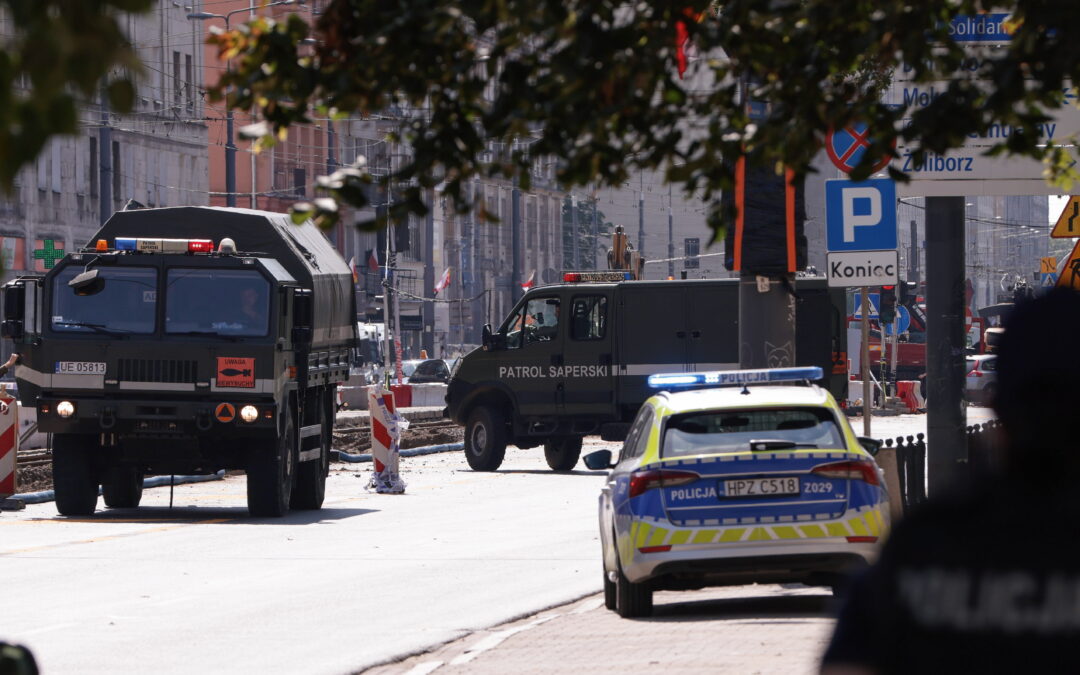
Part of central Warsaw was shut down today after unexploded ordnance from World War Two was found buried under a major road during construction work.
The discovery, which came just days after the city commemorated the anniversary of its wartime uprising against Nazi-German occupation, led to traffic being diverted and residents being warned to stay away from their windows and avoid going outside while bomb disposal experts worked to safely remove the item.
W Al. Solidarności znaleziono niewybuch, najprawdopodobniej z czasów II wojny światowej.
ℹ️ Czytaj więcej: https://t.co/Fv6oe84XiM pic.twitter.com/BfjQPZveYZ
— tvp.info 🇵🇱 (@tvp_info) August 4, 2026
The object, reportedly around 70 centimetres long, was found early on Tuesday morning on Solidarity Avenue, a major thoroughfare, during modernisation work on tram lines.
“We were digging a trench and I literally just touched it with the tip [of my digger],” the operator of the excavator who found it told broadcaster TVN. Staff working at the site were immediately evacuated to a safe distance.
Police later confirmed that the item is unexploded ordnance, and that initial findings indicate it dates from World War Two.
Bomb disposal experts arrived at the scene in the afternoon. However, they have not confirmed precisely what type of ordnance was discovered or its origin, reports Polsat News.
Warsaw was the site of major fighting during World War Two, beginning in 1939, when Nazi Germany invaded and occupied Poland. In 1943, the Warsaw Ghetto Uprising, the largest single act of Jewish resistance during the war, took place.
On 1 August 1944, the Polish underground Home Army launched the Warsaw Uprising, which was the largest single act of armed resistance anywhere in German-occupied Europe during the war. In response, the Germans destroyed much of the city, around 85% of which lay in ruins by 1945.
Warsaw’s historic Old Town was meticulously rebuilt after the war. But many other parts of the city were redeveloped by the newly installed communist authorities, including Solidarity Avenue (which during the communist era was named after Polish-Soviet Red Army General Karol Świerczewski).
Thousands of vehicles drove over the unexploded ordnance every day for decades. “Warsaw is marked by history, and there are many such surprises,” Witold Urbanowicz, spokesman for the city’s tram operator, told news website Interia.
After the fall of the Warsaw Uprising – which began 80 years ago today – the German occupiers expelled the city's entire population.
However, some survivors decided to remain among the ruins. They became known as "Robinson Crusoes" and this is their story https://t.co/UuVbfbcpQ4
— Notes from Poland 🇵🇱 (@notesfrompoland) August 1, 2024
Unexploded ordnance is regularly found in Poland. In May this year, around 200 anti-personnel mines dating from World War Two were discovered at the construction site of a student dormitory at Kraków’s Jagiellonian University.
In October last year, two men were hospitalised after an artillery shell that one of them had brought home from a forest exploded in his apartment while the pair were under the influence of alcohol.
Earlier that year, wild boars unearthed 21 mortar shells buried in a forest since the war. In 2023, 72 unexploded artillery shells were discovered during renovation work at a primary school and four pieces of World War Two ordnance were found in the walls of a church undergoing renovation.
Wild boars dug up 21 mortar shells from World War Two that had been buried in a Polish forest.
The unexploded ordnance has now been safely removed without harm to either the animals or humans https://t.co/W9kaPr1BNw
— Notes from Poland 🇵🇱 (@notesfrompoland) March 17, 2025
Notes from Poland is run by a small editorial team and published by an independent, non-profit foundation that is funded through donations from our readers. We cannot do what we do without your support.
Main image credit: Dawid Zuchowicz / Agencja Wyborcza.pl

Daniel Tilles is editor-in-chief of Notes from Poland. He has written on Polish affairs for a wide range of publications, including Foreign Policy, POLITICO Europe, EUobserver and Dziennik Gazeta Prawna.