Keep our news free from ads and paywalls by making a donation to support our work!

Notes from Poland is run by a small editorial team and is published by an independent, non-profit foundation that is funded through donations from our readers. We cannot do what we do without your support.
Russia has criticised the demolition of a Soviet-era monument in Poland, calling the decision “sacrilegious” and a “flagrant violation” of an agreement between the two countries on respecting places of remembrance.
However, Poland’s state Institute of National Remembrance (IPN), which financed the demolition, says that the monument was a “Soviet propaganda object” that was removed under a law requiring the “decommunisation” of public spaces.
🔻🔻🔻 pic.twitter.com/uT5hb95Lg7
— Instytut Pamięci Narodowej (@ipngovpl) July 31, 2026
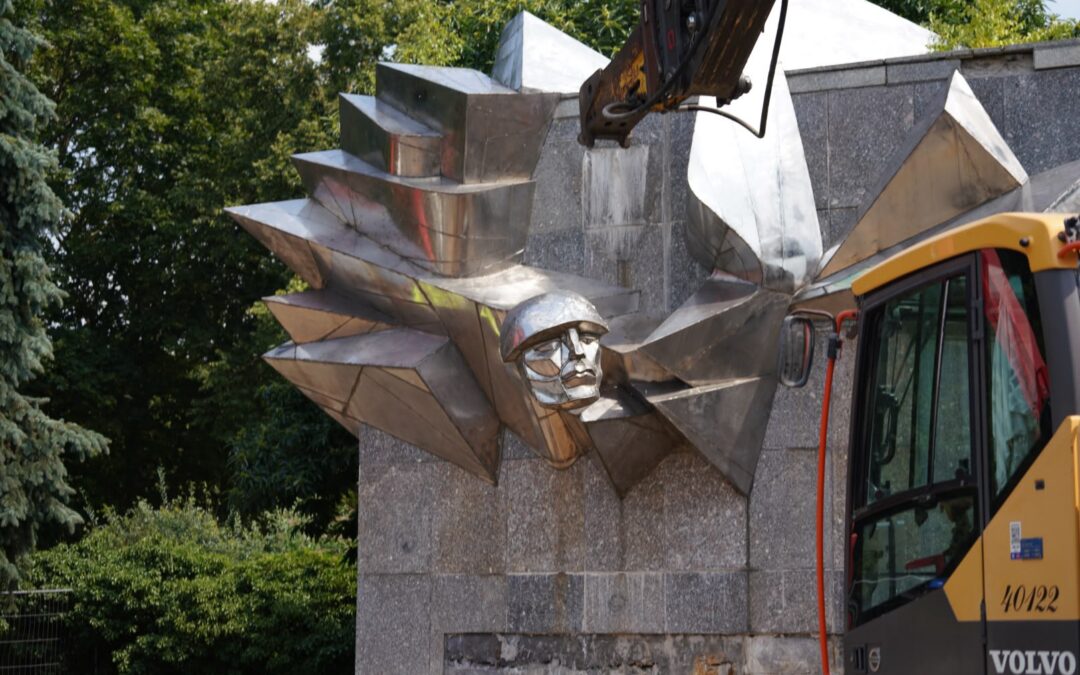
On Friday, around 150 residents in Pyrzyce, a town of 12,000 in northwestern Poland, gathered to watch the demolition of a monument to the Red Army that had stood there for decades.
Initially, a memorial had been established in the town alongside a cemetery for Red Army soldiers in the immediate aftermath of World War Two, when the Soviets had driven the Nazi German occupiers out of Poland but then introduced a new communist government of their own.
However, the soldiers’ remains were later moved to a military cemetery elsewhere in the region and the monument itself was redesigned and moved to another location within Pyrzyce.
Its final form, created in 1984, was a huge rectangular concrete structure weighing several hundred tons and featuring a relief depicting the head of a Soviet soldier. A plaque said “Eternal glory to the fallen heroes 1941-1945” (a timeline that ignores the Soviet invasion and occupation of parts of Poland in 1939).
Such Soviet monuments remained in many Polish towns and cities long after the fall of communism in 1989.
In 2016, the then-ruling national-conservative Law and Justice (PiS) government introduced a law requiring local authorities to “decommunise” public spaces by removing objects and names that “propagate communism”.
However, only in 2022, after Russia’s full-scale invasion of Ukraine, did the removal of Soviet-era monuments gather pace, with dozens demolished since then.
Those efforts were led by the IPN, in particular during the time that the institute was headed by Karol Nawrocki between 2021 and last year, when he was elected president of Poland.
Another Soviet memorial has been demolished in Poland – the 43rd since Russia's full-scale invasion of Ukraine.
"We say ‘no’ to Russians who believe these lands somehow belong to their sphere of influence,” declared the Institute of National Remembrance https://t.co/aG9VQVlUQI
— Notes from Poland 🇵🇱 (@notesfrompoland) December 12, 2025
At the start of this year, the local authorities in Pyrzyce began public consultations on removing their Soviet memorial, finding that a majority were in favour of the move, according to the IPN.
In February, the town council voted to remove the monument. It will now be replaced with a new one commemorating Polish independence.
“We are aware that this change evokes various, often very strong, emotions among residents,” wrote the local authorities on social media. “We respect both the voices of those supporting the actions taken and those who differ in their assessment of the current monument and its place in the history of Pyrzyce.”
“We hope that independence – as a paramount value for all Poles – will unite residents beyond differences of opinion and assessment of the past. We want the emerging space to be a space of shared remembrance, reflection, and a dignified celebration of the most important national ceremonies.”
The removal of the monument drew condemnation from the Russian embassy in Warsaw, which announced on Monday that it had lodged a formal protest.
It called the decision the “latest sacrilegious step by the Polish authorities” and said that it “constitutes a direct and flagrant violation” of a 1994 agreement between Poland and Russia on respect for graves and other places of memory.
“The illegal dismantling of monuments is an overt attempt to falsify history, to erase from the consciousness of the Polish nation the memory of the heroism of Soviet soldiers,” added the embassy.
⚡️Komentarz Ambasady Rosji w Polsce
31 lipca 2026 r. w Pyrzycach (województwo zachodniopomorskie) na podstawie decyzji władz polskich został przeprowadzony demontaż pomnika ku czci poległych w latach 1941–1945 bohaterów – żołnierzy radzieckich.
❗️Ten kolejny świętokradczy krok… pic.twitter.com/cKhfFxIL9s
— Russian Embassy, PL (@rusemb_pl) August 3, 2026
In response to such complaints from Russia, Poland has regularly pointed out that the 1994 agreement relates to graves and war cemeteries, not separate monuments and symbols, which can be legally removed.
The IPN notes that such monuments were “Soviet propaganda objects”, designed to support the Moscow-backed communist regime, rather than genuine places of commemoration.
Attending the demolition ceremony in Pyrzyce on Friday, IPN deputy president Karol Polejowski pointed out that the final version of the monument had been established in 1984 shortly after the period of martial law in Poland, when the authorities brutally clamped down on the democratic opposition.
“Local communist activists, eager to curry favour with their Soviet masters, erected a monument honouring the Soviet army. This is not a symbol of liberation – it is a symbol of enslavement!” he declared, as the monument was torn down.
💪 Sowiecki obiekt propagandowy zostanie zastąpiony przez Pomnik Niepodległości, a przestrzeń wokół nowego monumentu stanie się godną sceną dla uroczystości patriotycznych. pic.twitter.com/5x4KEzG3Vb
— Instytut Pamięci Narodowej (@ipngovpl) July 31, 2026
Notes from Poland is run by a small editorial team and published by an independent, non-profit foundation that is funded through donations from our readers. We cannot do what we do without your support.
Main image credit: IPN/X

Daniel Tilles is editor-in-chief of Notes from Poland. He has written on Polish affairs for a wide range of publications, including Foreign Policy, POLITICO Europe, EUobserver and Dziennik Gazeta Prawna.