Keep our news free from ads and paywalls by making a donation to support our work!

Notes from Poland is run by a small editorial team and is published by an independent, non-profit foundation that is funded through donations from our readers. We cannot do what we do without your support.
The speaker of parliament has launched the process of selecting new members of a key judicial body, despite the fact that it will take place under rules introduced by the former government that the current authorities regard as illegitimate.
The institution in question, the National Council of the Judiciary (KRS), is responsible for nominating judges to courts. It has been at the heart of Poland’s rule-of-law dispute after the former Law and Justice (PiS) government in 2017 changed the manner in which the KRS’s members are appointed.
Previously, most were chosen by judges themselves. However, after PiS’s reforms, most were selected by politicians. The move was widely condemned by expert bodies as undermining judicial independence. Polish and European court rulings have found the KRS to no longer be a legitimate body.
The government that replaced PiS in 2023 has proposed legislation to transfer the power to elect most KRS members back to the judiciary. The bill was approved by parliament in January but has yet to be signed by President Karol Nawrocki, a PiS ally.
The justice ministry has presented a bill that would overhaul one of the institutions at the heart of Poland's rule-of-law crisis.
It wants to ensure that the body responsible for nominating judges is made independent of political control https://t.co/9Cilwx6e46
— Notes from Poland 🇵🇱 (@notesfrompoland) November 6, 2025
Given that the four-year terms of current KRS members will expire on 12 May, Wednesday this week was the final day permitted by law for parliament to launch the procedure for choosing their replacements, which must start at least 90 days in advance.
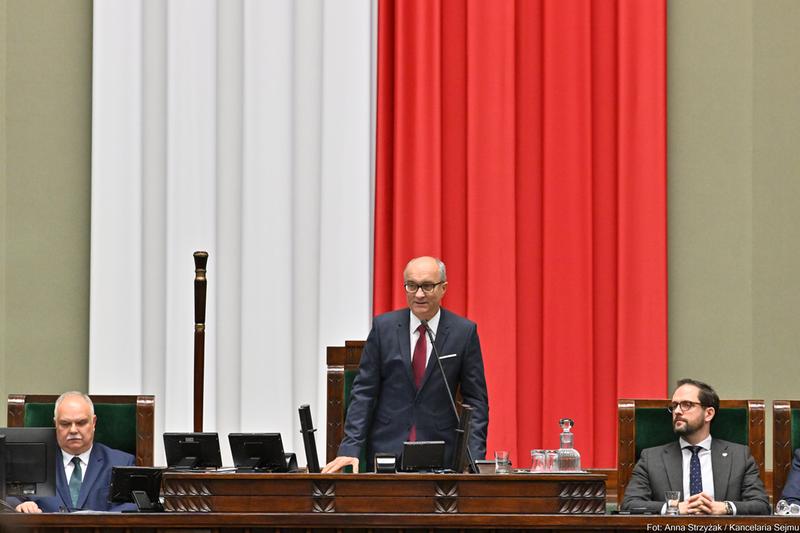
Justice minister Waldemar Żurek and Włodzimierz Czarzasty, the speaker of the Sejm, the more powerful lower house of parliament, had expressed hope that Nawrocki would sign the law before that deadline.
However, as he had not done so by Wednesday, Czarzasty said that he had no choice but to launch the process of choosing new KRS members because, although the current rules are flawed, they remain binding.
Marszałek Sejmu Włodzimierz Czarzasty wydał obwieszczenie o rozpoczęciu procedury zgłaszania kandydatów na członków Krajowej Rady Sądownictwa wybieranych spośród sędziów. https://t.co/Koz54BFHBL
— tvn24 (@tvn24) February 12, 2026
“I asked the president to…sign the bill on the KRS, which he has in his possession. He did not sign it. Therefore, the president takes full responsibility for the fact that I had to initiate the procedure according to the old, bad law,” said Czarzasty, quoted by the Onet news website.
He noted that the law currently in force “takes away judges’ independence” and “has led to the legal system being very unstable”. Because thousands of judicial appointments have been made by the reformed KRS since 2017, there are legal doubts about the status of those judges and the legitimacy of their rulings.
In one recent case, a court annulled a divorce because it had been granted by a judge appointed through the disputed process.
Earlier this week, however, Czarzasty said that, if the president ends up signing the bill, any steps taken under the current rules to elect new members would have no legal effect. Nawrocki has until 19 February to make a decision.
Żurek announced earlier this week that the government has a “plan B” if the president vetoes the bill, which he said officials at the presidencial palace had indicated was likely.
The plan would involve parliament, where the government has a majority, simply approving KRS members democratically chosen by judges themselves. That would in effect restore the situation that existed before PiS’s 2017 reform, though without actually changing the law.
“Let the democratic majority respect the choice of the judicial community, so that this process is in line with the constitution and serves citizens as well as the stability of judicial rulings,” said Żurek on social media.
Dziś rozpoczyna się procedura zgłaszania kandydatów do KRS.
Niech sędziowie wybiorą najlepszych spośród siebie – ludzi kompetentnych, niezależnych i o niekwestionowanym kręgosłupie moralnym.
Większość demokratyczna niech uszanuje wybór środowiska, tak aby proces ten był zgodny… pic.twitter.com/SeyMjrCqG1
— Waldemar Żurek (@w_zurek) February 11, 2026
In 2019, Poland’s Supreme Court ruled that, due to PiS’s reforms, “the KRS is not an impartial and independent body” as it had been rendered “dependent on the executive authorities”. In 2022, the same court found the KRS to no longer be consistent with its role outlined in the constitution.
In 2021, the European Court of Human Rights likewise found the overhauled KRS was no longer independent from legislative or executive powers. The same year, Poland became the first country to ever be expelled from the European Network of Councils for the Judiciary.
However, even some proponents of reversing PiS’s reforms have argued that it would be impractical and unfair to simply cancel all appointments made through the KRS since 2017, leading the ruling coalition to put forward bills that included measures to resolve the status of illegitimately appointed judges.
Fifteen months since the change of government, Poland's rule-of-law crisis continues – indeed, many Poles think the situation has got worse.@J_Jaraczewski explains the roots of the crisis, what its impact has been, and how it might be resolved https://t.co/7KOCURV3dU
— Notes from Poland 🇵🇱 (@notesfrompoland) March 17, 2025
Notes from Poland is run by a small editorial team and published by an independent, non-profit foundation that is funded through donations from our readers. We cannot do what we do without your support.
Main image credit: Anna Strzyżak/Kancelaria Sejmu (under CC BY-SA 4.0)

Alicja Ptak is deputy editor-in-chief of Notes from Poland and a multimedia journalist. She has written for Clean Energy Wire and The Times, and she hosts her own podcast, The Warsaw Wire, on Poland’s economy and energy sector. She previously worked for Reuters.