Keep our news free from ads and paywalls by making a donation to support our work!

Notes from Poland is run by a small editorial team and is published by an independent, non-profit foundation that is funded through donations from our readers. We cannot do what we do without your support.
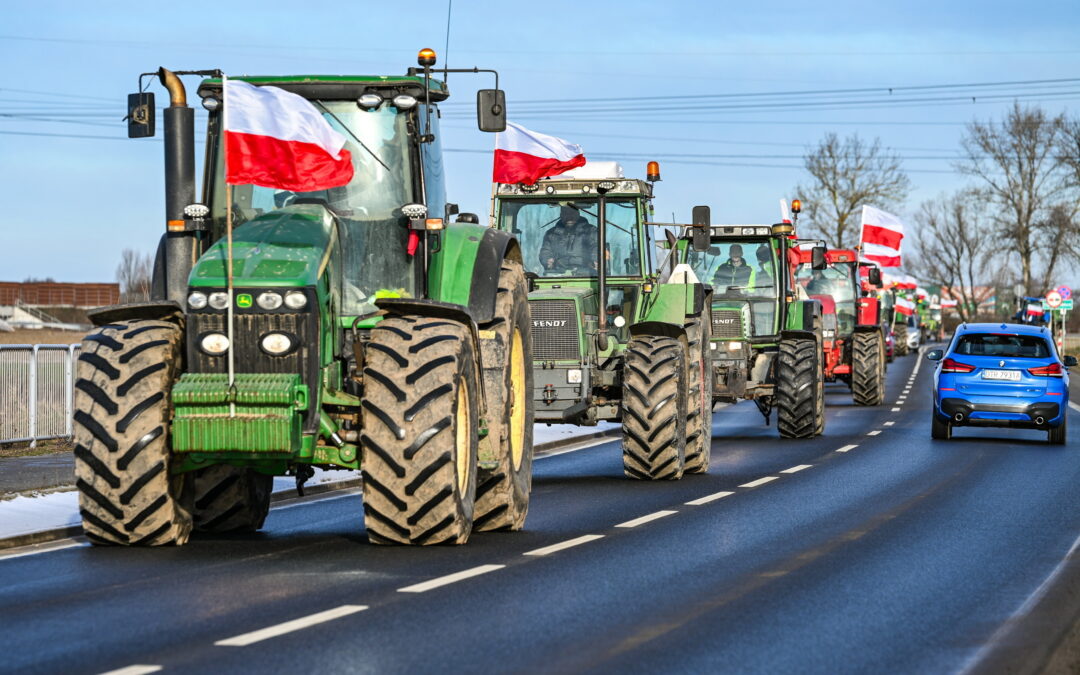
Polish farmers have today staged nationwide protests against a planned free trade agreement between the European Union and South America’s Mercosur bloc. They argue that the deal, which is also opposed by the Polish government, would threaten European agriculture and food safety.
Demonstrations were planned in 186 locations around the country. In Kraków, Poland’s second-largest city, a column of farmers and their supporters marched through the streets. “We want to live with dignity, and feed you well,” read one placard.
In some places, tractors were used to block or slow traffic. Around 30 tractors blocked one of two lanes on national road 50 near Warsaw, reported broadcaster TVN.
#ProtestRolników w Wartkowicach(woj. łódzkie), zablokowany wiadukt nad autostradą A2. Rolnicy z powiatu poddębickiego protestują przeciwko ratyfikacji umowy handlowej UE z państwami Mercosur. pic.twitter.com/gfE2Dn0eMl
— Michał Gwardyński (@m_gwardynski) December 30, 2025
Farmers argue that the proposed EU-Mercosur deal would open European markets to cheaper food produced to lower standards, thereby undermining local farms already struggling with what they describe as a lack of effective protection.
Although Poland is among a minority of EU states that have voiced opposition to the agreement, and Prime Minister Donald Tusk has recently reiterated that position, farmers say they must continue protesting because the Polish government has not done enough to protect their interests.
“The aim of the protests is not to express opposition ‘on principle’, but to exert political pressure at the last possible moment,” Agnieszka Beger of Grassroots National Farmers’ Protest (OOPR), the movement coordinating the protests, told financial news service Money.pl.
Dziś w Krynicznie, wspólnie z rolnikami z powiatu trzebnickiego, wołowskiego i średzkiego protestowaliśmy przeciwko umowie handlowej z krajami Mercosur. Realizacja tej umowy to będzie potężny cios w polskie rolnictwo. Nie ma na to naszej zgody! 🇵🇱🚜 #protestrolnikow #rolnictwo pic.twitter.com/x9KMctNgMM
— Wojciech Gnat 🇵🇱 (@WojciechGnat) December 30, 2025
OOPR says protests are the result of the “passivity and ineffectiveness of the Polish government regarding the EU-Mercosur agreement”.
“If the Polish government had acted effectively during the negotiations, built a real coalition of countries opposing the agreement, and enforced genuine market protection mechanisms, farmers would not have had to protest today,” the movement said in a Facebook post.
“Placing the blame solely on the European Union is a simplification that does not reflect the truth,” it added.
However, in a statement yesterday, the agriculture minister declared that the government is “fulfilling its promises to Polish farmers” by “leading a diplomatic offensive” in Brussels in order to “build a coalition [of member states] to block the [Mercosur] agreement”.
The French and Italian governments have also recently expressed reservations about the Mercosur deal, with both Emmanuel Macron and Giorgia Meloni voicing concern about its impact on local agriculture.
Speaking amid today’s protests, agriculture minister Stefan Krajewski said that, if it is not possible to build a blocking minority, Poland would propose measures to financially compensate farmers for losses caused by the deal.
But Jarosław Kaczyński, leader of the national-conservative opposition Law and Justice (PiS) party, today declared that “the Tusk government is deceiving the Polish public by doing nothing to block this agreement”. He said that the farmers “are protesting in the interest of us all”.
Minister @StefanKrajewski podczas konferencji w #KPRM po spotkaniu Rady Ministrów: Od początku mówimy "NIE" dla umowy z krajami Mercosur, ale jeśli mniejszości blokującej nie uda się zbudować, proponujemy szereg poprawek, które zakładają rekompensaty finansowe w razie… pic.twitter.com/hBFOCREBND
— Ministerstwo Rolnictwa i Rozwoju Wsi (@MRiRW_GOV_PL) December 30, 2025
Negotiations between Brussels and the Mercosur bloc, which includes Argentina, Brazil, Paraguay, Bolivia and Uruguay, have been ongoing for decades.
The currently proposed deal would grant tariff preferences for South American products such as beef, poultry, dairy, sugar and ethanol, while opening Mercosur markets to European industrial goods. There had been talk of signing the agreement this month, but reports now suggest it will happen in January.
In the meantime, farmers from several EU countries, including Poland, Italy and France, protested in Brussels in mid-December.
Farmers drove tractors into Brussels on Thursday, blocking roads and clashing with police outside an EU leaders’ summit to protest a proposed free-trade deal with South American nations. pic.twitter.com/WpJ7CTuilp
— Clash Report (@clashreport) December 18, 2025
On 17 December, the European Council and European Parliament reached a provisional agreement on safeguard measures intended to protect EU agricultural producers if they suffer harm from the Mercosur agreement.
However, a vote on whether to approve the measures has been repeatedly postponed, reportedly because they lack enough support among member states, according to news service Euractiv.
Robert Kuryluk, an organic farmer from eastern Poland, told Notes from Poland that, even if the safeguards are introduced, they do not do enough to protect the sector.
He also accused the EU of hypocrisy, saying that it claims to care for the environment but that the result of the Mercosur deal would be “thousands of hectares of rainforest being cut down” so that food can “be sold cheaply to wealthy Europe”.
Kuryluk said that Brussels is sacrificing European agriculture for the benefit of other industries: “In exchange for the automotive and agrochemical sectors thriving, European agriculture will be destroyed.”
Poland has announced that it will not support a proposed free trade agreement between the EU and the South American Mercosur bloc in its current form.
It fears that the deal will harm Polish farmers. France has opposed it for the same reason https://t.co/E0uH9rVB23
— Notes from Poland 🇵🇱 (@notesfrompoland) November 26, 2024
Notes from Poland is run by a small editorial team and published by an independent, non-profit foundation that is funded through donations from our readers. We cannot do what we do without your support.
Main image credit: Krzysztof Zatycki / Agencja Wyborcza.pl

Alicja Ptak is deputy editor-in-chief of Notes from Poland and a multimedia journalist. She has written for Clean Energy Wire and The Times, and she hosts her own podcast, The Warsaw Wire, on Poland’s economy and energy sector. She previously worked for Reuters.