Keep our news free from ads and paywalls by making a donation to support our work!

Notes from Poland is run by a small editorial team and is published by an independent, non-profit foundation that is funded through donations from our readers. We cannot do what we do without your support.
By Agata Pyka
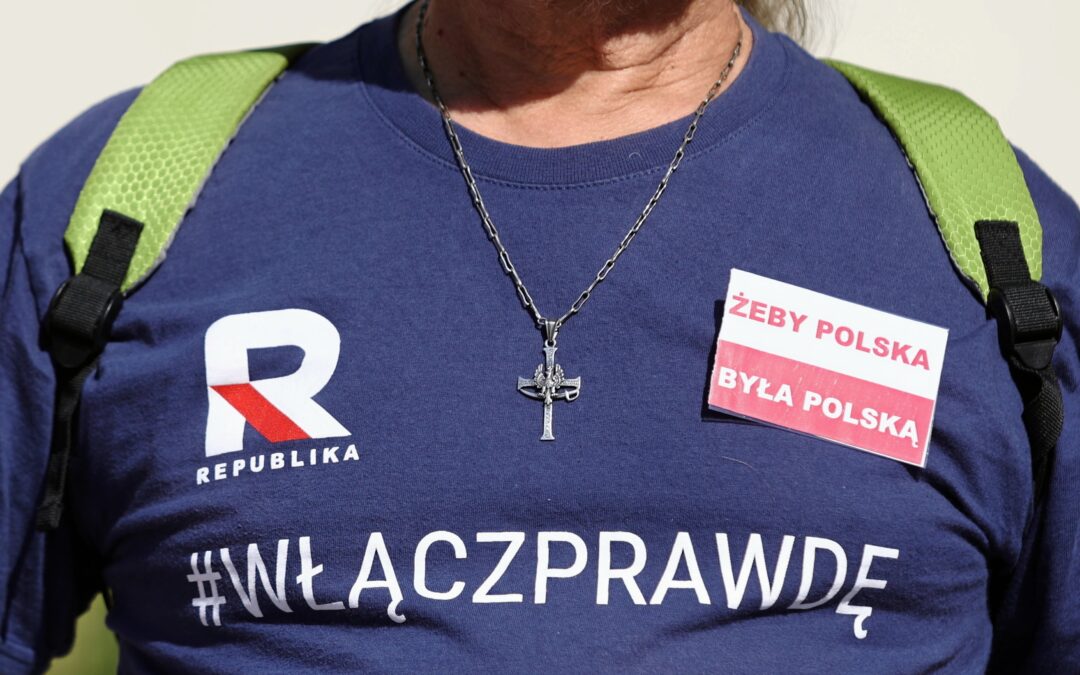
The arrival of a more liberal government in 2023 helped take conservative broadcaster Republika from relative obscurity to the top of the news ratings. The station has transformed the media landscape, but questions remain over its long-term prospects.
“German propaganda attacks the Polish president.”
“Tusk has no regrets about his harmful words toward President Trump.”
”European Court of Justice is pushing for LGBT ‘marriages’ in Poland. What next?”
These are some recent headlines from TV Republika, a conservative media outlet that in September this year ranked as the most-watched news channel in Poland. That completed a dramatic rise for the station, which saw its viewing figures rise 1900% between 2023 and 2024.
📌 Udział programów informacyjnych w widowni we wrześniu. ⬇️
◽ @RepublikaTV – 6,4%
◽ @tvn24 – 4,8%
◽ @tvp_info – 1,7%
◽ @wPolscepl – 1,5%
◽ @PolsatNewsPL – 1,4%
#media #monitoring #raport #KRRiT #ranking #oglądalność pic.twitter.com/d6Y6PNDSnr— KRRiT (@KRRiT__) October 22, 2025
Republika’s polarising, partisan style and growing success have seen some label it the “Polish Fox News”. Like its American counterpart, it has become an integral part of the media landscape, though questions remain as to how sustainable this success will be.
Filling the conservative void
Avoided by liberal circles and followed closely by Polish conservatives, Republika has risen to its current fame after it filled the spot previously occupied by the state broadcaster TVP.
Public media in Poland have long been under the influence of whichever parties are in power. However, that bias was taken to an unprecedented level under the rule of the national-conservative Law and Justice (PiS) party between 2015 and 2023.
During that time, TVP was used as a propaganda mouthpiece, with its news broadcasts praising the PiS government and attacking its political and ideological opponents.
A prominent figure from state TV admits they produced "worse propaganda" than under communism to support the ruling party's election campaign.
But he thinks this "Stalinist logic" backfired and contributed to the negative outcome of the election for PiS https://t.co/8CsLIeVgNz
— Notes from Poland 🇵🇱 (@notesfrompoland) October 18, 2023
However, when PiS lost power in 2023, the new, more liberal ruling coalition led by Prime Minister Donald Tusk made “depoliticising” public media one of its priorities.
Within a week of taking power, the new government launched a controversial and legally contested takeover of TVP and other state media outlets in order to remove PiS influence (and, media monitoring organisations note, replace it with its own influence).
That prompted a boycott of the “new” TVP by its former conservative viewership, which turned away from the channel in search of new sources of information.
For Republika, this was a golden opportunity. It used the changes at public media to grab much of TVP’s former audience, as well as many of the PiS-era star presenters and other staff forced out by the broadcaster’s new management.
Republika’s success story
Despite existing since 2013, Republika functioned only as a minor channel for around a decade. In 2023, it ranked last for viewership among 38 TV stations monitored by AGB Nielsen Media Research. Its 0.2% market share placed it below even MiniMini+ (0.23%), a channel aimed at children aged three to eight.
That situation changed dramatically in 2024, when multiple stars of PiS-era TVP – such as presenters Danuta Holecka, Michał Rachoń and Ewa Bugała – moved to Republika, bringing conservative viewers with them and helping improve Republika’s programming.
“The employees of the old TVP who moved to Republika brought their know-how with them, thanks to which the station operates much more professionally and is more watchable,” explained Marcin Kostecki, chief of fact-checking at Demagog, a leading NGO dedicated to fighting disinformation.
This has been confirmed to us by one devoted viewer of Republika, 75-year-old Halina, who lists the station’s advantages: “Full journalistic professionalism and an enormous commitment to gathering information and developing the station”.
She previously sourced her information about events in Poland and the world almost exclusively from TVP, but decided to switch to Republika due to the current government’s changes to state television.
“I believe that, currently, TVP does not allow for statements that are inconsistent with the presenter’s expectations, which creates room for manipulation of facts, omission of important information, or misrepresentation of the truth,” Halina explains.
State TV is seen as the least objective news source among Poland’s main stations, according to a new poll.
Amid campaigning for the European elections, 90% of politicians appearing on TVP’s main evening news discussion show were from the ruling coalition https://t.co/LrYgDqvATQ
— Notes from Poland 🇵🇱 (@notesfrompoland) June 10, 2024
When Tusk’s government launched its effort to “depoliticise” state television, the new TVP promised to offer viewers “clean water” instead of a “propaganda soup”. However, according to Demagog’s findings, the station has failed to provide depoliticised reporting.
It found that TVP regularly omits information inconvenient for the new government, criticised PiS-aligned President Andrzej Duda more than the other broadcasters, and marginalised the opposition.
“I also dislike the judgemental attitude towards the section of society that holds rather conservative views,” says Halina. “These factors have led me to stop watching TVP and watch Republika instead.”
State TV has shown a pro-government bias since its takeover by @donaldtusk's new administration, a report has found
The station's coverage has omitted information disfavouring the government and aired criticism of opposition-aligned President @AndrzejDudahttps://t.co/hkxau2BY6V
— Notes from Poland 🇵🇱 (@notesfrompoland) February 23, 2024
Republika certainly provides a safe space for politicians from the conservative PiS and the radical right-wing Confederation (Konfederacja), another opposition group.
Based on Demagog’s analysis, over 58% of guests at Republika’s flagship news programme in October 2024 were PiS politicians. Those from Confederation placed second, with close to 14%.
Kostecki notes that Republika has succeeded in attracting not only former PiS-era TVP viewers, but also “anti-establishment viewers who had previously not watched television at all”.
This approach yielded impressive results. In 2024, Republika’s 200,000 viewers placed it sixth in the ranking of television stations in Poland, representing a 1900% increase year-on-year.
In the second quarter of 2025, it reached its best result yet and placed second, right behind TVP1, with over 345,000 viewers and a 6.83% market share.
The “Polish Fox News”
While Republika’s style, politics and growing prominence have drawn comparisons to its US counterpart, the station has also directly been part of efforts by Poland’s conservatives to cultivate ties with their US counterparts.
PiS has been a vocal support of Donald Trump, enthusiastically celebrating his return to the White House. Both Duda and his successor as president, Karol Nawrocki, who is also aligned with PiS, have cultivated close relations with Trump.
In his maiden speech at the @UN, Poland's new president, @NawrockiKn, said that he "agrees with Donald Trump that in recent years Europe has descended into an ideological frenzy that has led to poor decisions regarding migration and to green madness" https://t.co/t82kaoNCrW
— Notes from Poland 🇵🇱 (@notesfrompoland) September 24, 2025
In May, Republika co-organised and broadcast the first Polish edition of the Conservative Political Action Conference (CPAC), a major American conservative event, featuring speeches by US Republicans and PiS politicians.
Republika’s CEO and editor-in-chief Tomasz Sakiewicz was the first to speak on stage after a public prayer was held. He warned that the government in Poland “wants to shut down TV Republika” and introduce hate speech laws that will “ban people from saying what they think”.
“If there is one thing of great value and one great message that comes from the republican experience, it is the defence of freedom,” he declared. “Let us stand up for this defence of freedom.”
Donald Trump’s homeland security secretary, Kristi Noem, has called on Poles to elect conservative Karol Nawrocki as president during a speech today at CPAC Poland, days ahead of his election run-off against government-aligned centrist Rafał Trzaskowski https://t.co/eMP13DEwgv
— Notes from Poland 🇵🇱 (@notesfrompoland) May 27, 2025
Republika reporters have often clashed with government representatives at press conferences. Earlier this year, the station was for months banned from even attending press briefings by Tusk, notes media news service Wirtualne Media.
The government argues that Republika regularly broadcasts “disinformation”. For example, in October, the station claimed that Tusk wanted to extradite a Ukrainian man suspected of involvement in Nord Stream pipeline bombings. In fact, Tusk had expressly said he opposed extradition.
Future of Poland’s conservative media
Despite – indeed in part because of – the government’s hostility, Republika’s success continues. The latest available audience data show that it placed first among news channels and third in overall market share.
However, the station’s position is being challenged by other right-wing platforms that have in recent times gained popularity, such as the wPolsce24 news channel.
After receiving a broadcasting licence in 2024, by the second quarter of 2025, wPolsce24 had a market share of 1.54%, making it the 14th most-viewed station.
A deputy PM has suggested withdrawing the licence of a conservative TV station after one of its viewers made a death threat against the head of a charity following critical coverage of him
However, the idea has sparked criticism even within the government https://t.co/8DCpDXoPpL
— Notes from Poland 🇵🇱 (@notesfrompoland) January 14, 2025
“It is important to remember that just as the liberal audience is not homogeneous, neither is the conservative one,” says Dorota Piontek, head of the social communication department at Adam Mickiewicz University in Poznań, quoted by Demagog.
The expert emphasised that, while wPolsce24 tries to reach a slightly more intellectually demanding audience, Republika offers programmes that are more populist in nature.
To address the growing competition, Republika has begun to extend its flagship programme to overlap with that of wPolsce24.
But Demagog views Republika’s position as stable. “Republika could only lose if a war broke out between it and state television, after another potential takeover of it by PiS in the future,” says Kostecki.
“However, I think it would be more beneficial for the next government, if it is again a PiS government, to keep all the television stations that are favourable to it,” he added.
Poland’s culture ministry has presented a draft media bill that it says “will ensure the depoliticisation of public media”.
However, the opposition has called the plans a “sham” that will simply "entrench" the government's power over state broadcastershttps://t.co/pSWEsPG5vu
— Notes from Poland 🇵🇱 (@notesfrompoland) October 31, 2025
Halina, the devoted Republika viewer, declares she “does not intend to abandon Republika in favour of TVP, even if PiS comes back into power”. She says that she values the station’s independence from the state.
However, that independence certainly does not translate into impartiality.
A recent study of the main evening news programmes in Poland found that Republika’s had by far the highest proportion of content, 56%, classified as polarising, compared to 21% on TVP and 23% and 19% for TVN and Polsat, the main private broadcasters, respectively.
Kostecki warns that, while media pluralism is important, the rise of Republika is part of a worrying trend of media consumers “sealing themselves in their own bubble” rather than “building their worldview based on diverse opinions”. This “makes them more vulnerable to false information”.
Trust in Poland’s public media has risen for the second year running following the 2023 change in government.
However, the proportion of Poles who trust public media (35%) is still far outweighed by those who distrust it (48%) https://t.co/UBL3CRY4Ma
— Notes from Poland 🇵🇱 (@notesfrompoland) September 23, 2025
With Tusk’s governing coalition increasingly fragile, a PiS-led government, perhaps in partnership with Confederation, is a real possibility after the 2027 parliamentary elections in Poland.
If that happens, it would represent both opportunities and risks for Republika. On the one hand, better relations with the state – and the possibility of lucrative advertising and partnerships with state-owned companies – could boost the station.
However, were PiS to seek to turn TVP back into a propaganda mouthpiece, that could draw viewers and staff back away from Republika.
Just as Fox News helped reshape the conservative media ecosystem in the United States, Republika has played a similar role in Poland. Whether that continues beyond the next elections remains to be seen.
Notes from Poland is run by a small editorial team and published by an independent, non-profit foundation that is funded through donations from our readers. We cannot do what we do without your support.
Main image credit: Konrad Kozlowski / Agencja Wyborcza.pl

Agata Pyka is a former assistant editor at Notes from Poland. She specialises in Central and Eastern European affairs, cybersecurity, and investigative reporting. She holds a master’s degree in political communication from the University of Amsterdam, and her work has appeared in Euractiv, the Balkan Investigative Reporting Network (BIRN), and The European Correspondent, among others.