Keep our news free from ads and paywalls by making a donation to support our work!

Notes from Poland is run by a small editorial team and is published by an independent, non-profit foundation that is funded through donations from our readers. We cannot do what we do without your support.
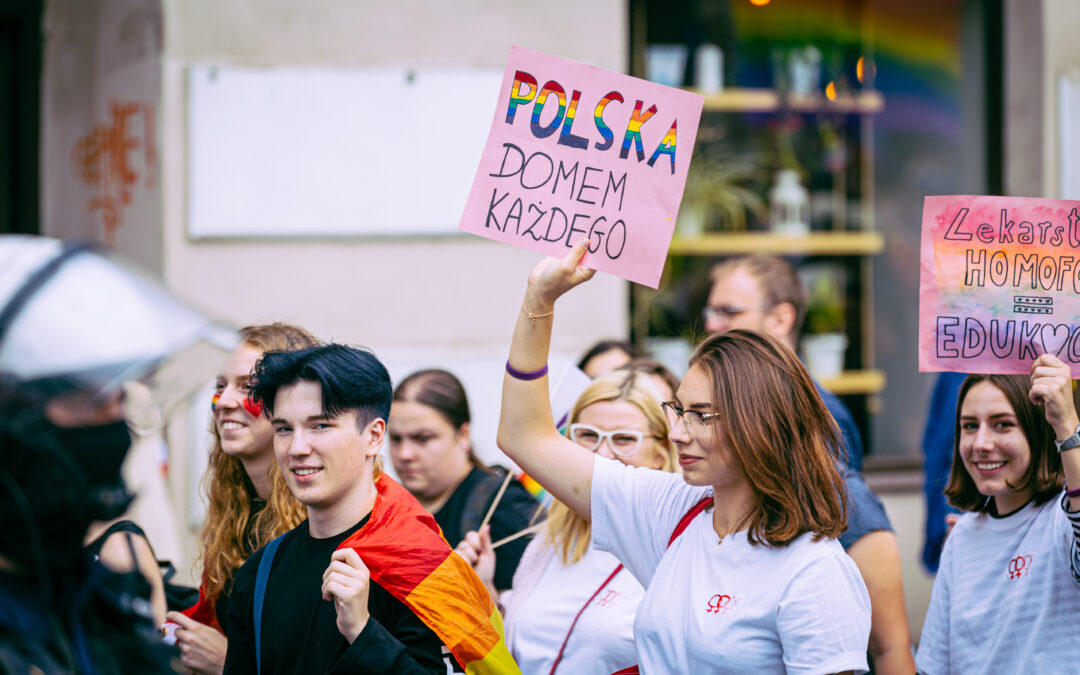
All registry offices in Poland can now recognise same-sex marriages conducted in other European Union countries, after a government regulation issued in May went into force. The decision came in response to a ruling by the Court of Justice of the EU (CJEU) requiring Poland to recognise such unions.
Deputy prime minister Krzysztof Gawkowski expressed his “great joy, because finally in Poland we have a law that gives the right to dignity”. The government’s plenipotentiary for equality, Katarzyna Kotula, warned local authorities that they will be breaking the law if they refuse to comply with the new rules.
However, the mayor of one town in a conservative region has already declared that his administration will not recognise such marriages. He argues that doing so would violate Poland’s constitution, which mentions marriage as a union between a man and a woman.
Od jutra polskie państwo będzie lepiej chronić godność i prawa swoich obywateli.
Nowe wzory aktów małżeństwa umożliwią transkrypcję zagranicznych aktów małżeństw jednopłciowych z pełnym szacunkiem dla par. To koniec administracyjnej fikcji i niepewności, z którą przez lata… pic.twitter.com/mRZYkEg9W4
— Krzysztof Gawkowski (@KGawkowski) August 22, 2026
Polish domestic law still does not allow any form of same-sex unions to be formed. However, last year, the CJEU ordered that the country recognise same-sex marriages conducted in other EU member states. That was followed by a similar ruling from Poland’s own Supreme Administrative Court (NSA).
One obstacle to implementing those decisions was that, previously, Poland’s civil registry only allowed male-female marriages to be entered. But, under a regulation issued by the government in May, the system now allows either mixed-sex or same-sex marriages.
Even before that went into force on Sunday, some Polish cities, starting with Warsaw and Wrocław, had already begun transcribing same-sex marriages conducted abroad into their registries. They simply listed one spouse in the “man” section and the other as a “woman”, even though that was not accurate for one of them.
But some local authorities have refused to do so, pointing to article 18 of Poland’s constitution, which states that: “Marriage, being a union of a man and a woman, as well as the family, motherhood and parenthood, shall be placed under the protection and care of the Republic of Poland.”
Such doubts were cited by the mayor of Zakopane, a town in southern Poland, last week when he announced that his administration did not intend to begin recognising foreign same-sex marriages after the regulation came into force.
“We will not be issuing such transcriptions in Zakopane,” said Łukasz Filipowski, quoted by local news service Nasze Miasto. He argued that doing so would “not be in accordance with the constitution”, adding that, while Zakopane is “tolerant”, it “promotes the traditional family model…[as] our foundation”.
Filipowski pointed to a ruling in July by the Constitutional Tribunal (TK), which found that the government’s regulation conflicts with the constitution’s definition of marriage. However, the government considers the TK to be improperly constituted and therefore regards its rulings as invalid.
Poland's Constitutional Tribunal has ruled that a new regulation allowing foreign same-sex marriage certificates to be registered in Poland is unconstitutional.
The government says it will not implement the rulinghttps://t.co/xDAzLjcJQ4
— Notes from Poland 🇵🇱 (@notesfrompoland) July 28, 2026
In response to Filipowski’s remarks, Kotula told broadcaster TVN that officials who refuse to recognise foreign same-sex marriages “will be breaking the law”. She said that the personal views of officials cannot “translate into what [legal] actions they take” and that the government would be monitoring the situation.
Gawkowski – who, like Kotula, is a leading figure in The Left (Lewica), a junior member of Poland’s ruling coalition – also warned municipalities against issuing refusals. He noted that, as well as the CJEU ruling, Polish courts have also issued orders to recognise foreign same-sex marriages.
“In the end, these local authorities will lose [a court battle], so why embarrass themselves? Let’s not look for legal tricks. Let’s just implement something that has been done in other, normal countries for years,” Gawkowski told Polsat News.
However, even once same-sex marriages are transcribed into Polish civil registries, there remains uncertainty about what legal consequences that will have in practice, especially given that Poland’s domestic law does not allow for any legally recognised form of same-sex union.
Legal experts say that it may take years – and potentially many more legal challenges by same-sex couples – for the situation to be clarified.
Separately, parliament earlier this year approved a bill, proposed by the ruling coalition, that would have granted same-sex couples in Poland certain rights normally granted to married couples. However, the law was vetoed by President Karol Nawrocki, who is aligned with the right-wing opposition.
Poland has begun recognising foreign same-sex marriages. But the legal consequences for such couples remain unclear, especially as Polish law does not allow any form of same-sex union
We asked five experts for their view on what this will mean in practice https://t.co/h2KHmW8sMI
— Notes from Poland 🇵🇱 (@notesfrompoland) June 19, 2026
Notes from Poland is run by a small editorial team and published by an independent, non-profit foundation that is funded through donations from our readers. We cannot do what we do without your support.
Main image credit: Max Bashyrov/Flickr (under CC BY-NC 2.0)
Olivier Sorgho is senior editor at Notes from Poland, covering politics, business and society. He previously worked for Reuters.