Keep our news free from ads and paywalls by making a donation to support our work!

Notes from Poland is run by a small editorial team and is published by an independent, non-profit foundation that is funded through donations from our readers. We cannot do what we do without your support.
The Ukrainian Institute of National Remembrance (UINP) has reported the discovery of 30 human remains at a site in Poland where Polish partisans killed Ukrainian civilians during World War Two.
The head of the UINP, Oleksandr Alfyorov, thanked Poland for granting permission to conduct research at the location, which he said would help advance “true reconciliation” between the two countries over their difficult shared history.
Ukraine has likewise recently allowed Poland to search for and exhume the remains of Poles massacred by Ukrainian nationalists during the war.
At the end of August, the Polish authorities approved a request from Ukraine to conduct a search in the village of Łasków in southeastern Poland, around 10km from the border with Ukraine.
On 10 March 1944, units of the Home Army (Armia Krajowa) and Peasant Battalions (Bataliony Chłopskie), two major Polish underground resistance movements that emerged during the Nazi-German occupation, attacked Łasków, which had a predominantly ethnic Ukrainian population.
Estimates suggest that around 300 civilians were killed. Among them was a local Orthodox priest, Lev Korobchuk.
On the same day, members of the Home Army also attacked the nearby village of Sahryń, where they are estimated to have killed hundreds more Ukrainians. Ukraine has also submitted an application to carry out exploratory work there.
Poland has granted permission for Ukraine to conduct a search for the remains of Ukrainian civilians killed by Polish resistance fighters during WWII https://t.co/4JeAAhYJcY
— Notes from Poland 🇵🇱 (@notesfrompoland) September 2, 2026
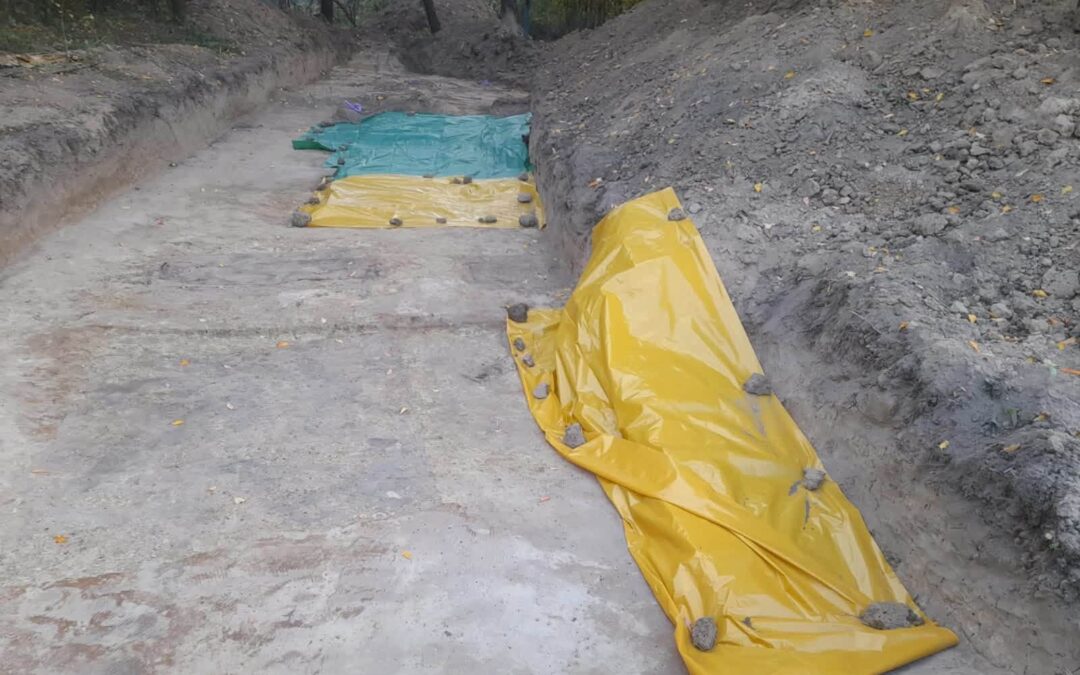
Work began in Łasków on 6 October and, on Wednesday this week, the UINP announced that it had “discovered the remains of 30 victims…[who] died as a result of the attack of the units of the Home Army and the Peasant Battalion in March 1944″.
Svyatoslav Sheremeta, the head of the Lviv-based Dolya memorial and search centre, which carried out the work on behalf of the UINP, said that they now hope to “conduct exhumation, rebury the dead, and honour their memory with dignity”.
“Thank you to the Polish side for the opportunity to conduct research,” added Alfyorov. “Our common task is to ensure a worthy commemoration of all victims, regardless of their origin and nationality.”
“True reconciliation begins with respect for everyone’s memory, recognition of the pain of the other side, and the common desire for understanding,” said the head of UNIP, which shared images from the search site in Łasków’s Orthodox cemetery.
At the time of writing, Polish officials had not yet commented on the development. However, when search work began last week, Rafał Kościański, a spokesman for Poland’s Institute of National Remembrance (IPN), told Radio Lublin that IPN staff were participating as observers.
Wiesław Koman, from the Provincial Office for the Protection of Monuments, added that cooperation between Polish and Ukrainian archaeologists at the site had been “impeccable”.
Meanwhile, Ukraine’s ambassador to Poland, Vasyl Bodnar, told the broadcaster that the work in Łasków was “a step towards reconciliation between our nations”.
“This is happening on both sides of the border and demonstrates the openness of both sides to commemorating the victims of the past conflict,” said Bodnar. “There are differing voices from different sides of the political arena, but this is the right path, one we should have been on for a long time.”
Polish and Ukrainian researchers have exhumed the remains of 115 Polish soldiers who died in 1939 defending Lviv – now in Ukraine but then part of Poland and known as Lwów – during the invasions by Nazi Germany and the Soviet Union at the start of WWII https://t.co/yQNeq2D54E
— Notes from Poland 🇵🇱 (@notesfrompoland) October 2, 2026
The legacy of wartime massacres has long overshadowed relations between Poland and Ukraine, who have otherwise become close allies since Russia’s full-scale invasion in 2022.
In 2017, Ukraine imposed a ban on searches on its territory for Polish victims of the Volhynia massacres, in which Ukrainian nationalists massacred around 100,000 ethnic Poles, mostly women and children.
Poland has recognised those massacres as a genocide. Ukraine rejects the use of that term, and also points to anti-Ukrainian repression in the interwar Polish state and the massacres of Ukrainian civilians carried out by Polish partisans during the war.
In a diplomatic breakthrough last year, Kyiv agreed to lift its moratorium on exhumations. Since then, it has granted permission for Poland to conduct searches and exhumations at a number of locations.
The remains of 55 Poles massacred by Ukrainian nationalists in WWII have been reburied at a ceremony in Ukraine attended by political and religious figures from both countries.
The victims, around half of them children, were exhumed this summer https://t.co/4q3giZhBAL
— Notes from Poland 🇵🇱 (@notesfrompoland) August 31, 2026
However, tensions over historical issues reemerged this year, when President Volodymyr Zelensky approved the naming of a military unit after the “heroes of the Ukrainian Insurgent Army (UPA)”, the group that led the Volhynia massacres.
That prompted his Polish counterpart, Karol Nawrocki, to strip Zelensky of Poland’s highest honour, the Order of the White Eagle.
However, the two sides subsequently made efforts to reach a diplomatic solution, including a pledge by Zelensky to “grant a substantial number of permits for search and exhumation work”
Notes from Poland is run by a small editorial team and published by an independent, non-profit foundation that is funded through donations from our readers. We cannot do what we do without your support.
Main image credit: UIPN/Facebook

Daniel Tilles is editor-in-chief of Notes from Poland. He has written on Polish affairs for a wide range of publications, including Foreign Policy, POLITICO Europe, EUobserver and Dziennik Gazeta Prawna.